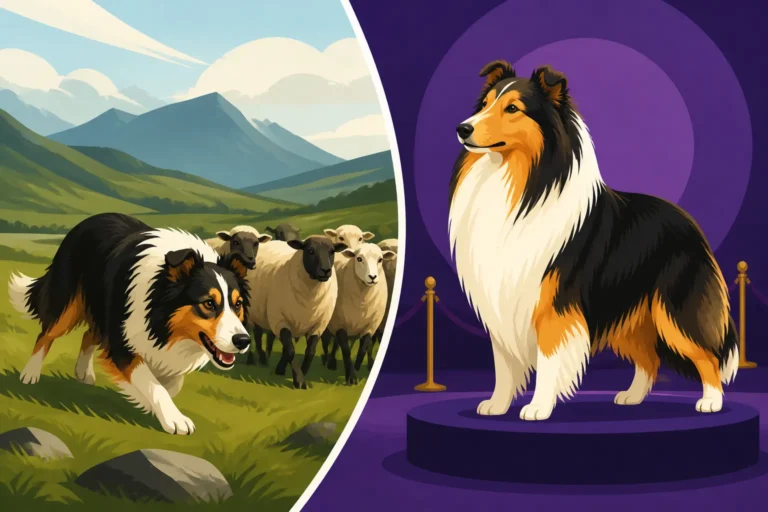
Whether Rough and Smooth Collies Can Be Bred Together
It’s a question that often pops up in Collie enthusiast circles, and honestly, it’s completely understandable why there might be confusion. Many people see Rough Collies with their magnificent, flowing coats and Smooth Collies with their sleek, close-lying fur, and assume they must be entirely separate breeds, or at least so distinct that breeding them together would be an unusual or even incorrect practice. This guide aims to clear up that misconception once and for all, delving into the genetics, history, and practicalities of breeding these two coat varieties of the very same beloved breed.
Understanding the Collie Varieties: More Alike Than Different
When you look at a Rough Collie and a Smooth Collie side-by-side, the most striking difference, of course, is their coat. One is a glorious cascade of long hair, forming a regal mane and elegant feathering, while the other presents a short, dense, and practical coat. Yet, despite this visual disparity, these are not two different breeds. They are, in fact, two varieties of the same breed, distinguished solely by the length of their outer coat. This fundamental truth is key to understanding why breeding them together is not only possible but also a long-standing practice in the breed’s history.
The Core Truth: One Breed, Two Coats
It’s easy to think of them as distinct, almost like comparing a Poodle to a Lab, but that’s not the case here. The American Kennel Club (AKC) and many other international kennel clubs recognize them as a single breed with two coat varieties. This means that a Smooth Collie is just as much a Collie as a Rough Collie, sharing the same breed standard for everything except coat length. They share the same majestic head, the intelligent eye, the graceful movement, and the famously gentle temperament. Breeders often refer to them simply as "Collies" and then specify "Rough" or "Smooth" to denote the coat. This designation is crucial for show purposes, but for everything else, they are one and the same. To really dig into this, you might want to read Rough and Smooth Are Two Varieties of One Collie.
If you’ve ever met both, you’ll know that the intelligence, loyalty, and sensitivity are identical across both coat types. They react to their families with the same devotion, show the same herding instincts (though often dormant in pet lines), and possess that uncanny ability to read their owner's emotions. Their differences are truly skin — or rather, coat — deep. This shared identity is why a good breeder considers the overall quality of the dog, not just its coat length, when planning a breeding program.
Historical Roots and Divergence
The Collie's origins trace back to Scotland, where they were indispensable working dogs, herding sheep in the rugged Highlands. In those early days, coat length wasn't a matter of aesthetics but practicality. Shorter coats were often favored by drovers, as they were less prone to collecting burrs and mud on long journeys, while longer coats might have offered more protection from harsh weather for sheep grazing in exposed pastures. These working dogs were bred for their ability, not their appearance, and both coat types naturally occurred within the same litters. The distinction between "Rough" and "Smooth" as formalized varieties truly began to emerge with the advent of dog shows and breed standards in the Victorian era.
Queen Victoria's admiration for the breed in the 1860s played a significant role in bringing the Collie into the public eye and fostering interest in selective breeding for appearance. As the breed moved from the fields to the show ring, breeders began to specialize. Some focused on enhancing the voluminous, flowing coats that became synonymous with the "Lassie" image, giving rise to the Rough Collie we largely recognize today. Others continued to appreciate and preserve the more utilitarian, short-coated variety, which maintained its loyal following. However, throughout this evolution, the genetic connection remained, and inter-variety breeding continued to be a tool for breeders seeking to combine the best attributes of both lines. It wasn't until later that some kennel clubs in certain regions began to consider them separate, but generally, the understanding persists that they are fundamentally one.
Temperament and Type Remain Consistent
One of the most reassuring aspects for prospective owners, and a key consideration for breeders, is that the core Collie temperament remains steadfast across both coat varieties. A Smooth Collie possesses the same gentle, intelligent, and often reserved disposition as its Rough-coated cousin. They are known for their deep devotion to their families, their innate protective instincts without aggression, and their sometimes-stubborn yet always-eager-to-please nature. There’s no evidence to suggest that one coat type is inherently calmer, more energetic, or more challenging to train than the other.
Any perceived differences in personality are usually down to individual variation within a litter, rather than a direct consequence of coat length. For instance, you might meet a highly energetic Smooth Collie and a more laid-back Rough Collie, but these traits are reflections of individual genetics and upbringing, not their external appearance. Both varieties are highly sensitive dogs who thrive on positive reinforcement and crumble under harsh training methods. They are typically good with children and other pets, and equally prone to developing that characteristic deep, resonant bark that Collie owners know all too well. Understanding What Separates a Rough Collie From a Smooth often comes down to this single, superficial feature.
The Genetics of Coat Length in Collies
To truly grasp why Rough and Smooth Collies can be bred together, we need to dip our toes into the fascinating world of canine genetics. It's not nearly as complicated as it sounds, especially when we focus on just one trait: coat length. The science behind it explains perfectly how a litter can contain both long-coated and short-coated puppies, even from parents who outwardly look quite different.
The Gene Responsible for Smooth vs. Rough
The difference in coat length between a Rough and a Smooth Collie is controlled by a single gene, often referred to as the FGF5 gene. This gene comes in two forms, or alleles: one for long hair (let's call it 'L') and one for short hair (let's call it 'S'). The long hair allele (L) is recessive, meaning a dog needs two copies of it (LL) to express the long coat. The short hair allele (S) is dominant, meaning if a dog has even one copy of it (LS or SS), it will have a short coat.
So, a Rough Collie, with its magnificent long coat, must have two copies of the recessive long hair gene (LL). A Smooth Collie, on the other hand, can have either two copies of the dominant short hair gene (SS) or one copy of the dominant short hair gene and one copy of the recessive long hair gene (LS). This 'LS' type of Smooth Collie is particularly interesting for breeders because, while it looks like a Smooth Collie, it carries the gene for long hair. This is why you can sometimes see Whether a Litter Can Hold Both Collie Coats – it all depends on the genetic makeup of the parents, specifically whether they carry the 'L' allele.
Predicting Coat Types in a Litter
Now, let's look at how this plays out in breeding.
- Rough x Rough (LL x LL): All puppies will be LL, meaning all will be Rough Collies.
- Smooth x Smooth: This is where it gets interesting, depending on the genetic makeup of the Smooth parents.
- SS x SS: All puppies will be SS, meaning all will be Smooth Collies.
- LS x SS: About half the puppies will be LS (Smooth) and half will be SS (Smooth). All puppies will be Smooth, but some will carry the long hair gene.
- LS x LS: This cross can produce Rough Collies! Approximately 25% of the puppies will be LL (Rough), 50% will be LS (Smooth and carrier), and 25% will be SS (Smooth and non-carrier). This means two seemingly identical Smooth Collies can produce Rough-coated puppies.
- Rough x Smooth (LL x SS or LL x LS): This is the scenario we're most interested in.
- LL x SS: All puppies will be LS, meaning all will be Smooth Collies, but they will all carry the gene for long hair.
- LL x LS: About half the puppies will be LL (Rough) and half will be LS (Smooth and carrier). This means a Rough Collie bred to a Smooth Collie (who carries the long hair gene) can produce a mixed litter of both Rough and Smooth puppies.
This table summarizes the possible outcomes:
| Parent 1 Genotype | Parent 2 Genotype | Possible Puppy Genotypes | Phenotypes (Appearance) |
|---|---|---|---|
| LL (Rough) | LL (Rough) | LL | All Rough Collies |
| SS (Smooth) | SS (Smooth) | SS | All Smooth Collies |
| LS (Smooth) | LS (Smooth) | LL, LS, SS | Rough, Smooth (carrier), Smooth (non-carrier) |
| LL (Rough) | SS (Smooth) | LS | All Smooth Collies (all carriers) |
| LL (Rough) | LS (Smooth) | LL, LS | Rough, Smooth (carrier) |
This genetic understanding empowers breeders to predict and plan for coat types, making informed decisions about their breeding programs.
The Role of DNA Testing in Breeding Decisions
Given the nuances of coat length genetics, DNA testing has become an invaluable tool for responsible Collie breeders. A simple cheek swab can determine a dog's genetic makeup for the FGF5 gene (LL, LS, or SS). This information removes the guesswork and allows breeders to make precise decisions about pairings. Knowing if a Smooth Collie is an SS (non-carrier) or an LS (carrier of the long hair gene) is incredibly important.
For example, if a breeder wants to ensure they only produce Smooth Collies, they can test their dogs and ensure at least one parent is SS. If they are aiming for a mixed litter or want to introduce specific traits from a Smooth line into a Rough line, knowing the carrier status of their Smooth allows them to predict the coat types they might get. This is just one example of the many genetic tests available today that contribute to healthier puppies and informed breeding, along with panels for conditions like MDR1 or CEA. When you're considering a puppy, asking about What the Collie DNA Health Panel Covers is a great start. Reputable breeders utilize these tools to ensure the health and integrity of the breed.
Practical Implications of Breeding Rough to Smooth
Beyond the genetics, there are practical considerations for breeders who choose to perform a Rough-to-Smooth cross. These range from how the resulting puppies are registered to managing expectations of prospective owners, as well as the overarching goal of improving the breed.
What to Expect in a Mixed Litter
When a Rough Collie is bred to a Smooth Collie (and the Smooth carries the long-hair gene, or the Rough is bred to a Smooth carrier), the resulting litter can indeed contain puppies of both coat varieties. This can be quite a delightful surprise for a breeder, seeing a mix of fluffy Rough-coated pups and sleek Smooth-coated pups all nursing from the same mother. Identifying the coat type at birth can be a little tricky sometimes, as even Rough Collie puppies start with a relatively short, soft coat, but experienced breeders can usually tell the difference within the first few weeks. The 'fluff factor' and the density of the coat around the ears and legs often give it away.
Each puppy will still inherit all the other wonderful Collie traits – the potential for intelligence, trainability, and that deep connection with their human family. The care requirements for a young puppy, whether Rough or Smooth, are largely the same: proper nutrition, socialization, and veterinary care. You’ll find all the essentials for a growing puppy on sites like Chewy, from quality food to chew toys that aid teething. The main divergence in care will only become apparent as the puppies mature and their distinct coat types become undeniable.
Registration and Show Ring Considerations
For purposes of official registration with kennel clubs like the AKC, puppies resulting from a Rough-to-Smooth breeding are registered simply as "Collies." The specific coat variety (Rough or Smooth) is typically indicated on their individual registration papers. This process is straightforward and does not pose any unique challenges compared to registering puppies from two Rough or two Smooth parents. The key is that both parents must be purebred, registered Collies themselves.
When it comes to the show ring, however, the varieties are judged separately. A Rough Collie competes against other Rough Collies, and a Smooth Collie competes against other Smooth Collies. A judge would never compare a Rough and a Smooth against each other for Best in Show at a specialty show, for example. This separate judging ensures fairness within the distinct coat varieties, recognizing their unique presentation while still acknowledging their shared breed standard. Breeders participating in conformation events will, therefore, select puppies from such a litter based on which variety they intend to show, if any, and how well the individual puppy meets that variety’s specific ideals within the overall Collie standard.
Managing Puppy Placement for Mixed Coats
For breeders, managing puppy placement from a mixed litter requires clear communication with prospective owners. Some families come specifically looking for a Rough Collie because of its classic "Lassie" look, while others might actively seek a Smooth Collie for its lower grooming commitment. A breeder with a mixed litter needs to be upfront about the options available and educate potential buyers on the differences and similarities. They will explain that while the Smooth requires less brushing, both still shed, and both possess the same wonderful Collie temperament.
A responsible breeder will also educate new owners about the grooming needs specific to each coat type. While a Smooth Collie might only need a good brush-down once a week with a standard brush you can find at Chewy, a Rough Collie demands a significant investment of time in grooming to prevent mats and keep its coat healthy. This means explaining the long-term commitment of grooming a Rough, and perhaps showing prospective owners some of the tools involved, like a sturdy pin brush and an undercoat rake. Transparency helps ensure that each puppy goes to a home that is truly prepared for its particular needs. How Long Brushing a Collie in Full Coat Takes is definitely something to discuss!
Why Breeders Might Choose a Rough-to-Smooth Cross
So, why would a dedicated Collie breeder, with all the careful planning involved, intentionally breed a Rough to a Smooth? It’s not simply a matter of curiosity. There are very strategic and important reasons, all aimed at the long-term health and improvement of the Collie breed as a whole.
Broadening the Gene Pool
One of the most compelling reasons to perform a Rough-to-Smooth cross is to broaden the gene pool. In any breed, over-reliance on a small number of popular sires or line-breeding can lead to a narrowing of genetic diversity. This can, in turn, increase the prevalence of certain health issues or reduce overall vigor. By judiciously incorporating both varieties into a breeding program, breeders can access a wider array of genetics. For instance, a Rough Collie line that might be strong in certain desired traits but weak in others, or perhaps carrying a specific genetic predisposition, could benefit immensely from an outcross to a healthy Smooth Collie from a different, robust line.
This genetic influx helps maintain the overall health and resilience of the breed. It allows breeders to introduce fresh bloodlines while still staying within the confines of the purebred Collie, ensuring that future generations remain strong and healthy. It's a testament to the idea that form follows function, and that health should always be paramount. After all, what good is a beautiful coat if the dog isn't thriving? It's a foundational principle often discussed in articles like Whether Collie Health Has Improved Since the 1980s.
Enhancing Specific Traits
Beyond general genetic diversity, breeders might also use inter-variety breeding to enhance specific desired traits. Perhaps a particular Smooth Collie has exceptional structure, an ideal temperament, or a stunning head study, but its coat is, by definition, short. If a breeder of Rough Collies wants to incorporate these specific virtues into their long-coated lines, breeding to that outstanding Smooth can be a highly effective strategy. The resulting Smooth puppies would carry the genes for these desirable traits, and some of them would also carry the recessive long-hair gene. When those carrier Smooths are then bred back to Rough Collies, the desired traits can be passed on, eventually appearing in Rough-coated descendants.
This careful selection allows breeders to refine and improve the breed's characteristics over generations. It’s a bit like a chess game, where each move is planned with the long-term outcome in mind. The goal is always to produce Collies that conform well to the breed standard, possess excellent health, and maintain their renowned temperament. This strategic approach highlights the dedication and foresight required of truly responsible breeders.
Maintaining the Health and Vigor of the Breed
Ultimately, the decision to breed a Rough to a Smooth Collie is often driven by a commitment to the overall health and vigor of the entire breed. Some health conditions, though not tied to coat length, can become more prevalent in certain lines. By crossing varieties, breeders can sometimes "breed away" from these predispositions, or at least introduce genes that provide greater resilience. The Smooth Collie, because it has traditionally been a less popular variety, sometimes has slightly different genetic strengths compared to the more popular Rough Collie lines. Tapping into these different strengths can be invaluable.
Consider the dedication involved in performing all the recommended health tests, like those for MDR1, CEA, and dermatomyositis, before even considering a breeding pair. Reputable breeders invest significant time and resources in ensuring they are producing healthy puppies. By thoughtfully combining Rough and Smooth lines, they aim to create a robust and resilient population of Collies for future generations, honoring the breed's heritage as a strong, healthy working dog. This holistic approach to breeding is what differentiates responsible, ethical breeders from those simply looking to produce puppies. Don't forget to inquire about What a Health Tested Collie Puppy Costs as it reflects this dedication.
Addressing Common Misconceptions About Inter-Variety Breeding
Despite the genetic realities and historical precedents, misconceptions sometimes persist about breeding Rough and Smooth Collies together. These myths often stem from a lack of understanding or outdated information. It's important to debunk these to promote responsible breeding practices and a clear understanding of the breed.
The Myth of "Inferior" Smooth Collies
One common, and unfortunate, misconception is that Smooth Collies are somehow "inferior" or less "purebred" than Rough Collies. This couldn't be further from the truth. As established, they are genetically the same breed, with coat length being the only distinguishing feature. The idea that a Smooth Collie is a "failed" Rough Collie, or a lesser version, is simply inaccurate and does a disservice to this wonderful variety. Smooth Collies are often highly prized for their practical coats, which require less extensive grooming, making them an excellent choice for active families or individuals who appreciate the Collie temperament but prefer a lower-maintenance coat.
Historically, the Smooth Collie was arguably the more common working type, valued for its functionality over its aesthetics. Its coat provides ample protection from the elements without gathering burrs or mud as easily as a long coat. They exhibit the same intelligence, trainability, and loyalty, and often possess a slightly more rugged build due to their working ancestry. Recognizing the Smooth Collie's inherent value and charm is essential, and any suggestion of inferiority is simply born from a misunderstanding of the breed's history and genetic makeup.
Dispelling Health Concerns Related to Coat Length Crosses
Another concern sometimes raised is whether breeding Rough and Smooth Collies together might lead to health problems or compromise the quality of the coat in future generations. This fear is largely unfounded. As we discussed, the coat length gene is a simple Mendelian trait, meaning it operates independently of many other genetic factors that contribute to health or structure. Breeding Rough to Smooth does not inherently introduce new health risks or dilute the breed's genetic integrity. In fact, as explored earlier, it can actually enhance the overall health by increasing genetic diversity.
What can affect health are irresponsible breeding practices, such as breeding dogs with known genetic conditions, ignoring health clearances, or breeding for extreme traits. These issues are entirely separate from coat length. A Rough Collie bred to a Smooth Collie (or vice-versa) follows the same rigorous health testing protocols as any other responsible breeding. Breeders still perform DNA tests for conditions like [MDR1 Mutation] or [Collie Eye Anomaly], regardless of the coat types involved. The focus remains on producing healthy, well-tempered puppies with sound structure, whether they end up with a flowing Rough coat or a sleek Smooth one.
Ensuring Responsible Breeding Practices
The ability to breed Rough and Smooth Collies together effectively underscores the importance of responsible breeding practices. It’s not just about mixing and matching; it's about making informed decisions based on genetics, health clearances, temperament, and conformation to the breed standard. A truly responsible breeder considers the entire dog – its health, its personality, its structure – and selects breeding partners that complement each other, regardless of their coat length variety. They are transparent about their breeding choices and provide full disclosure to prospective puppy buyers.
This includes providing proof of health testing, discussing the lineage of the puppies, and being honest about what a new owner can expect in terms of grooming, exercise, and temperament. They understand that a beautiful puppy from a site like Chewy's vast pet supply selection is only part of the equation; the real value lies in a healthy, well-adjusted companion that will bring joy for many years. When looking for a Collie puppy, always seek out breeders who are knowledgeable, ethical, and committed to the welfare of both Rough and Smooth varieties, understanding that both are integral to the future of this magnificent breed. You should be able to look into Whether a Collie Breeder Should Publish Results.
Disclaimer
This article is for general informational purposes only and does not constitute professional advice. Laws, prices and regulations vary by location and change over time. Consult a qualified professional for guidance on your specific situation.