Whether the Collie Comes From Scotland or England
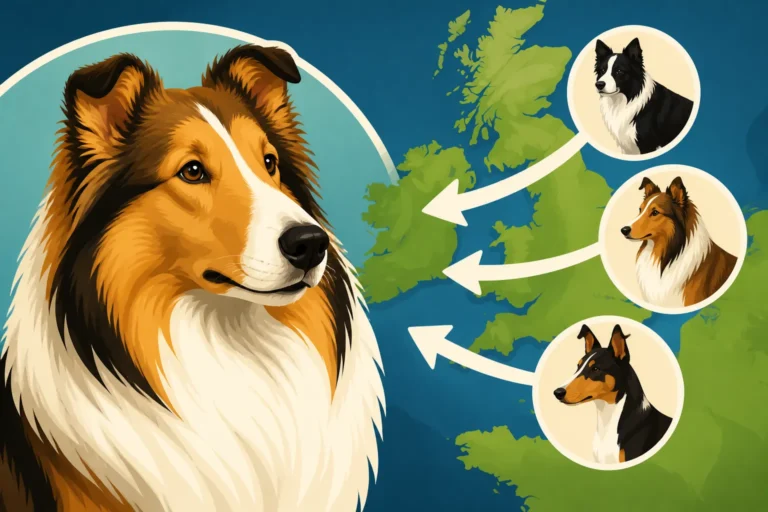
The Collie is most accurately described as a Scottish breed shaped by life across the wider British Isles, especially the borderlands between Scotland and England. That answer can feel less tidy than choosing one country, but it separates the breed’s pastoral roots from the later English show scene that helped standardize and popularize it.
The Collie’s roots are Scottish, with a borderland story
Working dogs developed around Scottish livestock
The Collie’s history reaches back to the working dogs kept by people who raised and moved livestock in Scotland. These were practical farm and herding dogs, not yet the uniform breed people picture today: there was no single appearance, pedigree system, or official standard that defined every dog called a collie.
Their work depended on the needs of the farm and the local terrain. A capable dog might help gather sheep, move cattle, or keep livestock together while people managed them. Over generations, farmers favored dogs that were useful, responsive, and suited to their conditions. That kind of selection helps explain how a recognizable type emerged, even though the early dogs did not all look alike.
It is also why claims about a precise founding location should be treated cautiously. The Collie did not appear on one particular farm in one clearly documented year. It developed gradually from regional working dogs, with local breeding practices and movement of people and animals shaping the population.
The Scotland–England border was not a hard line for dogs
A modern map makes it tempting to ask whether the Collie is Scottish or English as if the dogs stayed on one side of a fixed boundary. Historically, livestock work and rural trade connected communities across what is now the Scotland–England border. Dogs could be bred, sold, or taken to work in neighboring districts.
That matters because the breed’s ancestry is better understood as regional than as a neat national origin story. Scottish pastoral traditions are central to the Collie’s background, while English farms and breeders also contributed to the dogs’ later development. The name “Collie” itself is commonly associated with Scottish usage, but the exact history of the word is not settled enough to serve as proof of a single origin point.
The same regional perspective helps explain why early dogs could vary. Working animals were valued for what they did, and a farmer might choose a dog for soundness and ability rather than for a particular head shape or coat. The modern breed’s appearance came later, as people increasingly recorded pedigrees and selected dogs to fit shared expectations.
From working type to recognized breed
A working type becomes a formal breed through more than one step. People first keep dogs that are useful and recognizable; later, breeders begin to describe the type, keep records, and favor particular traits. Dog shows and breed organizations then give those descriptions greater influence.
For the Collie, the transformation from farm dog to show breed took place in Britain, with English show culture playing a major role. That does not make the breed English in origin. It means that the formalized, public version of the Collie was shaped in a setting where exhibitions and organized breeding were becoming important.
This distinction is useful when reading older accounts. Some describe the Collie as a Scottish sheepdog; others emphasize British breeders and English shows. These statements can both be true when they refer to different parts of the story: roots in Scottish working dogs, followed by wider development and formal recognition across Britain.
How English influence shaped the modern Collie
Shows and standards changed what people expected
Before dog shows, there was no reason for every farm dog to match a written description. A working collie could be a little taller or shorter, have a different coat, or show a different outline from another dog in the next district. The central question was whether it could do its job.
As organized shows grew in popularity, breeders had a new reason to select for a more consistent appearance. Written standards helped define the Collie as a recognizable breed, and show judging rewarded dogs that matched those ideals. This process did not erase the working background, but it did give appearance a larger role in breeding decisions.
It is important not to imagine that one show or one breeder created the modern Collie overnight. Standards, pedigrees, and breeding preferences develop through repeated choices over time. English institutions and show settings helped make those choices visible and organized, while the underlying dogs came from a broader British working tradition.
Queen Victoria helped make the Collie fashionable
Queen Victoria’s interest in dogs, including Collies, helped draw public attention to the breed during the Victorian era. Royal enthusiasm could influence what people admired and wanted, and the Collie became more visible beyond the farms and rural communities where its working ancestors had been valued.
That popularity helped shift the public image of the dog. The Collie was no longer seen only as a useful livestock worker; it could also be a companion and a fashionable show dog. Those roles later overlapped. Many Collies lived as family dogs while retaining traits shaped by generations of herding work, such as alertness, sensitivity, and a tendency to watch what is happening around them.
The historical link between royal interest and breed popularity is explored in Queen Victoria Made the Collie Fashionable in the 1860s. It is a useful reminder that popularity and origin are not the same thing: public attention helped expand the Collie’s reputation, but it did not create its Scottish working roots.
Rough and Smooth Collies are two varieties of one breed
The Rough Collie’s long coat is the variety most people picture, while the Smooth Collie has a short, close coat. Both belong to the Collie breed, and the difference in coat does not mean one is Scottish and the other English, or that they have separate national origins.
The two coat types reflect variation within the breed rather than a simple split between different ancestral populations. Their shared background is part of the reason it is misleading to treat one variety as the “original” Collie and the other as a later unrelated dog. Their appearance and care needs differ, but they remain closely connected.
For a clearer comparison of the two varieties, see Rough and Smooth Are Two Varieties of One Collie. The distinction matters to prospective owners choosing a coat-care routine, but it does not change the answer to the origin question: the breed’s roots are associated most strongly with Scotland, while its formal development involved a wider British context.
What the name and history can tell us
“Collie” does not settle the national question
The word “Collie” is often linked to Scottish language and usage, and that connection fits the breed’s pastoral history. But word origins can be complicated. Names change in spelling and meaning, and similar terms may be used differently in different places or periods.
A name can offer a clue, but it cannot by itself establish exactly where a breed began. The same caution applies to old descriptions of “collies,” which may refer broadly to working sheepdogs rather than to the standardized modern Collie. Reading a historical reference without checking its context can make the breed seem more fixed and uniform than it actually was.
That is why a careful answer combines several kinds of evidence: the breed’s association with Scottish livestock work, the movement of dogs across the border region, and the later role of organized breeding and shows. No single label explains the whole story.
Separate breed origin from breed standardization
When someone says “the Collie is Scottish,” they are usually talking about its working roots and traditional association with Scotland. When someone points to English breeders, shows, or organizations, they are often talking about how the modern breed was described, exhibited, and standardized.
Those are different questions, not conflicting answers. A breed can originate as a regional working type and later be shaped by people in several countries. This happens especially when livestock, markets, and human communities cross political borders.
The difference is similar to the distinction between a dog’s ancestry and its modern breed standard. The former is a long, gradual history; the latter is a written description that gives breeders and judges a shared reference. For more background on the Collie’s earlier working role, The Collie Was a Scottish Droving Dog Before It Was a Show Dog looks at the work that preceded its show-ring identity.
Be cautious with overly neat origin stories
Breed histories are often retold in a simplified way: one country, one founder, one decisive date. Those versions are easy to remember, but they can overstate what the evidence shows. The Collie’s story is more believable when it is allowed to be gradual, regional, and shaped by changing human needs.
For example, it is reasonable to connect the Collie with Scottish pastoral work without claiming that every early Collie looked like a modern Rough Collie. It is also reasonable to recognize English influence in show breeding without concluding that the breed began in England. The more carefully the terms are separated, the less contradictory the history appears.
A related overview, Where the Collie's Ancestors Came From, can help readers distinguish the breed’s deeper ancestry from the later development of the recognizable Collie. That distinction is especially helpful when comparing the Collie with other herding breeds that share a broad regional history.
What the Collie’s origins mean for owners today
History can explain traits, but it cannot predict every dog
A Collie’s herding background helps explain why many are observant, responsive to movement, and closely tuned in to people. Those tendencies may show up when a dog watches children running in a yard, alerts to activity beyond a window, or follows family members from room to room. They are inherited possibilities, not a guarantee that every Collie will behave the same way.
Individual temperament depends on more than history. Genetics, early socialization, training, health, and the dog’s day-to-day environment all matter. A Collie with a strong working instinct may benefit from structured games and reward-based training, while another may be content with walks, companionship, and low-key activities.
So the breed’s Scottish roots can provide useful context, but they are not a shortcut to understanding a particular dog. If you are choosing a puppy or adopting an adult, ask about the individual dog’s behavior and background rather than relying only on general breed lore. The Household a Collie Was Built For offers a broader look at the kind of home and relationship that can suit this people-oriented breed.
Coat care belongs to the modern ownership story
The difference between Rough and Smooth coats is one practical legacy of the breed’s development. A Rough Collie’s abundant coat needs regular attention, especially around areas where friction can encourage tangles. A Smooth Collie has less long feathering, but still sheds and benefits from routine brushing.
The history of a working dog does not mean that a modern Collie should be left to manage its coat without help. Owners can establish a calm grooming routine early, check behind the ears and around the legs, and ask a groomer or veterinarian about any coat or skin concern. If you shop for basic grooming supplies at a local store or through Chewy, choose tools that suit the dog’s coat and use them gently. Chewy is one retail option, not a substitute for advice from a groomer who can assess the coat in person.
Breed history also does not determine what food an individual dog needs. Age, activity level, body condition, and health are more useful considerations when discussing diet with a veterinarian. A retailer such as Chewy may be one place owners encounter pet-care products, but a product listing should not be treated as a personalized feeding recommendation. For the same reason, owners comparing food or coat-care items through Chewy should check the product details and consult their veterinary team when a health issue is involved.
A clear answer to the Scotland or England question
If you need a short answer, say that the Collie has Scottish roots and was later developed and standardized through a wider British history that included England. That phrasing recognizes the breed’s strong connection to Scotland without pretending its later development stopped at a national boundary.
| Question | Most useful answer |
|---|---|
| Where are the Collie’s traditional working roots? | Scotland and the wider Scottish pastoral tradition |
| Was the breed shaped only in Scotland? | No. Dogs and breeding practices crossed regional borders, and English show culture helped shape the modern breed |
| Does the word “Collie” prove an exact birthplace? | No. The name is a clue, not a complete historical record |
| Are Rough and Smooth Collies from different countries? | No. They are two coat varieties of the same breed |
| Is “Scottish breed” an accurate shorthand? | Yes, if it refers to the breed’s roots rather than every stage of its later development |
A Collie is therefore not best understood through a strict Scotland-versus-England contest. Its working foundation is closely tied to Scotland, while its modern breed identity grew through people, livestock work, and organized breeding across Britain. That fuller answer is less dramatic than a single birthplace, but it is much more faithful to how the breed developed.
Disclaimer
This article is for general informational purposes only and does not constitute professional advice. Laws, prices and regulations vary by location and change over time. Consult a qualified professional for guidance on your specific situation.