Whether the Collie Is Related to the Border Collie
A Collie and a Border Collie share a herding-dog heritage, but one is not simply a smaller or older version of the other. Their names, histories, working styles, and modern breed identities overlap enough to cause confusion—especially when someone is choosing a puppy or trying to identify a rescue dog. This guide explains what connects them and what keeps them distinct.
How the Collie and Border Collie are related
They share a broad herding heritage
Both breeds belong to the story of British herding dogs. For generations, people in Britain relied on dogs to move and manage livestock, and those dogs were shaped by the demands of their work and the preferences of the people who bred them. That shared purpose helps explain why Collies and Border Collies can have similar instincts: both may notice movement quickly, stay attentive to people, and try to influence where animals—or even family members—go.
But a common working background does not establish that one modern breed directly descended from the other. The historical record does not reduce neatly to a single founding dog or a simple family tree. Regional farm dogs were bred for practical work over long periods, and the labels used for them changed. The relationship is best described as shared heritage within the wider tradition of British herding dogs, rather than a straightforward parent-and-offspring relationship between today’s breeds.
The word collie has also been used in different ways across history, which adds to the muddle. In everyday conversation, it might mean the familiar long-coated Rough Collie, the short-coated Smooth Collie, or sometimes a herding dog more generally. The Border Collie, by contrast, developed a distinct identity as a working breed associated with the Anglo-Scottish border region. For more on the older pastoral role of the Collie, see The Collie Was a Scottish Droving Dog Before It Was a Show Dog and What the Collie Herded in Scotland.
Their modern breed identities are distinct
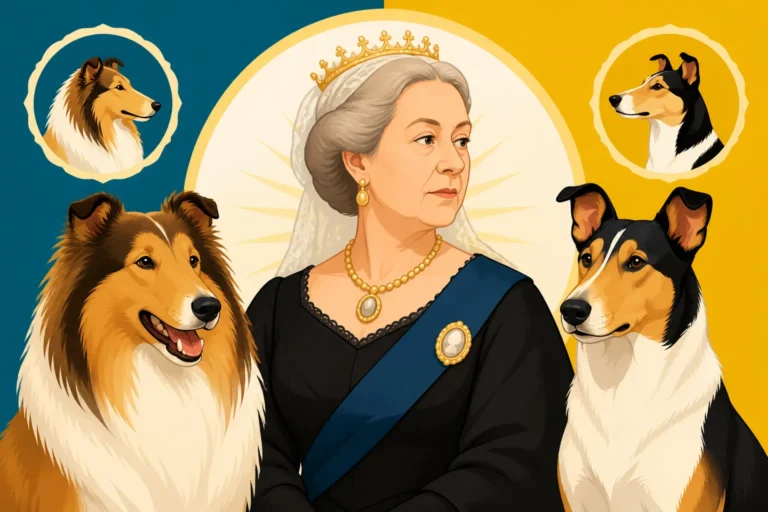
When people today say “Collie,” they often mean the breed recognized in Rough and Smooth varieties. These dogs share the same breed identity but have different coats: Rough Collies have a long outer coat and abundant feathering, while Smooth Collies have a short, dense coat. The distinction is about coat variety, not a separate herding breed. Whether the Rough and Smooth Collie Are One Breed explains that relationship in more detail.
A Border Collie is a separate breed, with its own standards, breeding communities, and working tradition. The Border Collie name refers to a particular breed identity, not simply to any Collie that happens to come from a border county. Nor does “Border” mean that the dog is a regional coat type of the Rough or Smooth Collie. The two breeds may resemble one another at a glance, but the labels describe different modern breeds.
This distinction matters in practical ways. A shelter listing that says “Collie mix” may be using the word broadly, while a breeder’s paperwork usually identifies a specific breed and variety. If you are trying to understand a dog’s background, ask for records and details rather than relying on appearance alone. Even a knowledgeable person may not be able to identify a mixed-breed dog’s ancestry with certainty just by looking at it.
| Question | Collie | Border Collie |
|---|---|---|
| Modern breed identity | A distinct breed with Rough and Smooth coat varieties | A separate herding breed |
| Coat varieties commonly discussed | Rough and Smooth | Several coat lengths and textures occur |
| Historical connection | Part of the wider British herding-dog tradition | Part of the wider British herding-dog tradition, strongly associated with the border region |
| Direct descent from the other breed | Not established as a simple direct line | Not established as a simple direct line |
| Best way to identify an individual dog | Reliable records, breeder information, or a qualified assessment | Reliable records, breeder information, or a qualified assessment |
Why the names and histories are easy to confuse
“Collie” has meant more than one thing
One reason people ask whether a Collie is related to a Border Collie is that “Collie” can sound like a shared breed name. Historically, the word has had broader and less fixed uses than a modern breed label. It has been applied to types of herding dogs, while today’s breed names are more specific. That shift from broad everyday wording to formal breed identity can make old accounts hard to interpret.
The familiar image of the Rough Collie also shapes how people understand the word. Many people picture a long-coated dog with a full ruff and a narrow, expressive head. They may then assume that any dog called a “Collie” must be a version of that same breed. In reality, breed names and historic descriptions do not always line up with what a modern owner means by the word.
The Border Collie’s name adds another layer. Its name evokes a geographic region, but the breed is not simply “the Collie from the border.” Working dogs in that part of Britain were selected for the tasks they performed, and their history is tied to those working communities. If you want to explore the geographic question behind Collie origins, Whether the Collie Comes From Scotland or England offers useful context.
Working dogs were shaped by different priorities
Historically, a herding dog’s usefulness mattered more than whether it matched a tidy modern breed category. Farmers and shepherds valued traits that helped them manage livestock in their local conditions. Over time, particular breeding lines and practices became associated with different types of dogs. That process was gradual, not a clean moment when one breed suddenly split from another.
The Border Collie is especially associated with working ability and stock-handling skill. A Border Collie may use a focused stare, controlled movement, and responsiveness to a handler to influence livestock. Collies also have herding roots, but the breed’s modern identity has been shaped by a different combination of working, companion, and show traditions. These are broad historical patterns, not guarantees about any individual dog.
The shift from working roles to modern breed categories is part of the wider story of Collies. Breed communities, written standards, and dog shows helped define the Collie as a recognizable modern breed, while working communities maintained their own priorities. Whether Working Collies and Show Collies Diverged looks at how those priorities developed and why the phrase “working Collie” can mean different things in different conversations.
How to tell them apart without assuming too much
Appearance can offer clues, not proof
A Rough Collie often has a long, abundant coat, especially around the neck and chest, while a Smooth Collie has a short coat. Border Collies also come in a range of coat types, and their colors and markings can overlap with those seen in Collies. A black-and-white coat, for example, does not by itself prove that a dog is a Border Collie. Nor does a sable coat automatically establish that a dog is a Rough or Smooth Collie.
Build and expression may help an experienced observer form an impression, but appearance is not a reliable family history. Dogs vary within breeds, and mixed-breed dogs can inherit a combination of traits that makes visual identification especially tricky. Online photographs can amplify the problem because posture, grooming, age, and camera angle all affect what a dog appears to be.
If you are adopting, ask the rescue what is known about the dog’s history and whether the breed description is based on records or an estimate. If you are buying from a breeder, ask what the parents’ registered breeds are and request the relevant documentation. A DNA test may offer clues about ancestry, but it should not replace clear records when you need to confirm a dog’s official breed identity.
Temperament and working style vary by individual
People often compare Collies and Border Collies by saying one is calmer or more intense. Those descriptions can be useful starting points, but they are not dependable rules for every dog. A Border Collie from a strong working line may need substantial mental and physical engagement, while another may be perfectly content with a well-planned companion lifestyle. A Collie can be lively, busy, sensitive, or highly active too.
The dogs’ herding instincts may also show up differently. One might fixate on moving bicycles, while another circles children or tries to gather other pets. These are not signs that the dog is “bad,” but they do call for safe management and training. People considering either breed should think about the specific dog’s energy, confidence, and needs rather than choosing on a stereotype alone. For a broader comparison, see The Collie Against the Border Collie and the Sheltie and Whether a Collie Is Calmer Than a Border Collie.
Before bringing a dog home, ask what it enjoys, how it responds to new places, whether it has lived with children or other animals, and what kind of daily routine has worked so far. If the dog is a rescue, its current behavior may reflect stress or a recent transition as well as its underlying temperament. Give it time to settle, and work with a qualified trainer if chasing, nipping, or intense herding behavior becomes difficult to manage.
What the relationship means when choosing a dog
Choose for the dog in front of you
A shared herding heritage does not mean the two breeds are interchangeable. Their size, coat care, exercise needs, and typical working styles may differ, but individual variation is substantial. A good match depends on the dog’s actual needs and your household—not on the assumption that one breed is simply a more manageable version of the other.
If you are choosing between a Rough Collie and a Border Collie, consider the time you can realistically give to training, exercise, grooming, and companionship. A Rough Collie’s coat may need regular attention, especially in areas that tangle, while a Border Collie may require careful planning for mental engagement as well as physical activity. Neither breed should be selected based only on a dramatic photograph or the belief that a large yard will meet every need.
It can help to speak with people who live with the particular type of dog you are considering. Ask what an ordinary weekday looks like, not just what the dog does on a special outing. For coat-care supplies, some owners compare options at retailers such as Chewy, but the right grooming routine depends on the individual dog’s coat and tolerance. For more on the household needs behind the breed, see The Household a Collie Was Built For.
Ask practical questions before adoption or purchase
When a dog’s breed description is uncertain, focus on what can be established. Ask whether the dog has registration papers, information about its parents, prior veterinary records, or a documented history with livestock. If there are no records, that does not make the dog any less suitable as a companion; it simply means the label should be treated as an estimate.
A short list of questions can help you look past the name:
- What is known about the dog’s parents or previous home?
- Is the breed description documented or based on appearance?
- How does the dog behave around children, cats, other dogs, and moving objects?
- What exercise and training routine has the dog handled well?
- Are there coat-care, health, or behavior needs that require preparation?
The answers are more useful than debating whether the dog is “really” one breed or the other. If you are planning for everyday care, buying basics from a retailer such as Chewy may be one option, but check that any equipment suits the dog’s size, coat, and behavior. And if you are comparing food, Chewy is only a place to browse products; dietary choices should be based on the dog’s age, health, and veterinary guidance—not on its breed label alone.
The clearest answer is that Collies and Border Collies are related through a broad herding-dog heritage, but they are distinct modern breeds, and one should not be treated as a direct version or simple descendant of the other. Their shared history helps explain some similarities. Their separate development, working traditions, and breed identities explain why the distinction still matters.
Disclaimer
This article is for general informational purposes only and does not constitute professional advice. Laws, prices and regulations vary by location and change over time. Consult a qualified professional for guidance on your specific situation.