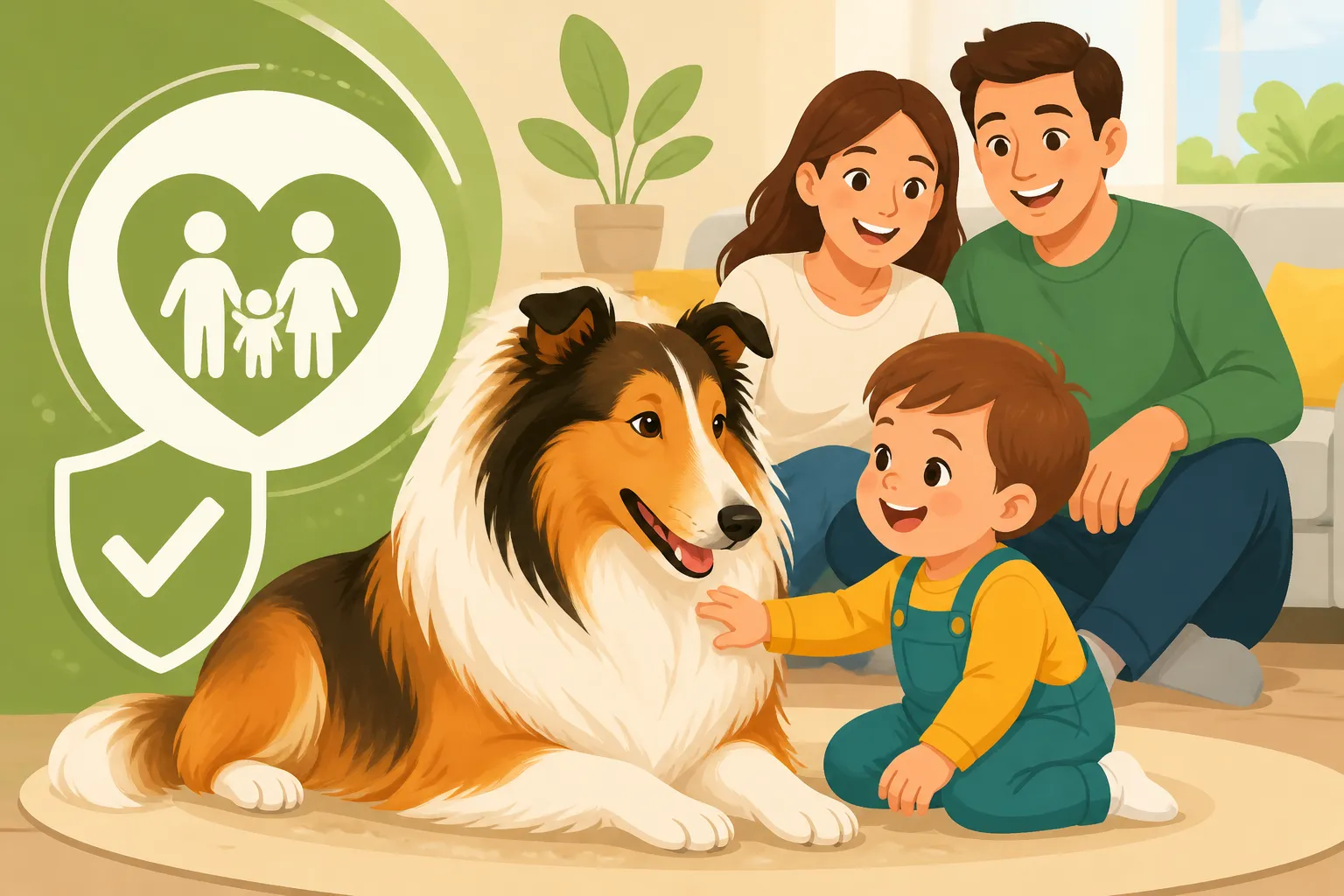
Whether a Collie Suits a Family With Toddlers
A Collie can be a gentle, devoted family dog, but living with toddlers asks more of both the dog and the adults than a sweet temperament alone can provide. This guide explains what Collies are like around very young children, how to reduce risks such as herding and accidental knocks, and what to consider before bringing one into a home with toddlers.
What living with a Collie and toddlers is really like
A Collie’s temperament can be a good fit, but it is not a guarantee
Many Collies are affectionate, attentive, and closely bonded to their families. Those traits can make them appealing companions for children. A Collie may follow the family from room to room, settle nearby during quiet play, or seem to notice when a child is upset. But individual dogs vary, and no breed description can promise how a particular dog will behave around a toddler.
The toddler stage is especially demanding because young children are still learning how to approach animals gently. A child may squeal, run, fall, grab fur, lean over a dog, or take a toy without warning. Even a patient dog can feel startled or uncomfortable. A Collie’s sensitivity to noise and sudden changes may also mean that a busy household is tiring, even if the dog is not aggressive.
It helps to think of suitability as a match between the dog, the child, and the adults’ routines. A calm adult Collie with a known history around young children may be a different proposition from an energetic puppy in a home where everyone is already stretched. For a broader look at the family fit, see Whether a Collie Suits a First Time Owner.
Toddlers and dogs need active adult supervision
A toddler and a dog should not be left together unsupervised, even when the dog is familiar, affectionate, or has never shown a warning sign. Supervision means an adult is close enough and attentive enough to intervene immediately—not simply somewhere else in the house. If you need to cook, answer the door, take a call, or help another child, use a gate or separate room rather than relying on the dog to manage the situation.
Give the Collie a child-free place to rest. A bed behind a gate, a crate used positively, or a quiet room can help the dog step away when household activity becomes too much. Teach the toddler that the dog’s resting place is off-limits. A safe retreat only works if the child is not allowed to follow the dog into it.
Adult supervision also includes reading the dog’s body language. Turning away, moving off, lip licking, yawning, freezing, or trying to hide can indicate discomfort or a desire for space. These signs do not mean the dog is “bad”; they are useful information. Step in early, create distance, and help the child switch to a calmer activity.
Build child-friendly habits on both sides
Rather than expecting a toddler to remember a long list of rules, make safe interactions simple and repetitive. Show the child how to stroke the dog gently on the shoulder or side, with an adult guiding the interaction. Keep hugs, climbing, face-to-face contact, tail pulling, and attempts to ride the dog completely off-limits. Children should not disturb a dog that is eating, chewing, sleeping, or holding a prized toy.
The Collie also needs practice around ordinary toddler behavior. Gradually and calmly introduce household sounds, toys, movement, and visitors, pairing them with a relaxed experience. Do not force the dog to approach a child or endure handling. If the dog chooses to move away, let that choice stand. A dog who can retreat is less likely to feel trapped.
If the dog growls, take it seriously as a warning that the situation needs to change. Do not punish the growl or force the dog to remain close to the child; suppressing a warning does not address the discomfort behind it. Separate them safely and consult a veterinarian or qualified, reward-based behavior professional for individual guidance. The related guide Whether a Collie Is Safe With a Toddler looks more closely at supervision and interaction.
Herding behavior, energy, and toddler safety
Why a Collie may circle or follow a running child
Collies were developed as herding dogs, and some retain instincts to watch, follow, circle, or control movement. A toddler running across the room, darting around furniture, or shrieking during play can be exciting or confusing to a dog. A Collie may shadow the child, circle the family, bark, or try to interrupt the movement. Some dogs may nip at heels, but this behavior is not inevitable and should not be treated as harmless just because it resembles herding.
Notice the situations that bring out the behavior. Does it happen when the toddler runs through a hallway, when several children play noisily, or when the dog is tired and overstimulated? Identifying a pattern lets adults manage the setting before the dog practices the behavior repeatedly. For instance, keep the dog behind a gate during high-energy indoor play, then offer a quiet activity or a supervised walk when the household settles.
Teach an alternative response with reward-based training. The dog can learn to go to a mat, come when called, or focus on an adult when children start moving quickly. Practice these skills when the child is calm first; expecting a dog to respond for the first time during a noisy chase is unrealistic. For more detail on instinct and family dynamics, read Why a Collie Herds Your Children, Whether a Collie Nips at Heels, and How to Stop a Collie Circling the Family.
Set up the home to prevent avoidable collisions
A Collie can be a substantial, active dog, and a playful turn or sudden leap can knock over a small child without any intent to hurt them. Use physical management where needed: baby gates, playpens, closed doors, and separate zones can keep toddler play and dog rest from overlapping constantly. This is especially useful during meals, naps, visitors, and the evening stretch when everyone may be tired.
| Situation | Helpful setup | What the adult should do |
|---|---|---|
| Toddler running indoors | Separate play area or dog behind a gate | Redirect the dog before chasing or circling begins |
| Dog eating or chewing | Quiet, child-free space | Keep the toddler away until the dog has finished and moved on |
| Busy visitors or noisy play | Retreat space for the dog | Check that the dog can leave without being followed |
| Shared calm time | Adult seated close by | Guide gentle contact and end the interaction if either seems uncomfortable |
| Adult needs to step away | Separate rooms or secure barrier | Do not leave the toddler and dog together unattended |
A sturdy gate can be a practical way to create separation without making the dog feel isolated from the family. If you are putting together a home setup, Chewy is one place families may look for gates, washable bedding, or enrichment items; check product measurements and safety details before choosing anything for your layout. The goal is not to confine the dog all day, but to make safe choices easier during predictable pinch points.
Exercise and rest help, but exercise is not a cure-all
A Collie generally benefits from daily physical activity and mental engagement, but there is no universal amount that will make every dog calm around toddlers. A sniffing walk, short training session, food puzzle, or quiet play can provide useful outlets. The appropriate activity depends on the dog’s age, health, temperament, and fitness, so build routines gradually rather than trying to tire the dog out with intense exercise.
Rest matters just as much. Puppies and adolescent dogs can become excitable when overtired, while adult dogs may need uninterrupted sleep away from children. A dog that is constantly following a toddler may be getting too little quiet time, even if it appears to be choosing to stay close. Schedule regular breaks behind a gate or in a calm room, and reward the dog for settling there.
Avoid encouraging rough chase games between a dog and a toddler. Games that involve a child running while the dog pursues can rehearse exactly the pattern a family is trying to prevent. Use adult-led play instead, with clear boundaries and toys suitable for the dog. A treat puzzle or chew can occupy the dog separately; Chewy can be a place to compare enrichment options, but choose items that are suitable for your dog’s size and chewing style, and supervise use when needed.
Choosing the right Collie for a family with toddlers
Consider an adult dog’s known behavior as well as its age
A puppy can grow up alongside a child, but puppyhood brings sharp teeth, jumping, chewing, unpredictable bursts of energy, and a need for consistent training. That can be a lot to manage while also caring for a toddler. A puppy’s behavior around children may change as it matures, so early friendliness is not a guarantee of future comfort or self-control.
An adult Collie may offer a clearer picture of its established temperament and experience. Ask whether the dog has lived safely with young children, how it responds to noise and sudden movement, whether it guards food or toys, and how it behaves when it needs space. Arrange introductions carefully and never use a single brief meeting as proof that a dog is suitable. A responsible rescue or breeder should be willing to discuss the dog’s behavior candidly rather than promise that every Collie is naturally perfect with children.
Also consider the household’s capacity. If one adult is managing most childcare, work, and dog care, adding a puppy can make daily life feel relentless. It is reasonable to wait until the child is older or the family’s schedule is more stable. Breed appeal should not outweigh the reality of time, supervision, and support.
Talk with children in terms they can understand
Toddlers learn through repeated, concrete demonstrations rather than explanations about canine consent. Use short phrases such as “Let the dog sleep,” “Hands gentle,” and “Call an adult.” Show the child how to toss a treat away from the dog rather than reaching toward its face, if the dog’s behavior and your professional guidance make that appropriate. Keep food and toys controlled so that a child is not put in the position of taking something from the dog.
Adults should avoid setting up interactions for photographs or encouraging a child to hug the dog for a cute moment. A dog may tolerate contact without enjoying it, and a still image cannot show the context. The safest family memories are built around comfortable, voluntary interactions: the dog resting nearby while an adult reads to the child, or the child helping an adult prepare the dog’s food from a safe distance.
A Collie can also be sensitive to shouting or tense handling. Calm, predictable responses help both the dog and child learn what is expected. For more on this side of the breed, see How a Collie Responds to a Raised Voice and Whether a Collie Is Gentle With Babies.
Make a realistic plan for coat care and daily routines
If you are considering a Rough Collie, plan for regular brushing and seasonal shedding. A toddler’s schedule can make it tempting to postpone grooming until the coat is tangled, but mats can be uncomfortable and difficult to work through. Short, frequent grooming sessions may fit more easily into family life than waiting for a long weekend session. A Smooth Collie has less coat to maintain, though it still sheds and needs routine care.
Keep grooming tools, dog food, medications, and small chew items out of toddler reach. If brushing happens near the child, use a barrier or have another adult supervise the child separately. Grooming should not become an opportunity for a toddler to pull at the coat or handle a dog that wants to move away.
Think through the ordinary week, not just the first exciting month. Who will walk the Collie when a toddler is ill? Who will manage grooming, training, and vet visits? Where will the dog rest during a playdate? Families who can answer these questions—and consistently maintain separation and supervision—are in a much better position to make the relationship work. The guide Whether a Collie Needs a Predictable Routine offers more on why steady patterns can help a Collie feel secure.
Signs the match needs extra support
Take stress signals and behavior changes seriously
A dog does not need to bite for a situation to be unsafe or stressful. Repeated avoidance, hiding, barking at the child, guarding a resting spot, or becoming unusually tense around movement are reasons to adjust the environment and seek help. Likewise, if the toddler is persistently chasing, grabbing, or ignoring boundaries, the adults need to increase separation rather than expecting the dog to tolerate it.
Keep a brief record of what happens before concerning behavior: time of day, noise level, what the child was doing, whether the dog had been resting, and what happened afterward. This can help a veterinarian or behavior professional identify triggers. It may also reveal practical patterns, such as incidents happening mainly when the dog has missed a walk or when the child is playing near the dog’s bed.
If a dog has snapped or bitten, separate the dog and child immediately and seek qualified professional advice. Do not try to test whether the dog is “over it” by repeating the same interaction. Manage access carefully while you get help, and consult a veterinarian to rule out pain or illness that could affect behavior. A Collie’s gentle reputation should never be used to dismiss a real warning.
Support both the dog and the toddler through changes
Toddlers grow quickly, and a household that feels manageable now may change when the child starts walking, shouting, visiting friends, or playing more actively. Keep reviewing the setup as the child develops. A gate that worked when the toddler was crawling may need to be repositioned once the child can open or climb it. Similarly, a dog that coped well with a quiet infant may need new support as the child becomes mobile.
Major changes such as moving house, a new baby, illness, or a change in work schedule can affect the dog’s routine. Maintain familiar walks, rest opportunities, and simple training cues when possible. If the Collie is nervous or struggling to settle, gradual confidence-building and professional support may be useful; see How to Build Confidence in a Nervous Collie.
A Collie can be a loving family companion, but the safest outcome depends on adults setting the pace. Choose a dog whose individual temperament and history suit your household, give the dog a real way to opt out, teach the child gentle boundaries, and supervise every interaction. If those responsibilities feel manageable, a Collie may fit well. If they do not, waiting is a thoughtful choice—not a failure.
Disclaimer
This article is for general informational purposes only and does not constitute professional advice. Laws, prices and regulations vary by location and change over time. Consult a qualified professional for guidance on your specific situation.