Whether Robert Burns Wrote About a Collie
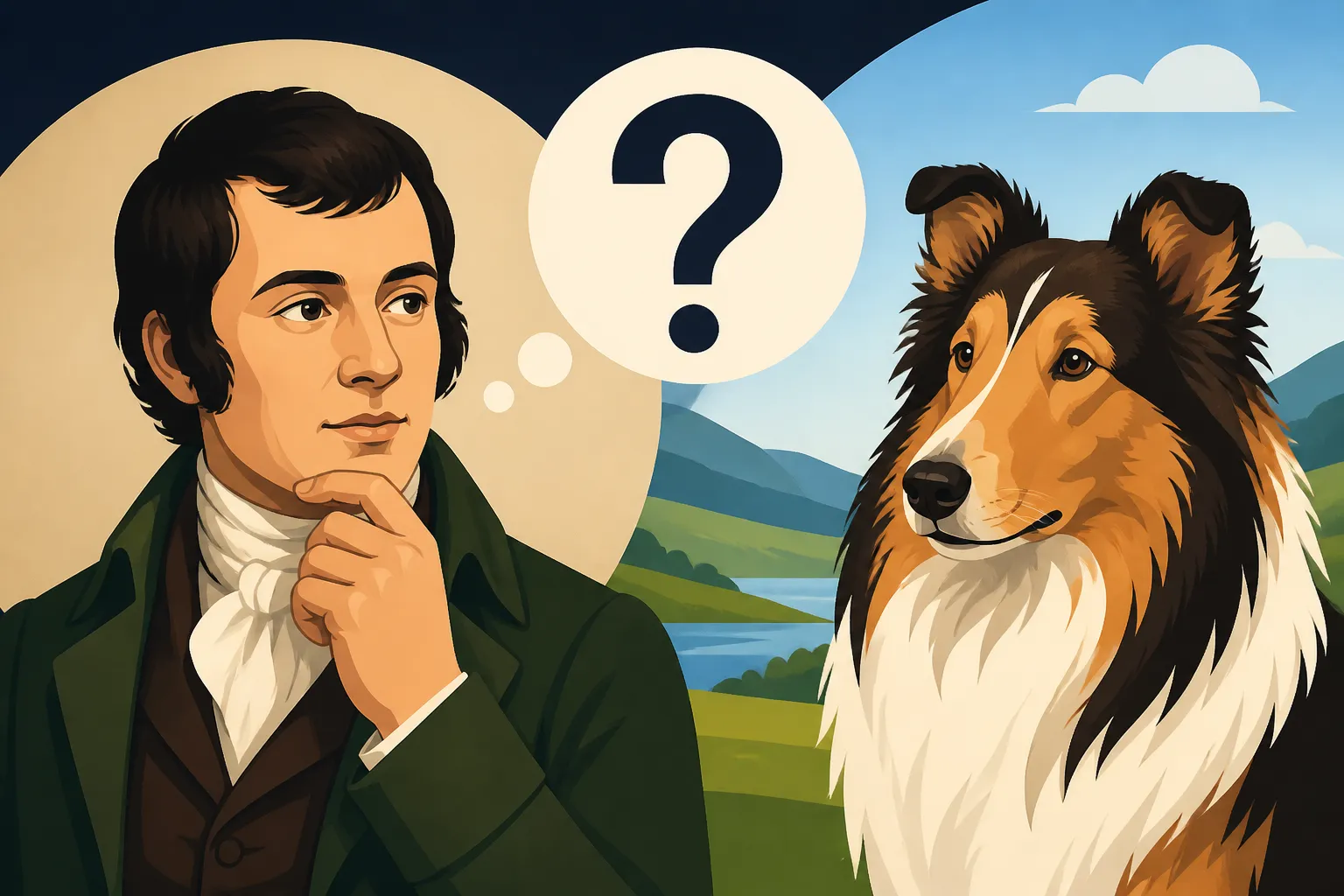
Robert Burns did write about a dog commonly identified as a collie, but the answer needs a little care: his poem names Luath as a shepherd’s dog, rather than describing him as a modern, formally defined Collie breed. This guide explains what the poem says, why Luath is linked with Collies, and what the poem can—and cannot—tell us about the dogs of Burns’s Scotland.
What Robert Burns wrote about a dog
Luath in The Twa Dogs
Burns’s best-known writing about a dog is The Twa Dogs, a poem in Scots first published in his 1786 collection Poems, Chiefly in the Scottish Dialect. Its two characters are Caesar and Luath, who meet and talk about their lives and the people they belong to.
The contrast between the dogs is part of the poem’s point. Caesar is kept by a wealthy household, while Luath is a shepherd’s dog. Their conversation gives Burns a way to compare the lives of rich and poor people. The dogs are characters in a social satire, not subjects in a guide to breeds or animal husbandry.
That distinction matters when asking whether Burns wrote about a Collie. The poem presents Luath as a working dog associated with a shepherd, a role strongly connected with the dogs later known as Collies. But the poem is not a detailed description of Luath’s appearance, ancestry, or breed.
Does Burns call Luath a Collie?
The safest answer is that Burns wrote about a shepherd’s dog who is commonly understood as a Collie, but The Twa Dogs does not establish that Luath belonged to the modern Collie breed as it is defined today. The text identifies his working role more clearly than it identifies a breed.
That may feel like a frustratingly careful answer when you want a simple yes or no. The reason is that the word “Collie” has a long history, while modern breed categories and standards developed later. A Scottish working dog in Burns’s time could be described by its job, region, or familiar type without fitting neatly into a later pedigree label.
| Question | What the poem supports |
|---|---|
| Does Burns write about dogs? | Yes. The Twa Dogs features Caesar and Luath. |
| Is Luath a shepherd’s dog? | Yes. That is the role associated with him in the poem. |
| Does the poem give a modern breed identification? | No. It does not provide a formal breed description. |
| Is Luath commonly linked with Collies? | Yes. His Scottish shepherding role makes that identification plausible and familiar. |
| Is the poem mainly about dog breeds? | No. It uses the dogs’ conversation to explore human society and class. |
For broader context, see The Collie Was a Scottish Droving Dog Before It Was a Show Dog and What the Collie Herded in Scotland. Those histories help explain why a shepherd’s dog in a Scottish poem is often connected with the Collie.
Why Luath is associated with Collies
A working role that fits the historical Collie
The connection between Luath and Collies is rooted in work. For generations, dogs in Scotland helped shepherds manage livestock across farms and open country. A capable working dog had to respond to its handler, pay attention to animals, and cope with long days outdoors. Luath’s place beside a shepherd fits that practical picture.
Still, a familiar job does not prove a precise breed identity. Dogs bred or kept for farm work were not always separated into the tidy categories people now expect from a kennel club or a pedigree record. A shepherd might value a dog for what it could do, rather than for a standardized look or a documented lineage.
This is why it is reasonable to call Luath a Collie in a broad historical or cultural sense, while avoiding the stronger claim that Burns gave us a detailed portrait of a modern Rough Collie or Smooth Collie. The poem tells us more about Luath’s social world and work than his coat, build, or ancestry.
The word “Collie” has its own history
The name “Collie” also needs context. The word’s origin is debated, and the name’s use has changed over time. What people meant by “Collie” in an earlier period does not always map exactly onto what the term means in a modern breed setting.
If you are curious about the name itself, Where the Word Collie Comes From explores that question, while Whether the Collie Comes From Scotland or England looks at the breed’s geographic associations. These issues are connected, but they are not the same as proving that a particular historical dog was a Collie by today’s definition.
Historical language often works this way. A writer may use a familiar description that readers of the time understood, while later readers bring newer categories to the text. Burns’s poem gives us a shepherd’s dog in a Scottish setting; the later association with Collies is a sensible interpretation, but it should not be mistaken for a modern pedigree record.
What the poem can tell us about Collies
Burns’s poem reflects the dog’s place in ordinary life
Luath is not presented as a decorative accessory or a show-ring animal. He belongs to the working life of a shepherd. That helps readers picture how dogs were valued in everyday rural settings: as companions and practical partners whose work was woven into the household’s livelihood.
The poem also gives the dog a voice. Burns uses Luath and Caesar to make observations about their owners and the wider world. That literary choice can feel strikingly modern, especially to Collie owners who recognize how closely a dog can observe household routines and human moods. But Luath is still a poetic character, shaped to serve the poem’s social argument.
The poem can therefore add texture to the history of working dogs without functioning as a complete record of Collie behavior or breeding. It gives us a vivid literary moment, not a checklist of traits that every Collie should have.
It is not a portrait of today’s show Collie
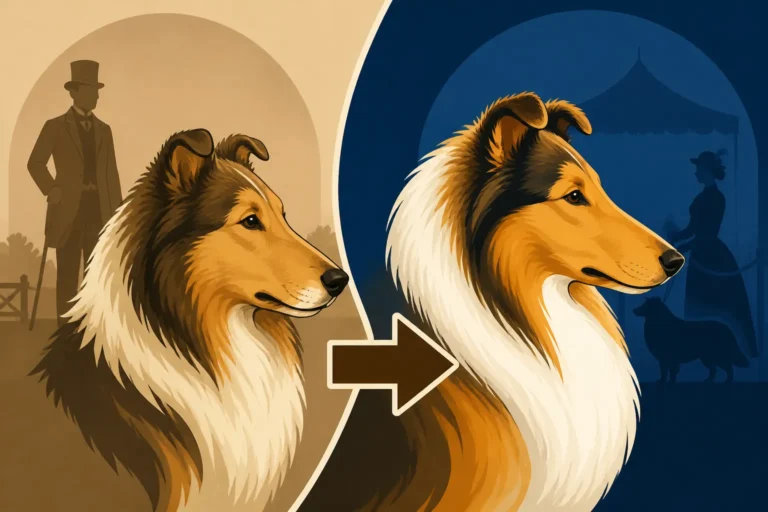
Modern Rough and Smooth Collies are varieties of one breed, but the development of today’s breed types and show traditions came through a longer process. Burns’s Luath belongs to an earlier world of working dogs, before the familiar modern distinctions were fully established.
For that reason, it is best not to use The Twa Dogs as evidence that the Collie of Burns’s day looked exactly like a Collie in a contemporary show ring. Historical working populations were shaped by practical needs and local breeding practices, and the appearance of individual dogs could vary.
The distinction between working and show types is explored in Whether Working Collies and Show Collies Diverged. For a related look at how the two coat varieties fit together today, see Rough and Smooth Are Two Varieties of One Collie. Both topics help make clear why a historical shepherd’s dog cannot automatically be assigned a modern variety.
How to talk about Burns and the Collie accurately
Use a qualified answer
If someone asks whether Robert Burns wrote about a Collie, a clear and fair answer is: Burns wrote about Luath, a shepherd’s dog in The Twa Dogs, who is commonly associated with the Collie; the poem does not identify him as a modern standardized Collie breed.
That phrasing is not evasive. It separates what the poem says directly from what readers reasonably infer. It also avoids treating today’s breed categories as if they had always existed in exactly the same form.
You can shorten the answer in casual conversation to “Burns wrote about a dog often identified as a Collie.” If the discussion is historical or literary, add that Luath is specifically presented as a shepherd’s dog and that the modern breed label requires caution.
Keep the literary and breed histories in view
The poem’s central interest is not canine classification. Burns uses the conversation between two dogs to comment on human life, including differences in wealth and circumstance. Reading it only as a Collie reference misses much of its purpose; treating it as a precise breed description goes beyond what the text can establish.
At the same time, the Collie connection is not arbitrary. Luath’s role as a shepherd’s dog belongs to a Scottish working-dog tradition closely associated with Collies. The poem is a useful cultural reference point, especially alongside histories such as The Collie Was a Scottish Droving Dog Before It Was a Show Dog and Whether a Modern Collie Could Still Work Sheep.
So the most balanced conclusion is that Burns gave literature a memorable Scottish shepherd’s dog, Luath, and later readers commonly recognize him as a Collie. That makes The Twa Dogs part of the breed’s cultural story, even though it is not a formal record of a modern Collie’s identity or appearance.
Disclaimer
This article is for general informational purposes only and does not constitute professional advice. Laws, prices and regulations vary by location and change over time. Consult a qualified professional for guidance on your specific situation.