Whether a Male Collie Is Much Larger Than a Female
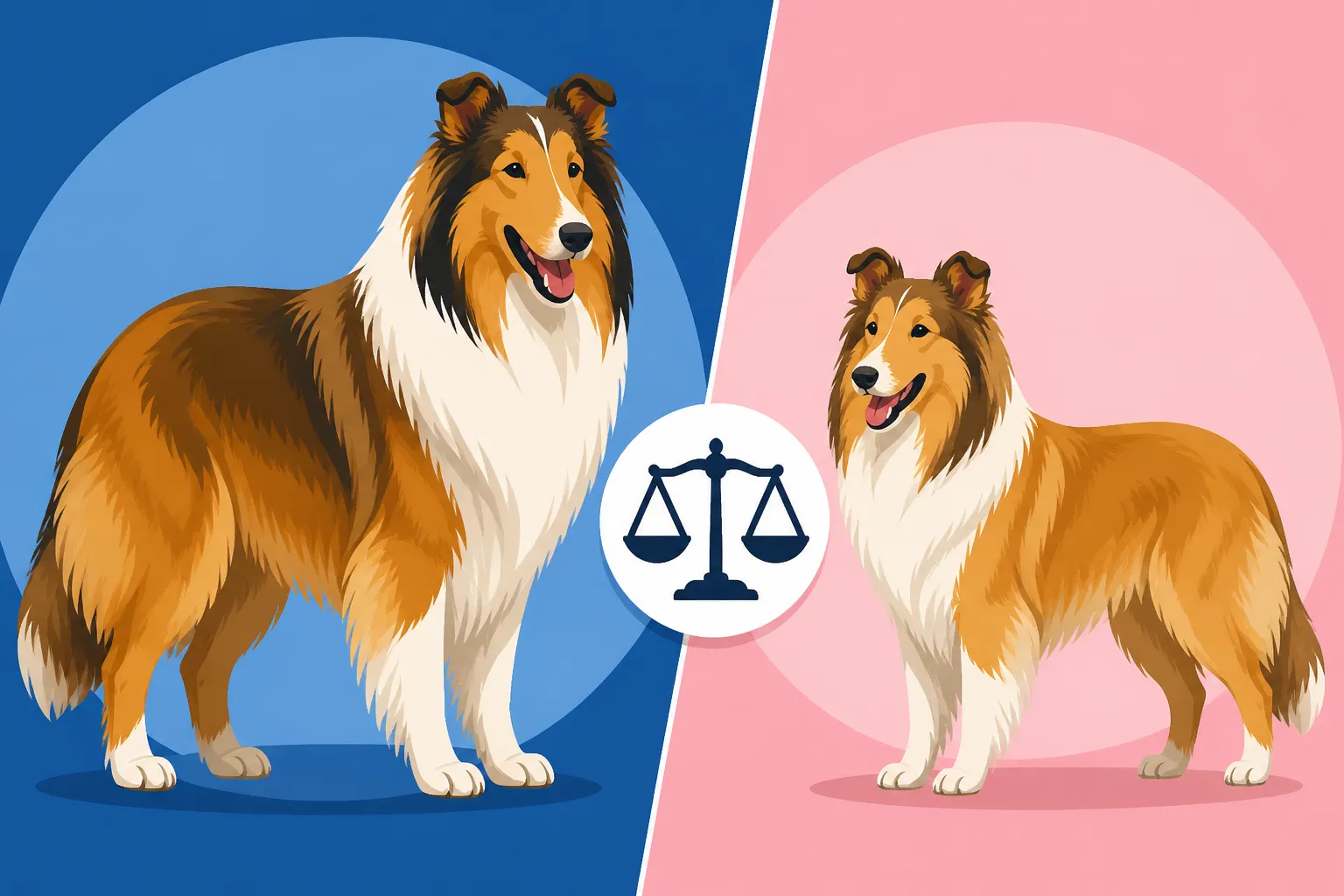
A male Collie is generally taller and heavier than a female, but the difference is usually noticeable rather than enormous. In the American breed standard, males are typically 24 to 26 inches tall at the shoulder, while females are 22 to 24 inches. Weight varies more from dog to dog, so coat, build, and body condition matter as much as sex when estimating an individual Collie’s size.
How male and female Collies compare in size
Typical height and weight ranges
The easiest difference to spot is often height: a male tends to stand a couple of inches taller at the shoulder. Weight ranges overlap, though, and a smaller male can weigh less than a large, sturdy female. These figures are useful as general expectations, not as a guarantee of what any particular puppy will become.
| Measurement | Male Collie | Female Collie |
|---|---|---|
| Typical height at the shoulder | 24 to 26 inches | 22 to 24 inches |
| Common adult weight range | About 60 to 75 pounds | About 50 to 65 pounds |
| Likely overall impression | Often taller and broader | Often somewhat smaller and lighter |
The height ranges above reflect the American Collie standard. Weight is not set as precisely in the standard, and figures can differ among individual dogs and sources. For a fuller overview of the breed’s measurements, see What a Collie Weighs and How Tall It Stands.
A two-inch height difference may sound small, but it can make a male look appreciably larger when he stands beside a female. Add a deeper chest, heavier bone, or a broader head and the difference may be more apparent. Still, it is not unusual for a female to be close in size to a smaller male.
Why the difference is not always obvious
Collies have abundant coats, especially the Rough variety. Their long outer coat and thick undercoat can make the chest, shoulders, and hindquarters look fuller than they really are. A female in full coat may appear broader than a lean, shorter-coated male, even if she is lighter and a little shorter.
That is why a visual guess can be misleading. If you are choosing a harness, crate, bed, or travel setup, measure the dog instead of choosing based on sex or appearance. Retail listings, including Chewy, may provide sizing charts, but the dog’s measurements are what help you compare options sensibly.
The Rough and Smooth Collie are two coat varieties of the same breed, not separate size categories. Their coats create different impressions, but either variety can include males and females across the usual size range. Rough and Smooth Are Two Varieties of One Collie explains how the varieties differ.
What affects an individual Collie’s adult size
Genetics and family build
A puppy’s sex gives you a rough clue, but the size of its parents and close relatives is usually more informative. If both parents are near the upper end of the usual range, a puppy may be more likely to grow into a larger adult. If the parents are smaller, their offspring may be smaller too, though no family pattern can predict an exact adult height or weight.
When speaking with a breeder, ask about the parents’ actual measurements and adult weights rather than relying on descriptions such as “big boy” or “petite girl.” A breeder who knows the family can often explain whether a particular line tends to be tall, fine-boned, or sturdier. You can also read What an Adult Male Collie Weighs and What an Adult Female Collie Weighs for more detail on each range.
Remember that “larger” is not automatically “healthier” or “better.” A Collie should be evaluated as an individual, with attention to sound movement and appropriate body condition—not just how impressive the dog looks standing beside another.
Growth, maturity, and body condition
Collies do not reach their final adult appearance overnight. A young dog may reach much of its height before it has fully filled out through the chest and body. Adult weight can also change as the dog matures, gains or loses muscle, or becomes less active. For more on timing, see The Age a Collie Stops Growing and Whether a Collie Fills Out Until Three.
This is one reason a lanky adolescent male can look surprisingly light beside a mature female. It does not necessarily mean he will remain that way, and it does not mean he should be encouraged to gain weight quickly. Puppies and adolescents need suitable nutrition and steady growth; a veterinarian can help assess whether a young dog is developing appropriately.
Coat can conceal body condition in either sex. Rather than judging by the outline of a fluffy Collie, feel gently along the ribs and look for a visible waist from above. If you are unsure whether a dog is carrying excess weight, Signs a Collie Is Overweight Under All That Coat offers helpful cues to discuss with your vet.
Choosing equipment and planning for a Collie’s size
Measure the dog instead of buying by sex
For a collar or harness, follow the maker’s instructions and measure the dog where the item will sit. A Collie’s neck and chest can vary substantially even among dogs of the same sex, and coat thickness can affect fit. Check that the equipment is secure without being tight, and reassess as a puppy grows or a mature dog’s body changes.
For a crate, consider the dog’s expected adult dimensions as well as its current size. A growing puppy may need a crate that can be adjusted as it matures, while an adult needs room to stand, turn, and lie down comfortably. A bed should likewise be chosen for the dog’s sleeping posture and actual length, not simply because a listing says “large.” Chewy and other retailers may show product measurements, so compare those with your own measurements before ordering.
If you are preparing for a puppy, ask the breeder what size crate or equipment has worked for dogs from the same family. A puppy that is expected to grow into a taller male may need different long-term arrangements from a smaller female, but the individual dog’s frame is still the deciding factor.
Budget for a full-sized dog, not a stereotype
A few inches of height may affect which crate or bed fits, but male-versus-female size alone does not determine the full cost of ownership. Food intake depends on the dog’s weight, age, activity level, health, and the energy content of its diet. Follow feeding guidance on the food label as a starting point, then adjust with veterinary advice and regular body-condition checks. Chewy may carry foods with different feeding instructions, so use the specific product’s label rather than assuming every food calls for the same portion.
Everyday items such as harnesses, coats, and travel restraints should fit the dog in front of you. If you shop online, compare the measurement chart with the dog’s current measurements and check whether the item allows adjustment. For a young dog, remember that a fit that works today may not work after another growth spurt.
A male Collie may need somewhat larger equipment on average, but a female is still a substantial dog. Both need secure handling, comfortable rest space, and equipment that fits safely. Avoid buying based solely on a “male” or “female” label when a tape measure can give you a better answer.
How much bigger is a male Collie in everyday life
What you may notice at home
In day-to-day life, a taller male may take up more vertical space at the food bowl, reach counters more easily, or feel heavier when he leans against you. A larger dog can also be more challenging to lift into a car or manage if he needs help after an injury. These differences are practical, but they do not mean every male will be difficult to handle or every female will be easy to lift.
For walking, training, and travel, temperament and manners can matter more than a small difference in height. A well-trained, heavier dog may be easier to manage than a smaller dog that pulls hard or gets overexcited. If you are comparing Collies with other breeds, Whether a Collie Is Bigger Than a Border Collie gives another useful size comparison.
It is also worth avoiding assumptions about weight based only on how a dog looks. A full-coated Collie can appear much heavier than the scale shows, while a lean, long-legged dog may look large despite being within a typical weight range. A vet can assess body condition and help you set a healthy target for that particular dog.
When size deserves a closer look
A Collie that is outside the usual range is not automatically unhealthy. Some individuals are naturally smaller or larger, and a dog’s overall condition, movement, and health history matter. But a sudden change in weight, difficulty maintaining weight, or a body shape that seems disproportionate is a good reason to check in with a veterinarian rather than trying to diagnose the issue by comparison with another dog.
Likewise, an unusually heavy Collie should not be presumed to be “just a big male.” Excess weight can be hidden by a thick coat, and it can place added strain on joints and general health. Ask a vet to assess body condition and suggest a realistic feeding and activity plan if needed.
Ultimately, male Collies are usually somewhat taller and heavier than females, but there is plenty of overlap. Use sex as a broad expectation, not a measuring tool. For a specific puppy or adult, look at family size, take accurate measurements, monitor body condition, and choose equipment that fits the dog you have.
Disclaimer
This article is for general informational purposes only and does not constitute professional advice. Laws, prices and regulations vary by location and change over time. Consult a qualified professional for guidance on your specific situation.