Whether Breeders Are Making Collies Larger
A Collie can look much larger than expected when its coat is in full bloom, and a tall, substantial dog may make you wonder whether breeders are deliberately changing the breed. This guide explains what the breed standards say, why some Collies appear bigger, how to judge a dog’s actual size, and what to ask a breeder before choosing a puppy.
Are breeders actually making Collies larger
There is no simple breed-wide answer. Individual breeders may favor different qualities, and some Collies look bigger than others, but that does not by itself show that the breed as a whole is getting larger. To assess a size trend, it helps to separate a dog’s measured height and weight from its coat, build, sex, and lineage.
What the breed standard tells you
In the United States, the Collie standard describes a height range at the shoulder, with adult males generally taller than females. A dog outside the preferred range may not meet the show standard, though that alone does not determine whether it is healthy, well cared for, or a suitable companion. Standards can also differ by country, so a breeder’s location and the registry they follow matter.
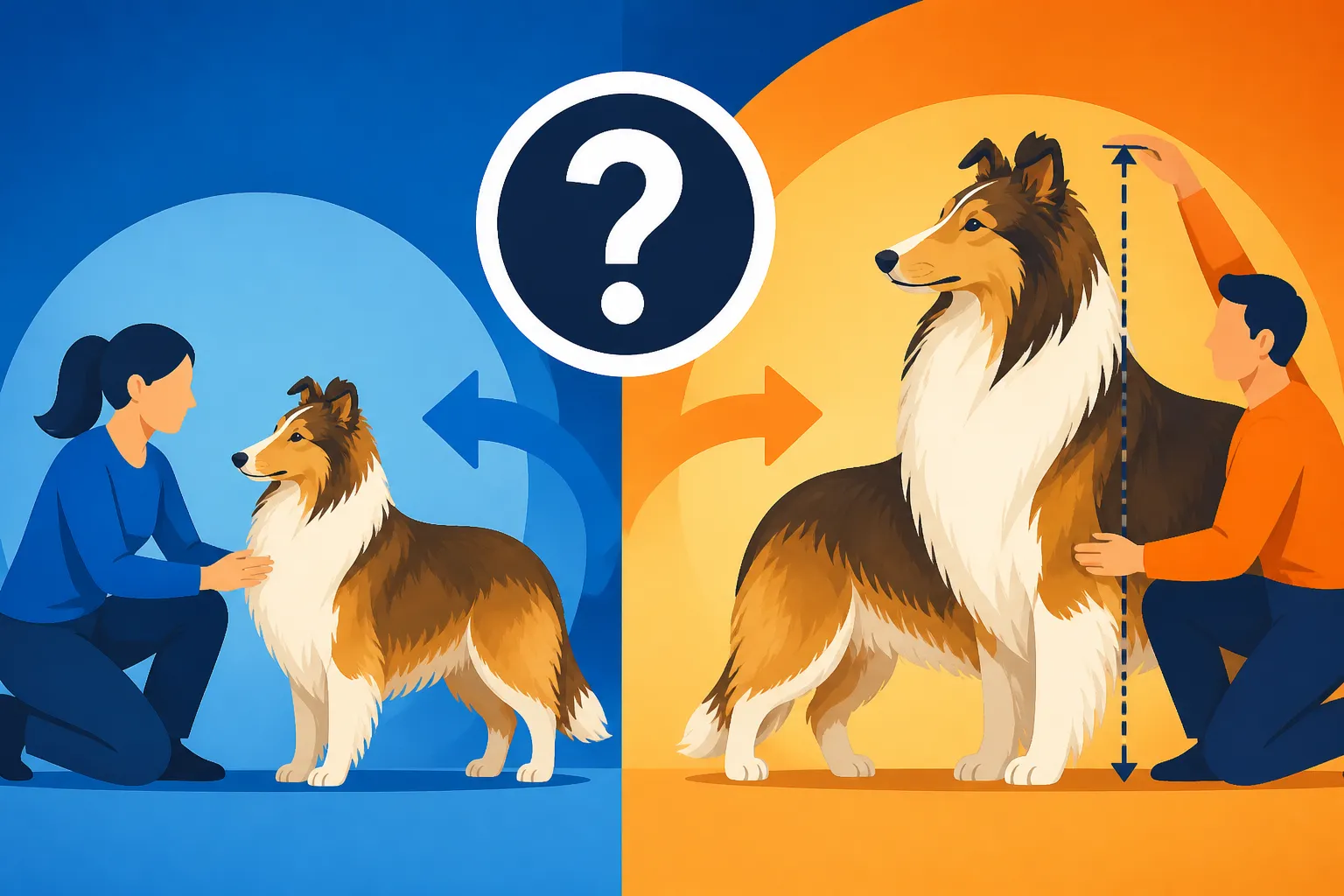
Height is measured at the withers, the highest point of the shoulders, not at the top of the head or the ears. A full Rough Collie coat can add considerable visual bulk without adding much actual height. For a closer look at the measurements and proportions, see What a Collie Weighs and How Tall It Stands.
A standard is a guide for breeding and judging, not a guarantee that every puppy will mature to one exact size. Puppies inherit traits from both parents and from earlier generations, so even littermates can vary. A responsible breeder should be able to discuss the size range in their lines rather than promise a precise adult weight.
Why some owners notice bigger Collies
People often judge size at a glance, and Collies are especially easy to misread because of their coat. A Rough Collie with a full mane, frill, and feathering may look much broader than a Smooth Collie of similar height and weight. A dog that is carrying extra weight can also appear bigger, but that is different from having a larger frame.
Sex is another source of variation. Adult males are often larger than adult females, though there is overlap between them. If a family is comparing a tall male with a smaller female, the difference may look like a change in breeding even when both dogs are within a normal range. The article Whether a Male Collie Is Much Larger Than a Female explains why sex is one part of the size picture, not a reliable prediction for every individual.
Photos can add to the confusion. Camera angle, a thick coat, stance, and the size of nearby people or objects all affect how large a dog appears. When someone says that “Collies are getting bigger,” it is worth asking whether they mean taller at the shoulder, heavier on the scale, broader in build, or simply more impressive-looking.
What would count as a genuine trend
A real population trend would need consistent measurements across many dogs and generations, not a handful of memorable examples. It would also need to account for sex, country, age, and whether the dogs were measured using the same method. A breeder producing a few large dogs does not prove that all breeders are selecting for increased size.
Breeding choices can influence a line over time. If a breeder repeatedly chooses taller or heavier parents, those traits may become more common among their puppies. But that is a statement about a particular breeding program, not necessarily about the entire Collie population. Well-considered selection should balance size with sound movement, temperament, health, and the breed’s overall structure.
It is reasonable to ask a breeder what adult dogs in their lines measure and weigh. Ask for more than the largest dog they have produced: the size of both parents, adult relatives, and previous puppies gives a more useful picture. A transparent breeder should explain variation without insisting that every dog in the line will turn out identical.
Why Collies can look larger than they are
A Collie’s outline is shaped by more than its height. Coat, body condition, grooming, and the way the dog is standing can all change the impression of size. Looking at these factors separately can help you decide whether you are seeing a genuinely large-framed dog or simply a Collie with a particularly abundant coat.
Coat volume can create a bigger silhouette
Rough Collies have a long outer coat and a dense undercoat, with especially noticeable hair around the neck, chest, and hindquarters. That coat can make the shoulders look broader and the body look deeper than it is. When the coat is clean, dry, and fully fluffed, the effect can be even more dramatic.
Smooth Collies are the same breed variety in a shorter coat, so their body shape is easier to see at a glance. A Smooth may look leaner beside a Rough of similar height, even if the dogs are close in actual weight. The distinction between the two varieties is explored in Whether the Rough and Smooth Collie Are One Breed.
For a fair comparison, look at the dog’s frame beneath the coat. You should be able to feel the ribs with light pressure, and the dog should have a visible waist when viewed from above. These checks are more useful than deciding whether the dog looks “small” or “big” in a photograph.
Body condition can be mistaken for frame size
A large-boned dog and an overweight dog are not the same thing. Coat can hide changes in body condition, so a Collie may gain weight without looking obviously different until you feel along the ribs or notice that the waist has become less defined. A veterinarian can assess body condition and help set an appropriate feeding plan.
Puppies also change shape as they grow. During adolescence, a Collie may look leggy, narrow, or out of proportion before developing adult muscle and coat. Comparing a six-month-old puppy with an adult dog can make the puppy seem unusually small or the adult seem unusually large, even though they are simply at different stages of development.
Food should be measured consistently rather than poured by eye, particularly if your dog’s weight is changing. Whether you buy food locally or through a retailer such as Chewy, use the feeding information on the specific product as a starting point, then adjust with your veterinarian based on the dog’s age, activity, and body condition. A retailer’s product listing cannot determine how much an individual dog should eat.
Photos and comparisons can distort size
A Collie photographed close to the camera may look larger than a person standing several feet behind it. A low camera angle can exaggerate leg length, while a seated pose can make the same dog look shorter and broader. Online comparisons are most useful when the dogs are measured or photographed in similar conditions.
Comparisons with other breeds can be misleading, too. A Collie may look tall beside a compact dog and less imposing next to a heavier breed. If you are comparing Collies with Border Collies, remember that the breeds have different proportions and coat types; Whether the Collie Is Bigger Than a Border Collie looks at that comparison more closely.
When asking a breeder about size, request adult measurements if available rather than relying on photos alone. A standing side view can help you see proportions, but it still does not replace a measurement at the shoulder and a weight taken on a scale.
Do different Collie lines and regions vary in size
Some variation between breeding lines is normal. Breeders may emphasize different characteristics, and dogs in different countries are assessed against different standards. Those differences are worth understanding, but they do not automatically mean one group is becoming oversized.
Show lines and working lines may have different priorities
Show breeders generally consider how closely a dog matches the relevant breed standard, including its size and proportions. Working breeders may place more emphasis on qualities that support the dog’s intended work, such as stamina, responsiveness, and practical movement. These priorities can influence the look of a line, but there is no rule that every show Collie is larger or every working Collie is smaller.
The history and development of these lines are more complicated than a simple size split. For background, see Whether Working Collies and Show Collies Diverged. When discussing a particular puppy, the most useful information is still the actual size and build of its close relatives, rather than a broad assumption based on the label “show” or “working.”
A dog bred for work should still be evaluated for soundness and appropriate body condition, just as a show-bred dog should. If you are interested in a Collie’s working ability, ask what the parents do and how their structure supports that activity. Whether a Modern Collie Could Still Work Sheep offers more context on the breed’s working potential.
American and British Collies are not a simple size comparison
People sometimes assume that Collies from one country are consistently bigger than those from another. In practice, you need to consider the standards used, the individual bloodlines, and the particular dogs being compared. A country label is not enough to predict a puppy’s mature size.
Different registries may express their standards and preferred measurements differently. That makes direct comparisons less straightforward than looking at two numbers on a page. When buying from abroad, ask the breeder to explain how they measure adult dogs and what standard their breeding decisions follow.
If a breeder says a line is “American-sized” or “British-sized,” ask what that means in concrete terms. Are they talking about shoulder height, weight, bone, coat, or overall appearance? Whether an American Collie Is Bigger Than a British One explores why the comparison needs more than a generalization.
Rough and Smooth coats change appearance, not the basic question
Because coat type changes a Collie’s silhouette, Rough and Smooth dogs can look like different sizes even when their underlying frames are similar. A heavily coated Rough may look substantial beside a Smooth, while a Smooth’s outline can make its legs and waist more apparent. It is better to compare measurements and body condition than appearance alone.
Coat type does not tell you exactly how tall or heavy a puppy will be as an adult. A puppy’s parents and close relatives can offer clues, but growth is still individual. Ask to meet or see adult relatives where possible, and ask the breeder what range they have observed in past litters.
If your interest is mainly in a dog that is easier to handle or lift, do not use coat variety as a stand-in for size. A Smooth Collie can still be a tall, strong dog, and a Rough Collie’s coat can make everyday grooming a bigger consideration. The variety may affect how large the dog appears and how much coat care it needs, but it is not a dependable shortcut to a smaller frame.
How to assess a Collie puppy’s likely adult size
No breeder can promise an exact adult height or weight for a growing puppy. Still, you can ask specific questions and look at useful evidence to make a more informed estimate. The goal is not to find the biggest or smallest puppy, but to choose a dog whose likely adult size fits your household.
Ask for measurements and family history
Ask the breeder for the adult height and weight of the sire and dam, if known, and whether they have measurements for adult offspring from previous litters. Also ask whether the dogs are measured at the shoulder or whether the numbers are estimates. Consistent measurements are more informative than descriptions such as “large,” “petite,” or “substantial.”
It can help to ask about variation across the breeder’s line: Have previous puppies matured at a range of sizes? Are there unusually tall or heavy relatives? Have dogs from earlier litters stayed within the breeder’s preferred range? Answers that describe a range are usually more realistic than guarantees.
If the breeder cannot provide exact measurements, that does not automatically mean something is wrong; not every owner measures a pet Collie. But a breeder should still be able to discuss the family’s general build and show you adult dogs where possible. If you are buying a puppy from a distance, ask for clear, recent information rather than trying to estimate size from puppy photos.
Use puppy growth as a clue, not a promise
A puppy’s current weight can be useful when tracked over time, but a single weigh-in cannot reliably predict adult size. Growth depends on age, sex, genetics, health, and nutrition. A puppy that looks especially sturdy at one stage may later develop into a lean adult, while a lanky adolescent may fill out gradually.
A veterinarian can monitor growth and body condition during routine visits. If you have adopted a rescue Collie or lack information about its background, the vet can help determine whether the dog’s weight is appropriate for its frame. This is especially helpful when a thick coat makes visual assessment difficult.
Avoid trying to make a puppy grow faster or larger by overfeeding. Excess weight is not a sign of better development, and it can put unnecessary strain on a growing dog. Follow veterinary guidance on nutrition and keep track of the puppy’s condition as it matures.
Questions to ask before choosing a puppy
A calm, specific conversation can tell you more than a breeder’s claim that a puppy will be “big” or “small.” Ask what size the breeder expects based on the parents and previous litters, and whether the puppy’s predicted size is important for your household. If you need a dog that can comfortably fit into a particular routine or living arrangement, say so plainly.
| Question to ask | Why it helps |
|---|---|
| How tall and heavy are the adult parents? | Gives a starting point for the family’s build |
| What size range have adult puppies from earlier litters reached? | Shows the variation seen in that breeding line |
| How do you measure height? | Helps make comparisons consistent |
| Are you describing height, weight, coat, or overall build? | Clarifies what “large” or “small” means |
| What standard do you follow? | Explains the breeder’s reference point |
| How do you monitor the puppy’s growth and body condition? | Shows whether size is considered alongside health |
If you buy food or basic care supplies through Chewy, keep a record of the food and serving amount you use as your puppy grows. Consistent notes can help you and your veterinarian spot changes in appetite or weight. Whether those supplies come from Chewy or a local shop, the important thing is to follow a feeding plan suited to the individual puppy.
A breeder should not pressure you to choose the largest puppy as the “best” one, or suggest that size alone proves quality. Temperament, health, structure, and fit with your home matter far more than whether one puppy appears bigger in a photograph. If a breeder makes a strong claim about a future adult size, ask what evidence supports it and how much natural variation they expect.
Disclaimer
This article is for general informational purposes only and does not constitute professional advice. Laws, prices and regulations vary by location and change over time. Consult a qualified professional for guidance on your specific situation.