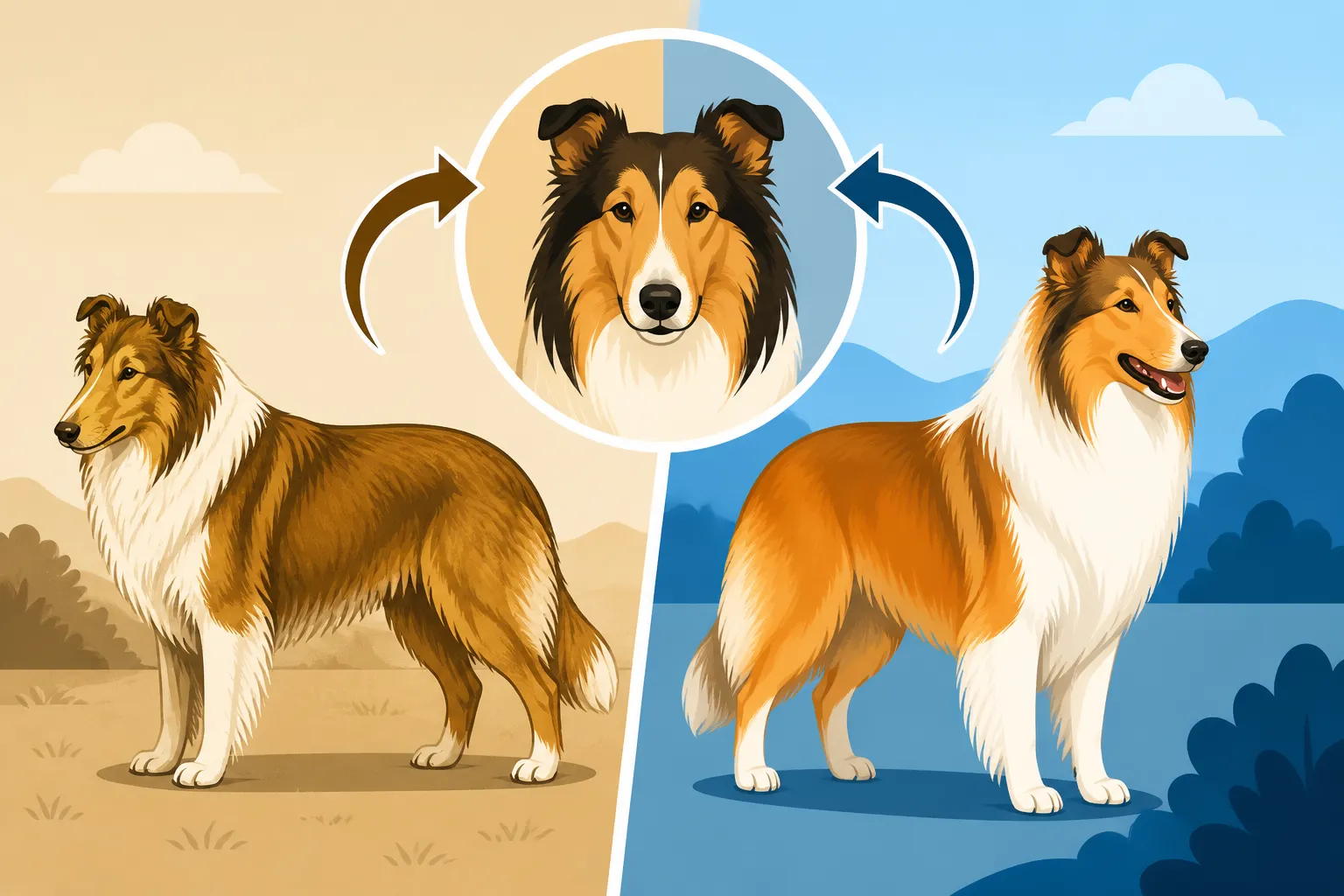
Whether the Collie Standard Has Changed Since 1900
A Collie shown around 1900 would be recognizable as a Collie today, but the written standard and the way judges interpret it have not stood still. Changes to wording, emphasis, and show-ring priorities can make the modern ideal look different without turning the breed into a different dog. This guide explains what changed, what endured, and how to read the standard in context.
What a breed standard describes
The standard is a written ideal, not a snapshot of every Collie
A breed standard describes the qualities considered desirable in a breed: its general appearance, structure, movement, coat, color, and temperament. It gives breeders and judges a shared reference point, but it is not a claim that every Collie will look exactly alike or match every detail.
The standard is also not a history book. It tells you what a Collie should be like for purposes such as breeding and conformation judging; it does not, by itself, explain how the breed developed. For that background, see The Collie Was a Scottish Droving Dog Before It Was a Show Dog.
A dog can be a healthy, much-loved Collie without being a perfect example of the written ideal. Conversely, a dog that looks impressive in a show ring is not automatically the best choice for every household or working purpose. A standard is one tool for understanding breed type, not a complete measure of an individual dog’s worth.
Breed standards can be revised and interpreted
A standard can change in two different ways. First, its wording may be formally revised through the breed organization responsible for it. Second, judges and breeders may place different emphasis on existing wording over time, even when the language itself has not changed.
That distinction helps explain why old photographs and modern show pictures may look different. A change in the appearance of winning dogs does not prove that the standard was rewritten to require that change. It may reflect shifts in breeding choices, presentation, or interpretation instead.
For a Collie owner, the standard is most useful as a guide to the breed’s intended type. It can help explain why a Collie has a particular outline or coat, but it should not be treated as a checklist for judging a pet at home.
How the Collie standard has changed since 1900
The early standard grew out of a breed becoming more formalized
By 1900, Collies were already moving through a world of organized breeding and dog shows. A written standard helped distinguish the type breeders and judges wanted to preserve. The breed’s earlier work as a Scottish droving dog remained part of its history, even as conformation shows gave people another way to evaluate it.
The basic idea of the Collie as a balanced, alert herding dog has endured. Its overall outline, expression, coat, and movement have long mattered to breed identity. What changes over time is often the exact language used to describe those traits, how precisely they are defined, and how much weight judges give them in comparison with one another.
A historical image can help illustrate how the breed looked in a particular period, but it cannot tell you what the official wording said. Nor does one photograph represent every Collie of its time. When comparing past and present, it is useful to keep the written standard separate from the appearance of a small number of dogs.
Modern standards describe details more explicitly
As dog breeding and show judging became more organized, standards developed as practical documents. Clearer descriptions can help reduce ambiguity about features such as proportions, coat, color, movement, and expression. That does not necessarily mean the desired breed type was replaced; it may mean that people became more specific about how to recognize it.
The Collie is recognized in rough and smooth varieties. Their coats differ, but they are varieties of the same breed rather than separate breeds with unrelated ideals. The distinction is useful when reading descriptions of coat and presentation, and Rough and Smooth Are Two Varieties of One Collie explains that relationship in more detail.
A current standard should be read as the present guide for the relevant registry, not assumed to be identical to a document used around 1900. If you are researching a particular historical claim, compare the actual editions from the organizations involved. A broad statement that “the Collie standard changed” may refer to revised wording, a changed judging emphasis, or both.
| Question | What it tells you | What it does not prove |
|---|---|---|
| Has the written standard been revised? | The official description has been updated | That every Collie changed in appearance |
| Do old and modern show dogs look different? | Breeding or presentation may have shifted | That the standard itself caused the difference |
| Are some traits described in more detail now? | The standard may be more precise | That the breed’s original character disappeared |
| Does a pet differ from the ideal? | Individual dogs vary | That the dog is not a Collie |
What has stayed recognizable
The Collie’s overall type remains central
Although details and emphasis can shift, the standard still aims to describe a recognizable Collie rather than a collection of isolated features. Balance matters: a dog should make sense as a whole, with structure and movement suited to its intended type. A dramatic coat or striking head cannot stand in for soundness and overall proportion.
The breed’s characteristic expression is also part of what people recognize. That expression is not just a matter of one feature; it comes from the combined effect of head shape, eyes, ears, and the dog’s alert, responsive manner. The standard offers a formal description, while everyday observers may simply say that a Collie has a familiar, gentle-looking face.
Temperament belongs in the larger picture too. A standard describes the breed ideal, but a written description cannot guarantee how an individual dog will behave. A Collie’s upbringing, health, experiences, and temperament all matter. For a broader look at the breed’s physical profile, see What a Collie Weighs and How Tall It Stands.
Coat and color remain visible parts of breed identity
The rough Collie’s long coat is one of its most recognizable features, while the smooth variety has a shorter coat. Coat descriptions matter in the standard, but it is easy to mistake show presentation for an instruction that every pet Collie must look like a competition dog. The needs of a show coat and the ordinary maintenance of a family dog are not identical.
Color is another visible area where the standard helps define breed type. Collies are commonly associated with sable and white, tricolor, and blue merle; white Collies also have a distinct place in breed descriptions. Color alone does not tell you whether a dog is well bred, healthy, or suitable for a particular home. The Four Colors a Collie Comes In gives a closer explanation of the recognized color patterns.
If the coat is the part of the standard that first catches your eye, practical care matters more than trying to recreate a show-ring finish. A suitable comb or brush can help with routine grooming; a retailer such as Chewy may be one place owners look for basic supplies. Whatever the source, choose tools for the dog’s coat and use them gently, especially around areas that tangle easily.
How to compare standards and old Collie images
Start with the correct organization and edition
There is not necessarily one universal standard used everywhere. Breed organizations can maintain their own wording and may revise documents at different times. So, when someone says “the Collie standard,” the first question is which registry and which edition they mean.
For a careful comparison, find a historical version close to 1900 and compare it with the current version from the same organization, if both are available. Look at the wording section by section rather than relying on a modern summary of what the older document supposedly said. Pay attention to whether a difference is a new requirement, a clarification, or simply a change in phrasing.
It also helps to distinguish a standard from a judge’s notes, a breeder’s description, or a show report. Those documents may discuss preferences and trends, but they are not interchangeable with the official standard. This is especially important when a claim online says that a specific feature was “added” or “removed.” The exact editions are the best way to check.
Treat photographs as evidence, not the whole story
Old photographs can make a comparison vivid, but camera angle, pose, grooming, age, and image quality all affect what you see. A dog standing with its head turned or its coat arranged differently may look unlike a modern show dog, even if the underlying structure is not as different as the picture suggests.
Use several examples from each period when possible. Compare dogs in similar poses, and look for broad patterns rather than drawing conclusions from one famous Collie. Consider whether the images show show dogs, working dogs, or household pets. Those groups may have been selected and presented for different purposes.
Finally, remember that the show ring is only one setting in which Collies live and work. If your interest is choosing a companion, the standard can teach you about breed type, but practical questions about temperament, health, and care deserve equal attention. A responsible breeder should be willing to discuss those matters openly; The Collie Against the Border Collie and the Sheltie can also help clarify what distinguishes the Collie from related herding breeds.
What a change in standards means for owners
For most pet owners, a revision to a breed standard does not require any change to daily care. It does not mean that an existing dog suddenly falls outside the breed, nor does it determine whether that dog is a good companion. The standard primarily matters in organized breeding and conformation judging.
It can, however, give owners helpful context. If a description mentions coat, proportion, or movement, you can better understand why those features appear in breed discussions. For grooming, a basic brush or comb may be enough for routine home care; Chewy is one possible place to browse supplies, but the right tool depends on coat condition and your dog’s comfort. If mats are tight against the skin, a groomer or veterinarian can advise on safer handling.
The most balanced answer is that the Collie standard has evolved in wording and interpretation since 1900, while many core elements of recognizable Collie type have remained. To understand a specific alleged change, compare dated official standards rather than assuming that differences in photographs prove a formal rewrite. And when it comes to life with an individual dog, the standard is context—not a verdict.
Disclaimer
This article is for general informational purposes only and does not constitute professional advice. Laws, prices and regulations vary by location and change over time. Consult a qualified professional for guidance on your specific situation.