Whether the Coat Gene Is Simple in Collies
A Collie puppy’s coat can leave even experienced owners guessing: two Rough-coated parents may produce a Smooth puppy, while a Smooth parent may carry the hidden instructions for a Rough coat. The basic inheritance pattern is fairly straightforward, but real coats involve more than one switch. This guide explains what coat genes can predict, what they cannot, and how to read a litter’s possibilities.
The basic genetics behind Rough and Smooth Collies
One major gene strongly influences coat length
Rough Collies have a long coat, while Smooth Collies have a short coat. In simple terms, coat length is strongly influenced by a gene associated with the FGF5 pathway. The long-coat version is generally recessive: a dog usually needs to inherit a long-coat copy from each parent to have a Rough coat. A short-coat version can mask a hidden long-coat copy.
For an easy illustration, imagine S represents a short-coat version and r represents a long-coat version. This is just explanatory shorthand, not necessarily the notation used on a laboratory report. A dog with two short-coat copies would be Smooth and would not pass a long-coat copy. A Smooth dog with one short-coat and one long-coat copy would also look Smooth, but could pass the long-coat version to a puppy.
A Rough Collie, in this simplified model, has two long-coat copies. That is why coat appearance alone does not reveal everything about a Smooth dog’s genetic makeup. A Smooth Collie can look exactly like a Smooth Collie while carrying a hidden long-coat version.
This is the useful starting point, not the whole story. A major gene can explain the broad Rough-versus-Smooth distinction without accounting for every detail in coat texture, density, furnishings, or how a puppy’s coat develops. For the relationship between the two varieties, see Whether the Rough and Smooth Collie Are One Breed.
Why two Rough parents can have a Smooth puppy
If both Rough-coated parents carry only the long-coat version in the simplified model, their puppies inherit a long-coat copy from each parent and are expected to be Rough. But a litter can include a Smooth puppy if a parent’s apparent coat type does not tell the whole genetic story, if the underlying inheritance is more complex than the simplified model, or if the dog has been identified incorrectly.
One reason the question causes confusion is the assumption that a Rough coat must mean the dog can pass only Rough-coat instructions. In the basic recessive model, it does mean the dog passes a long-coat copy. But a litter’s coat outcomes also depend on what the other parent can pass, and actual test results should be interpreted using the specific variant and inheritance model reported by the laboratory.
Conversely, two Smooth parents can produce Rough puppies if each parent is Smooth but carries a hidden long-coat version. Each puppy has to inherit that version from both sides for the long coat to appear. That possibility is one reason a breeder may want to understand the parents’ genetic results rather than relying on a family’s appearance alone. The related question Whether Two Rough Collies Can Produce a Smooth is worth considering alongside the broader topic Whether a Litter Can Hold Both Collie Coats.
What coat pairings can produce
A simple inheritance chart
The table below uses the illustrative S/r shorthand described above. It assumes one major coat-length gene, no unusual variants, and correct parentage. Real genetic reports may use different terms, so don’t treat these letters as a substitute for a lab’s interpretation.
| Parent pairing in the simplified model | Possible puppy coat types | What to keep in mind |
|---|---|---|
| Rough, r/r × Rough, r/r | All Rough | Each parent passes a long-coat copy in this model |
| Rough, r/r × Smooth, S/S | All Smooth, carrying long-coat copy | Each puppy gets S from the Smooth parent and r from the Rough parent |
| Rough, r/r × Smooth, S/r | Rough and Smooth | The Smooth parent may pass either version |
| Smooth, S/r × Smooth, S/r | Rough and Smooth | A puppy must inherit r from both parents to be Rough |
| Smooth, S/S × Smooth, S/S | All Smooth | No long-coat copy is passed in this simplified model |
These are possible inheritance patterns, not a promise about a specific litter. A breeder should not infer a dog’s genotype solely from a photograph, a pedigree description, or the coats of its parents. If a particular pairing matters, ask what test was run, which variants it evaluates, and how the laboratory interprets the result.
The mating of a Rough and Smooth Collie is not automatically a genetic mistake. The question is what each dog carries and what the breeder is trying to achieve, alongside health, temperament, structure, and the breed’s wider gene pool. For more on the pairing itself, see Whether Rough and Smooth Collies Can Be Bred Together.
Why a Smooth Collie may carry a long-coat version
A Smooth Collie’s short hair tells you what the coat looks like, but not necessarily whether the dog can pass a long-coat allele. If the dog has one short-coat copy and one long-coat copy, the short-coat version can determine its visible coat while the long-coat version remains hidden.
That hidden copy matters most when the Smooth dog is bred. If its mate also passes a long-coat copy, some puppies may inherit one from each parent and develop a Rough coat. If the mate cannot pass a long-coat copy under the relevant model, the puppies may all appear Smooth while some inherit the hidden version.
This is why “Smooth” and “genetically incapable of producing Rough puppies” are not interchangeable descriptions. A breeder who wants to make a prediction should use reliable parent information or appropriate genetic testing, not assume that a dog’s coat reveals every allele it carries. A Smooth coat is still a real and complete Collie coat type; it is not a visual clue that the dog is less of a Collie. See Whether a Smooth Collie Is Just a Short Haired Collie for more about the variety.
Why coat inheritance is not the same as coat appearance
Length is only one part of a Collie’s coat
A long-versus-short coat is the easiest feature to discuss genetically because it has a major influence on the difference between Rough and Smooth Collies. But a dog’s actual appearance is shaped by more than that single contrast. Coat density, texture, undercoat, feathering, and the way hair lies can vary from dog to dog.
That helps explain why two Rough littermates may not look identical even though both have long coats. One may have a fuller frill or heavier feathering; another may have a different texture or less apparent volume. Grooming, seasonal coat changes, age, hormones, health, and the individual dog’s hair growth can also affect what you see.
Puppies can be particularly misleading. A young dog’s coat may look sparse or soft before its adult coat comes in, and changes in color or coat condition can make the puppy seem as though its inherited coat type is changing. The underlying coat-length inheritance is not the same as the coat’s gradual development. For that puppy question, see Whether a Collie Puppy's Coat Predicts the Adult One.
Coat color and coat length are separate questions
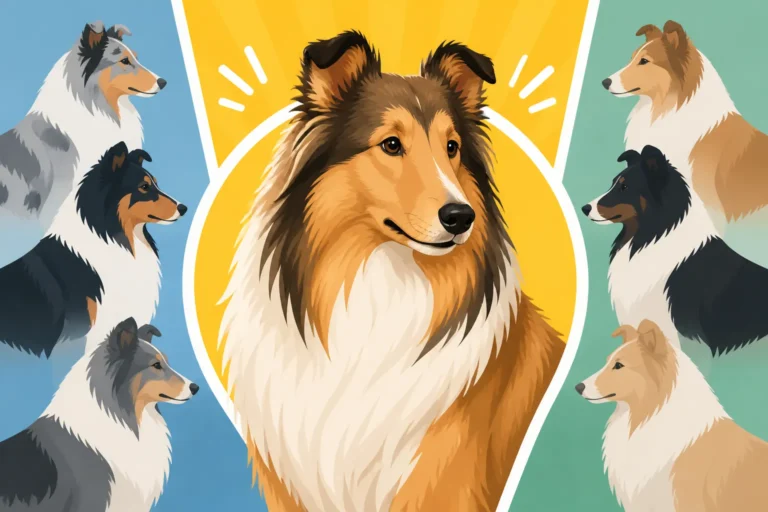
A Collie’s color does not tell you whether the dog carries a long-coat version. Sable and white, tricolor, blue merle, and white patterns concern color and pattern, while Rough versus Smooth refers to coat length. They are different features, and one should not be used to predict the other.
For example, a blue merle Collie may be Rough or Smooth. A sable Collie may also be Rough or Smooth. Likewise, two dogs with the same coat color can have different coat-length genotypes. If you’re comparing appearance in a litter, it helps to keep the questions separate: “What color or pattern is this puppy?” is not the same as “Which coat-length variants can this puppy inherit or pass on?”
The variety overview The Four Colors a Collie Comes In is a useful companion if color is part of what is making a puppy’s coat hard to interpret. Keeping color and length distinct prevents a common mix-up: treating visible coat differences as if they all came from one gene.
Using coat genetics when choosing or breeding a Collie
What a DNA test can and cannot tell you
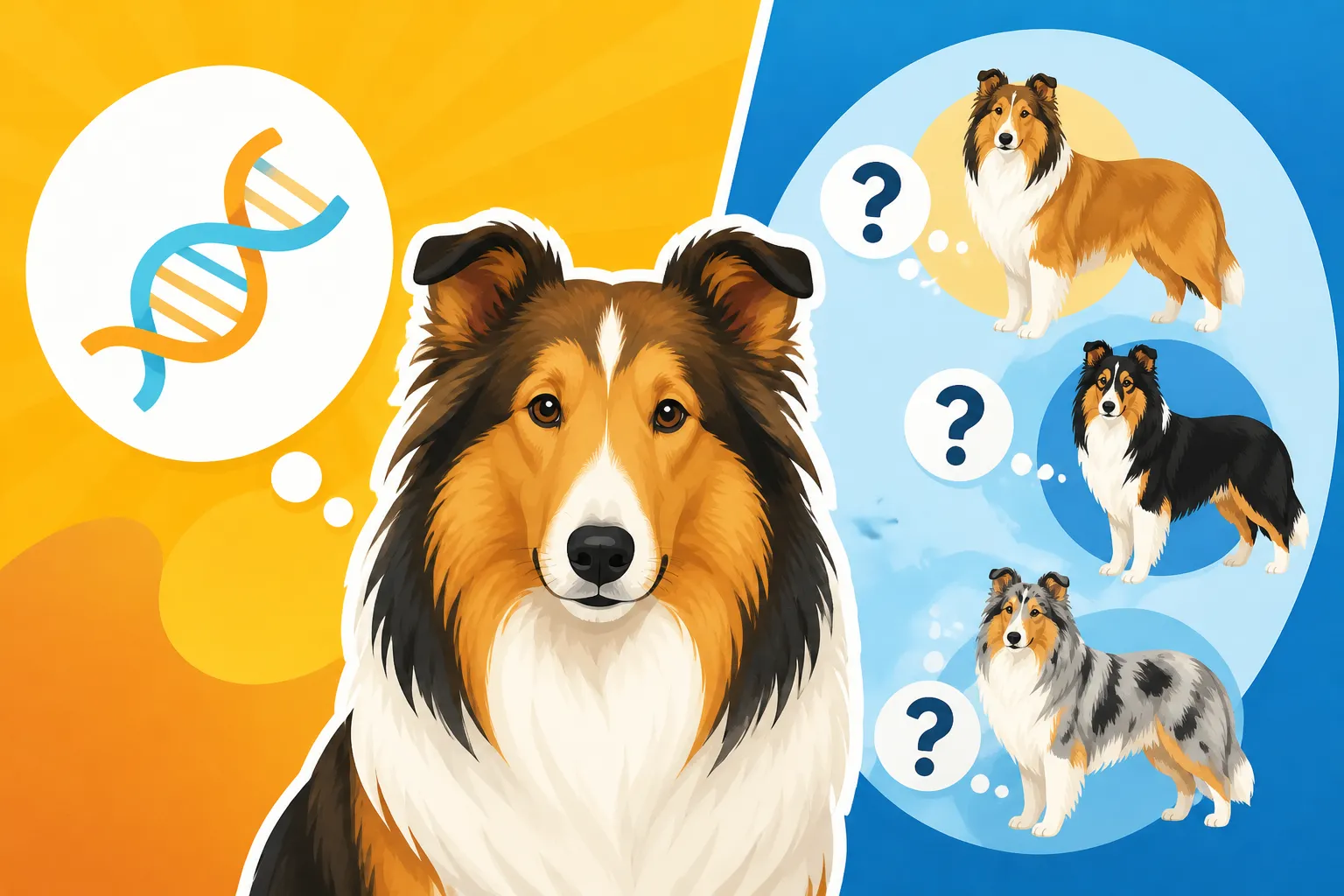
A coat test can be useful when the result answers a specific question, such as whether a Smooth Collie carries a tested long-coat variant. Before relying on a result, check what the laboratory tested and what its report actually concludes. Different tests may assess different variants, and a test’s usefulness depends on whether it covers the relevant genetic change for the dog.
A DNA result also cannot tell you everything about the puppy you will get. It may help predict coat length under a stated inheritance model, but it does not guarantee a particular coat texture, density, amount of feathering, or grooming experience. Nor does a coat-length result replace the broader health and temperament considerations involved in choosing a breeding pair.
When reviewing a test result, ask the breeder or laboratory:
- Which coat-related gene or variant was tested?
- Does the test distinguish a dog that carries one long-coat copy from one that carries two?
- What coat outcomes are possible from the planned pairing?
- Are the parents’ identities and results documented?
- What features does the test not predict?
If you are choosing a puppy, it is reasonable to ask whether the litter could include both coat types and how the breeder reached that conclusion. A clear explanation is more useful than a confident claim based only on what the parents look like.
Match the prediction to the question you care about
A family choosing a Collie as a companion may simply want to know whether to expect a Rough coat’s grooming needs or a Smooth coat’s shorter hair. In that case, the breeder’s explanation of the parents, litter possibilities, and coat development may be enough to set expectations. Coat type alone does not predict a Collie’s temperament or suitability as a companion; see Whether Smooth Collies Have the Same Temperament.
A breeder planning a pairing has a different reason to ask. The goal may be to understand whether Rough puppies are possible, avoid surprise coat types, or preserve genetic diversity while making informed choices. That decision should be based on test results and the dogs’ complete breeding context rather than selecting solely for a preferred coat.
And if you are looking at a young puppy whose coat seems neither clearly Rough nor clearly Smooth, give its development time and ask the breeder what is known about the parents and relatives. Puppy coat can be an unreliable guide to the finished adult appearance. The best answer usually comes from combining observable coat, parent information, and a properly interpreted test—not from treating one clue as a complete genetic explanation.
Disclaimer
This article is for general informational purposes only and does not constitute professional advice. Laws, prices and regulations vary by location and change over time. Consult a qualified professional for guidance on your specific situation.