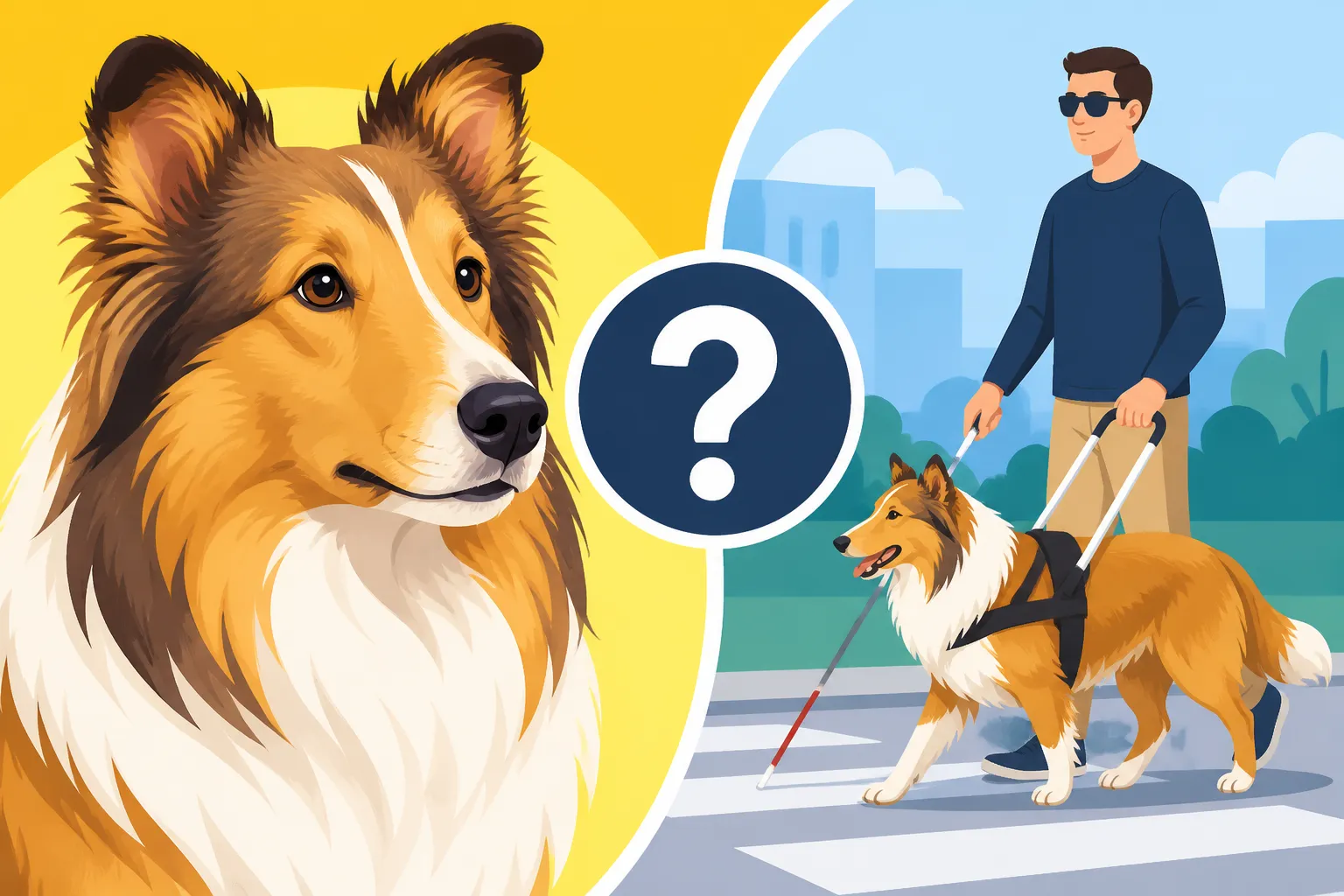
Whether the Collie Has Worked as a Guide Dog
A Collie can learn the skills needed to guide a person with low vision, but that does not mean every Collie is suited to the work. Guide dogs need steady nerves, sound health, focus in busy places, and an ability to ignore distractions. This guide explains where Collies may fit, what can make the job difficult, and how to think about an individual dog rather than the breed alone.
Can a Collie Work as a Guide Dog
Yes, a Collie can potentially be trained as a guide dog. The more useful question is whether a particular dog has the temperament, health, and working style for the role. Guide-dog training asks for much more than knowing how to walk on a lead: the dog must stay composed around traffic, people, other dogs, and sudden changes while responding reliably to a handler’s cues.
Guide dogs help people who are blind or have low vision navigate. They are not expected to make every decision for their handler. The handler gives directions, and the dog learns to guide safely, stop at obstacles and curbs, and resist a cue when following it would be dangerous. That partnership depends on trust and consistent teamwork.
What guide-dog work requires
A working guide dog needs to move through unpredictable environments without becoming overwhelmed or overly distracted. A busy sidewalk, a crowded station, a noisy shopping area, or an unfamiliar entrance can all test a dog’s concentration. The dog must also be comfortable wearing a harness and working close to a person.
Intelligence and willingness to learn are helpful, but they are not enough by themselves. A dog can be quick to pick up cues and still find the noise or pace of public settings stressful. Conversely, a dog that is calm and confident may learn a task at a different pace but prove more suitable for the work over time.
The dog and handler also need to work well together. A guide dog is not an autopilot system: the handler decides where to go and gives instructions, while the dog helps navigate safely. For a broader look at the difference between guide-dog work and other assistance roles, see Whether a Collie Works as a Service Dog.
Why breed alone cannot settle the question
Collies are often attentive and responsive to people, qualities that can support training. But breed traits are tendencies, not guarantees. One Collie may be relaxed around traffic and strangers; another may be watchful, sensitive to noise, or easily pulled off task by movement. Early experiences, health, and individual temperament all matter.
Guide-dog programs commonly assess dogs carefully rather than assuming that a breed will succeed or fail. They consider how a dog responds to new environments, how well it recovers after a surprise, and whether it can work calmly around distractions. A Collie that is affectionate and clever at home may still find the demands of public guiding challenging.
A breed overview such as Whether a Collie Suits a First Time Owner can help set expectations about everyday Collie traits, but it cannot predict a dog’s fitness for guide work. The practical answer comes from observing the individual dog and, when relevant, consulting professionals who understand guide-dog training.
Collie Traits That May Help or Hinder
There is no single Collie temperament. Still, some common breed tendencies are worth considering because guide-dog work calls for a particular balance: alert enough to notice hazards, yet steady enough not to react to every sound or moving object.
Attention, sensitivity, and noise
A Collie’s attentiveness can be useful in training. Many are observant and responsive to their people, and they may enjoy learning clear routines. Those qualities can help a dog build consistent working habits.
Sensitivity can be more complicated. A dog that notices every change in its surroundings may be highly engaged, but could also be more affected by loud traffic, sudden movement, or a crowded platform. This is not a reason to assume a Collie cannot work; it is a reason to pay close attention to the dog’s recovery after startling events and its ability to refocus.
Owners who recognize strong sound reactions may find Whether a Collie Is Noise Sensitive useful context. The important distinction is between noticing a sound and being unable to settle after it. Guide work calls for a dog that can return to the task when the environment becomes busy.
Herding instincts, alertness, and barking
Collies were developed as herding dogs, and some may be especially interested in movement. A bicycle passing, a person jogging, or a group of children running can attract a dog’s attention. Training can teach appropriate responses, but a persistent urge to chase, circle, or control movement could complicate work in public.
Barking is another individual consideration. A dog that frequently vocalizes at passersby or reacts to environmental changes may need support with those behaviors. In guide work, quiet, composed movement is often important—not because a dog must never make a sound, but because repeated reactivity can distract the dog and disrupt the handler’s confidence.
For more on the everyday expression of these instincts, see Why a Collie Barks and Whether a Collie's Herding Instinct Can Be Redirected. They address behavior in ordinary home and training settings; guide-dog suitability requires an additional, more demanding assessment.
| Collie trait | Possible advantage | Possible challenge for guide work |
|---|---|---|
| Attentiveness | May help the dog notice cues and learn routines | Can become scanning or distraction if the dog reacts to every change |
| Trainability | Supports learning structured tasks | Learning quickly does not guarantee calm public behavior |
| Sensitivity | Can make a dog responsive to a handler | Noise or unfamiliar situations may be stressful for some individuals |
| Interest in movement | May support awareness of the surroundings | Herding or chasing tendencies can compete with the task |
| Long coat in Rough Collies | A distinctive feature of the variety | Requires regular care and may collect debris during daily work |
| Individual variation | Leaves room for dogs with different temperaments | Breed descriptions cannot replace a real behavioral assessment |
Health, Coat Care, and Daily Work
A guide dog’s working life involves regular movement and time in public, so health and comfort matter alongside temperament. Any dog being considered for demanding work should have an appropriate veterinary assessment. A Collie’s breed-related health background is one reason not to treat “looks healthy” as a complete evaluation.
Health and stamina
Guide-dog tasks do not require an athlete’s performance, but a working dog needs to move comfortably and sustain everyday activity. Pain, impaired vision, or another health concern can affect a dog’s confidence and ability to navigate. A veterinarian can help assess a dog’s general fitness and advise on concerns that arise during training.
Collies also have inherited health considerations that prospective owners should understand. For example, Collie Eye Anomaly is one breed-associated condition; its effects can vary. Information about eye health is available in Collie Eye Anomaly Affects Most Collies, So Ask How Badly. That background is not a diagnosis, and it does not mean a dog with a particular finding automatically could or could not work. Decisions should be based on the dog’s actual vision and veterinary guidance.
It is also useful to keep medical information easy to share. If a dog is being considered for structured training, its health records and any known sensitivities should be available to the professionals involved. An individual health issue can change what work is appropriate even when a dog’s behavior looks promising.
Rough and Smooth Collies need different coat routines
Both Rough and Smooth Collies are varieties of the same breed, but their coats involve different levels of routine care. A Rough Collie’s longer coat needs regular brushing to prevent tangles and mats, especially behind the ears, around the frill, and in feathered areas. A Smooth Collie has a shorter coat, but still sheds and benefits from grooming.
A working dog’s coat needs to be comfortable and clean, not styled for appearance. Dirt, burrs, or mats can become an everyday nuisance, particularly if the dog spends a lot of time outdoors. The owner should plan a realistic grooming routine and make sure the dog is comfortable being handled, brushed, and checked after outings. Rough and Smooth Are Two Varieties of One Collie explains how the varieties relate, while Four Tools and Twenty Minutes: Brushing a Rough Collie offers practical coat-care guidance.
Weather and seasonal conditions also matter. A dog moving between indoor spaces, pavements, parks, and public transport may pick up debris or get wet. Coat care is not a reason by itself to rule a Collie out, but it is part of the daily responsibility. A handler should be prepared to check the coat and paws rather than assuming a long coat takes care of itself.
How to Assess a Collie’s Suitability
If you are wondering whether your own Collie could do guide work, start with the dog in front of you—not an idealized picture of the breed. A calm response in the living room does not show how the dog will behave around buses or crowds, and a single nervous moment does not necessarily define its whole temperament. Look for patterns across settings and get qualified guidance before making a major decision.
Observe the dog without forcing the test
Notice how your Collie handles ordinary changes: a visitor arriving, traffic passing, a new walking route, or a sudden but harmless noise. Does the dog startle and recover, or remain distressed? Can it turn attention back to you when asked? Does it become intensely focused on moving people or animals?
These observations are useful, but they are not a substitute for professional evaluation. Do not create risky situations near roads or use busy public places as a test. A qualified trainer or guide-dog organization can advise on safe ways to assess behavior and explain whether formal evaluation is an option.
Training experience can provide clues, too. A Collie that enjoys structured learning may thrive in activities such as obedience or rally, but success there does not automatically predict guide-dog suitability. The environments and responsibilities differ. Whether a Collie Excels at Rally and Obedience offers a useful comparison for owners interested in structured training.
Ask the right questions of professionals
If you contact a guide-dog organization or experienced trainer, describe the dog’s actual behavior rather than relying on labels such as “smart,” “shy,” or “well behaved.” Explain what happens around traffic, crowds, unfamiliar dogs, and loud sounds. Mention health concerns, training history, and how the dog responds after being startled.
Ask what assessment is appropriate, what health information they need, and whether the dog’s current behavior suggests another suitable activity. Not every dog that cannot do guide work has a problem; some are simply better suited to a different role or to life as a companion. A Collie’s heritage as a working dog does not mean every individual needs a demanding job, as discussed in The Household a Collie Was Built For.
Finally, keep the dog’s wellbeing at the center. Guide work is a specialized partnership, not a badge of success for a breed or owner. If a Collie appears anxious, uncomfortable, or unable to focus in challenging settings, pushing harder is not the answer. The right next step is a thoughtful assessment and a training plan that fits that particular dog.
Disclaimer
This article is for general informational purposes only and does not constitute professional advice. Laws, prices and regulations vary by location and change over time. Consult a qualified professional for guidance on your specific situation.