Whether a Real Collie Would Fetch Help
A Collie may bark, run to a familiar person, or retrieve a phone if someone has taught it what to do—but the breed does not instinctively know how to summon help. That distinction matters when you picture a dog responding to a fall or medical emergency. This guide explains what a real Collie might manage, what training can teach, and why a dog should never be your only emergency plan.
What a Real Collie Might Do in an Emergency
Intelligence is not the same as knowing what to do
Collies are often quick learners and attentive to the people around them. A dog that notices you are distressed might come close, bark, or look for another household member. Those actions can feel remarkably purposeful, especially when the dog is bonded to the person who needs help. But noticing something is wrong is not the same as understanding an emergency or knowing which response will be useful.
A Collie’s response depends on the individual dog, its temperament, past experience, and training. One might bark repeatedly when someone falls; another might stay close and whine. A dog that is worried by shouting or sudden movement may retreat instead. Breed tendencies can give you a starting point for training, but they cannot tell you how a particular dog will behave in a crisis. Whether Collies Are Actually That Intelligent
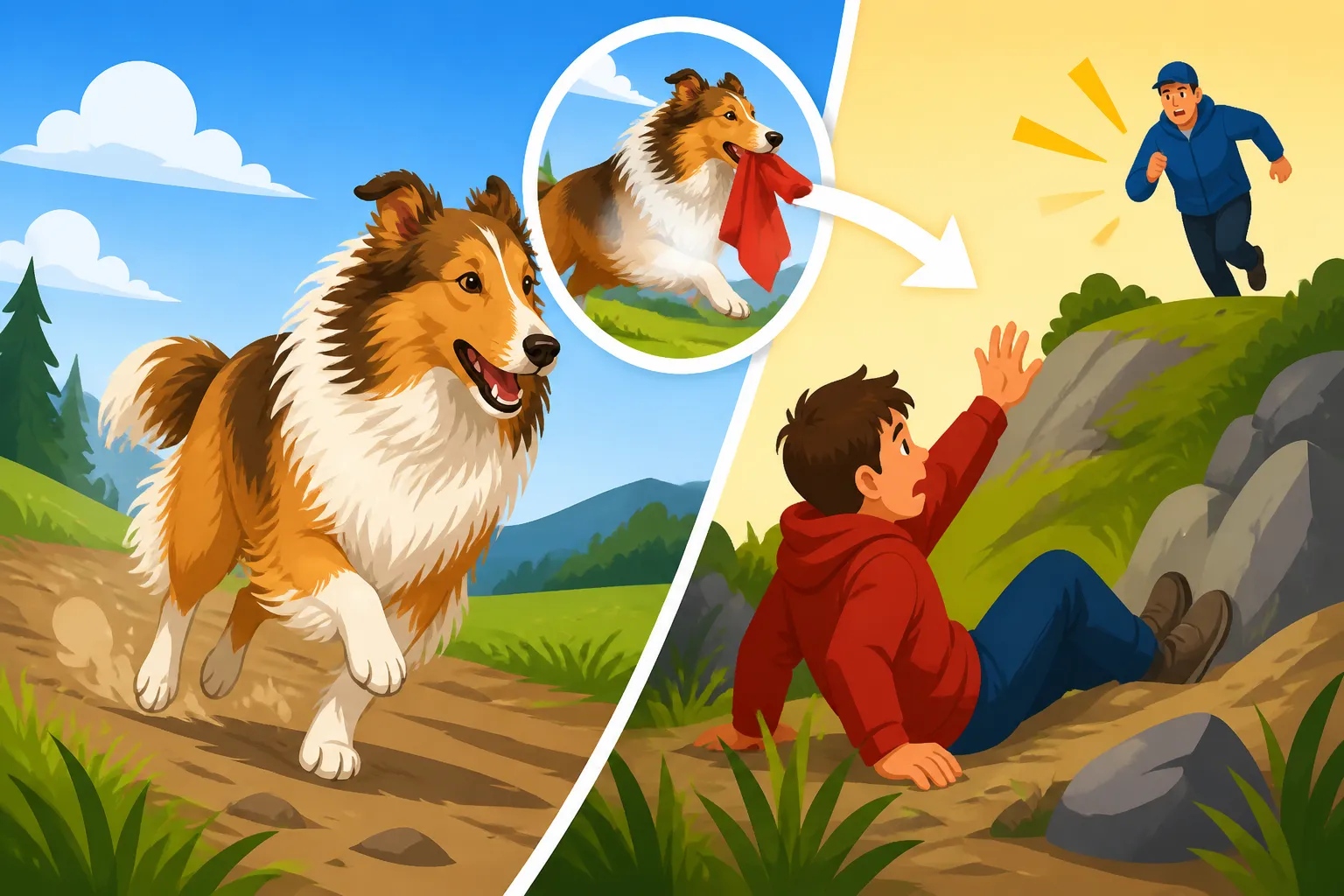
This is one reason stories about Lassie can create unrealistic expectations. A real dog may learn a reliable sequence of actions, but it will not automatically understand that a fall requires finding a neighbor, or that a particular person needs medical attention. The helpful behavior has to be taught, practiced, and made clear.
Possible responses vary from barking to retrieving an item
“Fetch help” can mean several different things. A dog might bring a phone, bark at a familiar family member, run to a nearby caregiver, or press a trained button. These are separate skills, and each has different limits. A Collie that can bring a toy on cue has not necessarily learned to distinguish a phone from other objects or to find the right person when you are unresponsive.
Even reaching another person may not solve the problem. The dog could be behind a closed door, the person might be away, or the dog might run outside and become distracted. A neighbor who hears barking may not know whether it signals an emergency or ordinary alerting. The more steps a task involves, the more chances there are for something to go wrong.
For that reason, think of a trained response as an added layer of support, not an emergency service. If your Collie can retrieve a phone, that may help you call someone when you are able to speak. It does not ensure the phone is unlocked, that the call connects, or that the dog can explain what has happened.
What Training Can Teach a Collie to Do
Choose one clear, practical task
Start by deciding what would genuinely help in your home. “Get help” is too vague as a training cue. A more teachable task might be bringing a specific soft phone pouch, barking at a named household member, or touching a clearly marked button. Choose a behavior your dog can perform safely and that a person can recognize as meaningful.
Consider the physical layout before you begin. If the dog must pass through a baby gate, open a heavy door, or cross a busy street, the task may not be dependable or safe. A plan that works in the living room may fail when the bedroom door is closed. Keep the first version simple, and avoid asking your dog to handle sharp, fragile, or medically important objects.
A Collie that enjoys learning may benefit from short, calm practice sessions with a reward for each step. Keep rewards handy in a pouch, whether you get training treats from a local pet shop or Chewy. The point is not the brand or the treat itself; it is to make the desired behavior easy to reward consistently.
Build the behavior in small steps
If you want your dog to bring a phone pouch, teach the pieces separately. First, reward the dog for approaching and touching the pouch. Then reward picking it up, holding it briefly, and carrying it a short distance. Only after those steps are comfortable should you add the cue and practice having the dog deliver the pouch to your hand or a defined spot.
For a “go find” behavior, begin with a familiar person who is nearby and easy to locate. Reward the dog for reaching that person, then gradually practice in different rooms and with small changes in distance. Ask the person to respond consistently, so your dog gets a clear payoff for finding them. If the dog becomes frightened, confused, or overexcited, make the exercise easier rather than repeating the cue more forcefully.
Positive reinforcement is especially useful for a sensitive dog. Clear cues, steady routines, and patient repetition help the dog understand the game; scolding or startling a dog during practice can make the task less reliable. For more on adapting your approach to the breed’s temperament, see A Collie Reads a Room Better Than It Reads a Command and What Motivates a Collie.
A dog may learn a task in one setting and struggle to perform it elsewhere. Practice in the places where you expect it to work, with different household members, and with ordinary distractions introduced gradually. Do not stage frightening emergencies to “test” your Collie. Rehearse calmly, reward the behavior, and make the real-life plan depend on people and devices as well.
What a Collie Cannot Be Expected to Do
A dog cannot reliably explain an emergency
A Collie can make noise or carry an object, but it cannot give a dispatcher your address, describe your symptoms, or answer follow-up questions. A person who hears barking may not know whether you have fallen, whether the dog wants to go outside, or whether someone is at the door. Even a well-trained dog cannot replace a human who can communicate what is happening.
A phone-retrieval task also has practical complications. The phone may be on a table the dog cannot reach, in another room, or out of battery. If the dog mouths or drops it, the device could be damaged. A phone should not be left where a dog may chew it simply because retrieval is part of a training plan. A purpose-made, lightweight pouch may be easier to teach, but it still needs testing and a backup plan.
Some assistance dogs are trained to perform specific tasks for a handler, but that does not mean every Collie is suited to every task, or that a household pet can be made into a dependable substitute for emergency response. If you need a dog to support a medical condition, talk with your healthcare professional and a qualified assistance-dog organization about appropriate options. Training needs and legal recognition depend on the task and location.
Alert barking can be useful, but it has limits
A dog that barks when someone needs attention may help alert a person who is close enough to hear. But barking is not automatically an emergency signal. Collies may bark at visitors, passing cars, outdoor sounds, or moments of excitement, so people can become accustomed to the noise. Teaching a distinct cue or response may help, but it still cannot guarantee that someone will be present or understand the signal.
It is also worth separating emergency alerting from ordinary barking. A dog that is rewarded for barking at every sound may become noisier, not more precise. If barking is already difficult to manage, practice a specific task independently and work on the everyday triggers too. Why a Collie Barks and Whether a Collie's Barking Can Be Reduced cover those issues in more detail.
A simple comparison can help you decide what to train and what backup to arrange:
| Possible task | What it may help with | Important limitation |
|---|---|---|
| Bark at a familiar person | Draw attention when someone is nearby | The person may be away or may not recognize the bark as an emergency |
| Find a household member | Bring someone to the room or location | The dog needs a clear cue, practice, and a reachable person |
| Retrieve a phone pouch | Put a communication device within reach | The phone may not work, be accessible, or be usable without help |
| Touch an alert button | Trigger a prearranged alert if the system is set up for it | The device and connection need to be maintained and tested |
| Stay beside the person | Provide company and avoid leaving them alone | Staying nearby does not summon help by itself |
How to Build a Safer Emergency Plan
Make people and devices the primary plan
If you live alone or have a health condition that could leave you unable to call for help, plan around dependable human and technical support first. Depending on your situation, that might include keeping a phone within reach, arranging check-ins with someone you trust, or using an alert system recommended by a qualified professional. A Collie’s trained task can complement those measures, but should not be the only way anyone learns there is a problem.
Think through ordinary details: Can you reach your phone from the bed, bathroom, and usual chair? Is the alert button accessible without standing? Does a trusted person know what to do if you do not answer? If you use a device or service, follow its instructions and test it as directed. These preparations may feel less dramatic than teaching a dog a heroic sequence, but they are much more practical.
Keep the dog’s needs in the plan too. If a neighbor or caregiver might come in during an emergency, make sure the Collie is comfortable with that person and has a safe place to settle. A startled dog at the doorway can complicate an already stressful visit. Consider basic cues such as going to a mat, waiting behind a gate, or greeting a familiar helper calmly. How a Collie Greets a Stranger
Practice and review the plan without relying on luck
Once your Collie learns a task, practice it periodically in a calm setting. Keep the cue consistent, reward the correct response, and notice whether the behavior is still easy for the dog. Changes in health, hearing, vision, mobility, or household routines can affect performance. If a task becomes frustrating or physically difficult, adjust it rather than insisting that the dog continue.
You can also make the plan easier for other people to understand. Tell household members what the dog has been taught to do and what the cue means. If a neighbor is part of the plan, explain when you would want them to check on you and how to contact you. A Collie’s bark or behavior should be treated as a useful signal, not as proof that the dog has handled the emergency.
The most realistic expectation is modest but valuable: a Collie may learn to perform a specific, rehearsed action that helps a person notice a problem or reach an item. Some dogs will enjoy that work; others may not be suited to it. Build the task around your dog’s temperament, keep the steps simple, and make sure the human backup plan still works if the dog is asleep, elsewhere, or unsure what to do. For broader context on the breed’s routines and needs, see The Household a Collie Was Built For and Whether a Collie Needs a Predictable Routine.
Disclaimer
This article is for general informational purposes only and does not constitute professional advice. Laws, prices and regulations vary by location and change over time. Consult a qualified professional for guidance on your specific situation.