Whether Collie Comes From a Scots Word for Black
If you have heard that “collie” means “black,” you may wonder whether the breed’s name refers to a dark coat. The usual explanation is more specific: the word may be connected to Scots terms for black-faced sheep, which some early dogs worked. The connection is plausible, but the precise origin is not settled—and it does not mean collies were named for having black fur.
Does collie come from a Scots word for black
The black-faced sheep explanation
The most commonly repeated explanation links collie to colley or a similar Scots form associated with black-faced sheep. These sheep were a familiar part of Scottish farming, and dogs used to manage flocks could naturally become known by the name associated with the animals they worked.
That distinction matters. The proposed link is not simply “collie means a black dog.” It is more like “the dog’s name may have developed from a term associated with black-faced sheep.” A name can travel from livestock to the dogs that tend them, especially in a working landscape where people identify an animal by its everyday role.
It is also easy to imagine how the simplified version took hold. A reader sees a possible connection with black, knows collies can have dark markings, and concludes that the name describes the dog’s coat. But the breed comes in several recognized colors, and the black coat explanation does not fit the word’s likely connection to sheep as well as the livestock theory does. For more on the animal behind the proposed link, see What the Collie Herded in Scotland.
Why the connection is plausible but not certain
The black-faced sheep theory makes sense in context: collies developed as working dogs in Scotland and neighboring areas, where managing sheep was part of daily rural life. A dog named after, or associated with, a kind of sheep would not be unusual. The name could have emerged gradually in speech rather than being coined in a single documented moment.
But a plausible story is not the same as a proven derivation. Historical words are often recorded after people have already used them for generations. By then, spellings may vary, meanings may have shifted, and speakers may not have agreed on a single origin. That leaves room for competing explanations and makes it difficult to point to one document as the definitive answer.
So the careful answer is: collie may be connected to a Scots word associated with black-faced sheep or black coloring, but the exact path from that term to the name of the dog remains uncertain. If you want the broader account of the name’s possible roots, Where the Word Collie Comes From is a useful companion topic.
What the name does and does not tell us about collies
It does not mean every collie was black
The word’s possible association with “black” can create a misleading picture of the breed. Collies are not named for a coat color in the straightforward way a person might assume from the phrase “black dog.” Rough and Smooth Collies share the same breed identity, and their coats can be sable and white, tricolor, blue merle, or white, depending on the dog and the breed’s accepted descriptions.
A tricolor Collie, for example, has black in its coat, but that does not prove the breed name describes its coloring. A sable-and-white dog may have little or no black appearance at a glance, while a blue merle has a distinct mottled pattern. The name belongs to the breed’s history, not to one particular modern color variety.
That is why it helps to separate two questions: “What might the word’s origin be?” and “What colors do Collies come in?” The first is an etymology question with an unsettled answer; the second is about the breed’s appearance. For an overview of its recognized colors, see The Four Colors a Collie Comes In.
It does not identify one exact kind of sheep
Even if the name is connected to black-faced sheep, that does not necessarily tell us that every early Collie worked one specific flock or that the term always referred to the same kind of sheep. Rural names and animal terms can vary by region and period. People may also use the same word differently depending on local speech.
This is a common trap with breed histories. A compact explanation—“the dog was named after black sheep”—sounds satisfying, but it can make a complicated history seem more certain than it is. The safer interpretation is that the sheep connection is a leading explanation, not a complete record of every early use of the word.
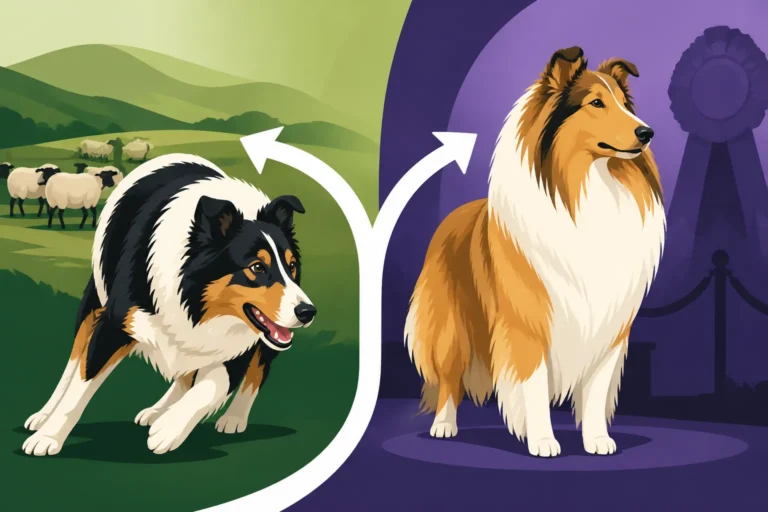
The dog’s working background is clearer than every detail of the name’s origin. Collies were associated with herding and farm work long before the modern show ring shaped public ideas about them. For that larger history, see The Collie Was a Scottish Droving Dog Before It Was a Show Dog.
How spelling and pronunciation complicate the story
Why you may see colley instead of collie
Older spellings are one reason the word’s origin is debated. Historical writing did not always use a single standardized spelling, particularly when recording regional speech. Forms such as colley may appear in discussions of the name, and they can look like evidence for a particular derivation.
They are useful clues, but spelling alone cannot settle the question. A word written as colley might reflect the sound a writer heard, a local spelling convention, or an earlier form that later changed. It does not automatically prove that the word came from a particular Scots term or that its meaning was exactly “black.”
When comparing spellings, look at the context: Was the word being used for a dog, a sheep, or something else? What period does the reference come from? Is it describing the animal or merely using a familiar name? Those details matter more than treating one spelling as a definitive answer. The spelling question is explored further in Whether Collie Was Ever Spelled Colley.
Why “coal” is not a complete explanation
Because coal is associated with blackness, some explanations connect collie directly with a word meaning coal or coal-colored. That may seem like an easy fit, especially if someone is thinking of a dark-coated dog. But a resemblance between words is not enough to establish their shared origin.
Etymologists look for a credible trail: earlier forms, historical uses, sound changes, and meanings that fit the places and communities where the word was used. Without that trail, “it sounds like coal” is an interesting suggestion rather than a conclusion. The sheep explanation may itself involve a word associated with dark coloring, but that is different from proving that the breed name directly comes from the English word coal.
A useful way to keep the possibilities straight is to compare what each explanation actually claims:
| Explanation | What it proposes | What it does not prove |
|---|---|---|
| Black-faced sheep connection | The dog’s name may be linked to a Scots term associated with sheep | That every early Collie worked the same flock |
| Black or coal-colored meaning | The word may relate to a term for dark coloring | That Collies were named because their coats were black |
| Similar-sounding word | The name may resemble another word by chance or through language change | That resemblance alone establishes an origin |
For a closer look at the coal theory, see Whether the Word Collie Means Coal. The point is not that every alternative is equally convincing; it is that a tidy-sounding explanation still needs historical support.
How to talk about the origin without overstating it
Use qualified language
If you are writing about the breed or answering a friend’s question, phrases such as “may come from,” “is often linked to,” and “one common explanation is” are more accurate than stating the origin as settled fact. That wording is not evasive. It reflects the difference between a widely repeated theory and a proven linguistic history.
For example, you could say: “The name Collie is often linked to Scots terms for black-faced sheep, which the dogs may have worked.” That gives the reader the likely explanation and its context without claiming that the word has a single certain origin.
By contrast, saying “Collie means black dog” leaves out the sheep connection and makes the name sound like a direct description of the animal’s coat. It can also lead readers to wonder why many Collies are not mostly black. A little qualification prevents that confusion.
Keep the word’s history separate from the breed’s history
The name’s origin is only one part of the Collie story. Dogs that worked with livestock, dogs bred for particular tasks, and dogs later shown in competitions all belong to a broader history that cannot be reduced to one word. The breed’s Scottish associations are important, but they do not mean every detail of its development happened in one place or at one moment.
That distinction also helps when reading older accounts. A historical source might use collie as a general term for a kind of working dog rather than using it precisely as modern breed organizations do. Meanings can become narrower over time as breed standards and registries define recognized types. For more on the breed’s geographic roots, see Whether the Collie Comes From Scotland or England.
The short answer, then, is that collie may have a Scots connection to black-faced sheep or to a related term for dark coloring. It is not established that the name simply means “black,” and it does not show that the breed was named for a black coat. The sheep explanation is a sensible and widely discussed theory, but the exact origin remains uncertain.
Disclaimer
This article is for general informational purposes only and does not constitute professional advice. Laws, prices and regulations vary by location and change over time. Consult a qualified professional for guidance on your specific situation.