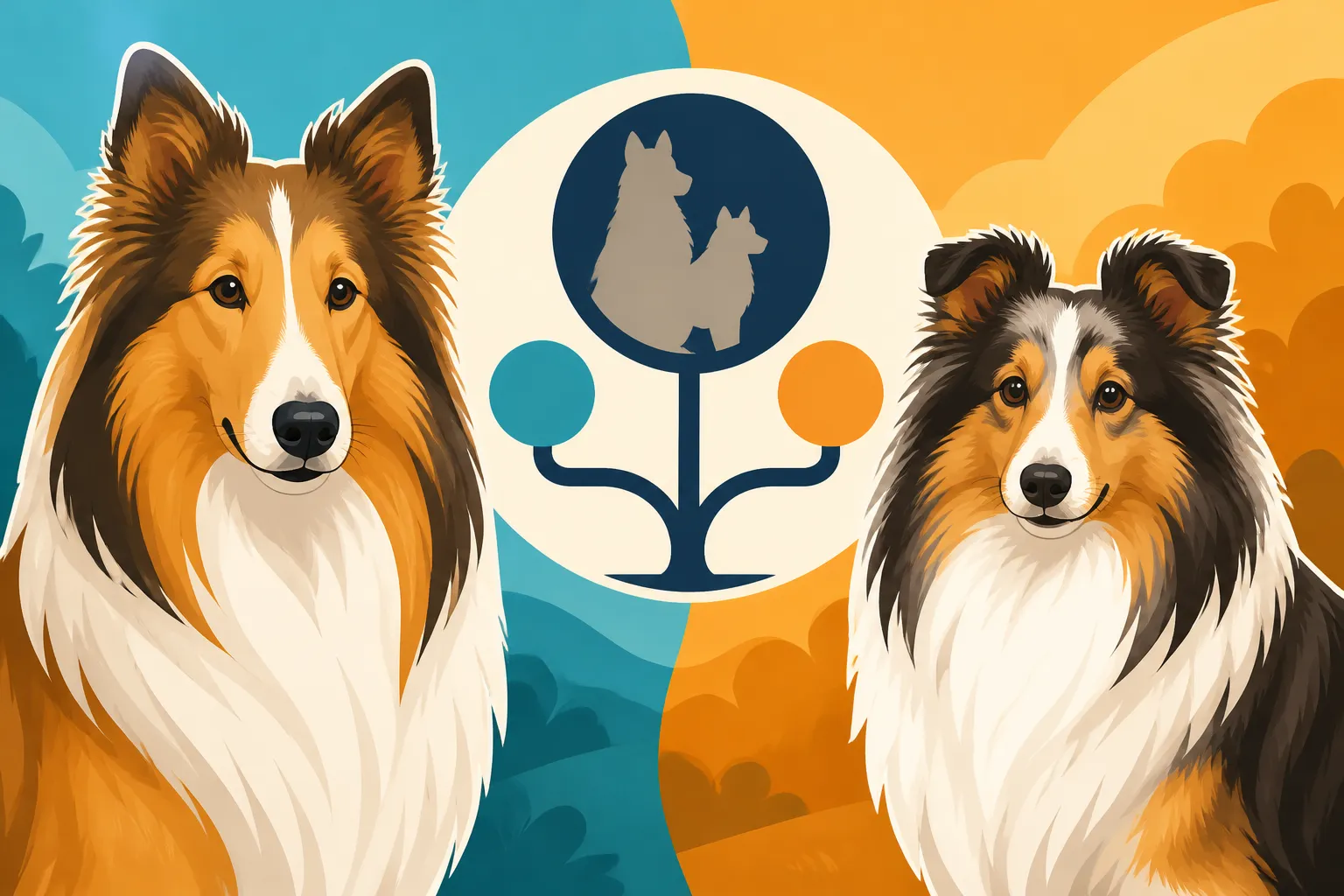
Whether the Collie and the Sheltie Share Ancestors
The Collie and the Shetland Sheepdog, usually called the Sheltie, look related for good reason: both belong to Britain’s herding-dog tradition, and Collie-type dogs likely contributed to the Sheltie’s development. But they are distinct breeds, not simply large and small versions of one dog. This guide separates their shared history from the parts that remain uncertain.
How the Collie and Sheltie Are Historically Connected
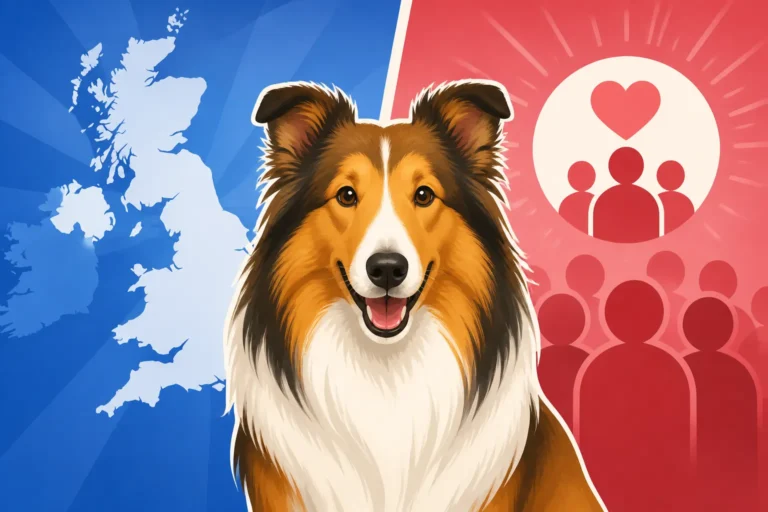
Both breeds come from Britain’s herding-dog tradition
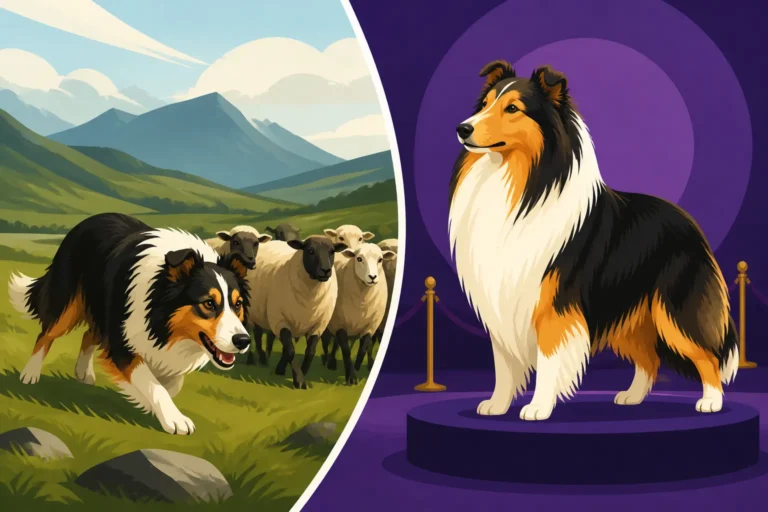
The Collie developed as a working dog in Scotland, where dogs helped manage livestock across varied terrain. The Sheltie took shape in the Shetland Islands, a group of islands off Scotland’s northern coast. There, farmers needed a capable dog suited to island life and its particular scale of livestock and farms.
That shared setting matters, but it does not mean the breeds began as one clearly documented family line. Herding dogs were practical farm animals, not always recorded in carefully maintained pedigrees. Dogs could be selected for their usefulness, bred locally, and moved between farms without the kind of paperwork that would let us trace every ancestor today.
Collies and Shelties therefore have a plausible connection through the broader population of British herding dogs. Collie-type dogs are generally understood to have influenced the Sheltie, but the precise mix of dogs behind the breed’s earliest development is less certain. For the Scottish working-dog background, see The Collie Was a Scottish Droving Dog Before It Was a Show Dog.
The Sheltie developed for a different island environment
Shetland farms and communities were not identical to the larger farming areas where Collies worked. A compact, quick dog could be useful around smaller holdings and livestock. Over time, local preferences and conditions helped shape the Sheltie as a distinct type, rather than as a Collie deliberately bred down to a smaller size.
The Collie, meanwhile, had its own working history and later underwent its own development as a recognized breed. As dogs became more commonly shown and registered, breeders began to describe and preserve particular appearances and traits. That process made breed boundaries clearer, even though the dogs’ earlier histories were less neatly separated.
So the most careful answer is that the breeds likely share some broader herding ancestry, and Collie-type dogs are thought to have played a role in Sheltie development. It would be too confident to claim that every Sheltie descends from a specific, well-documented Collie line or that the Sheltie is simply a miniature Collie. For more on the Collie’s own earlier work, see Whether a Modern Collie Could Still Work Sheep.
Why the Sheltie Is Not Just a Small Collie
Similar appearance can reflect related work as well as ancestry
The two breeds can look strikingly alike at a glance. Both may have a long coat, a narrow muzzle, a ruff around the neck, and familiar herding-dog expressions. Both also come in some overlapping colors and patterns. When a Sheltie stands beside a Rough Collie, it is easy to assume that one is simply a scaled-down version of the other.
Appearance alone, though, cannot tell the whole story. Dogs bred for similar tasks may develop comparable features and behaviors, even when their histories are not identical. A watchful expression, an alert response to movement, or a coat suited to outdoor life can reflect both inherited tendencies and the practical demands people placed on working dogs.
Size is one of the easiest differences to notice, but it is not the only one. The breeds have separate standards, histories, and breeding populations. Their similarities may reflect some shared ancestry, the same general type of work, and later selection for an appealing herding-dog look. For a closer look at their physical resemblance, see The Collie Against the Shetland Sheepdog.
Separate breed histories shaped separate dogs
As the Sheltie gained recognition, breeders worked to establish and preserve it as its own breed. Collies also developed as a distinct breed, with their own standards and breeding traditions. Once people maintained separate pedigrees and bred dogs toward different goals, the breeds continued along their own paths.
That distinction is important for everyday owners. A Sheltie should not be assumed to have exactly the same adult size, exercise needs, coat care, or temperament as a Collie. Nor should a Collie be expected to behave like a larger Sheltie. Individual dogs vary, of course, but breed identity is more than a shared silhouette.
It is also why the phrase “miniature Collie” can mislead. It may describe what a Sheltie resembles to someone unfamiliar with the breeds, but it does not accurately explain the Sheltie’s status as a separate breed. The distinction is explored further in Whether the Sheltie Is a Miniature Collie and Rough and Smooth Are Two Varieties of One Collie.
| Feature | Collie | Shetland Sheepdog |
|---|---|---|
| Breed identity | A distinct herding breed with Scottish roots | A distinct herding breed developed in the Shetland Islands |
| Historical connection | Part of Britain’s wider herding-dog history | Thought to have been influenced by Collie-type dogs |
| Typical impression | A larger, long-legged herding dog | A smaller, compact herding dog |
| Relationship | Not simply the Sheltie’s larger modern form | Not simply a miniature Collie |
| Best way to describe the connection | Likely related through broader herding ancestry | Likely shares some historical roots, but developed separately |
What We Know and What Remains Unclear
Early farm-dog records leave gaps
The early history of working dogs is often difficult to reconstruct. Farmers usually chose dogs for practical qualities: whether they could work stock, fit the demands of a farm, and live successfully in their surroundings. Those choices did not necessarily create a detailed written record of parentage.
That means breed histories can include reasonable conclusions without offering a complete family tree. The Sheltie’s island origins and its connection to the broader British herding-dog tradition are useful context, but they do not establish an exact recipe of breeds or named ancestors. Stories about particular crosses may circulate, yet a specific account should not be treated as settled fact unless it is supported by strong historical records.
This uncertainty is not unusual. Many familiar breeds emerged from local working populations before formal clubs, registries, and written standards organized them into the categories people recognize today. The Collie’s broader development is discussed in Where the Collie's Ancestors Came From, while Whether the Collie and the Sheltie Share Ancestors focuses on the question of how much their histories overlap.
Similar traits do not prove a precise family link
Collies and Shelties may both be bright, responsive, and tuned in to movement around them. They can also be vocal or inclined to notice changes in their surroundings. Those traits make sense for dogs shaped by herding and farm life, but they do not tell us exactly which individuals or breeds contributed to either population.
A dog’s behavior also reflects training, socialization, health, and its own personality. If a Sheltie circles children or a Collie barks at activity outside the window, that does not prove a particular ancestral connection. It may instead reflect general herding-dog instincts, learned habits, or a dog’s response to its environment.
For owners comparing the breeds, practical information about daily life is often more useful than trying to infer ancestry from one shared behavior. You can explore Whether a Collie Is Calmer Than a Border Collie for comparison with another herding breed, or Whether a Collie Suits a First Time Owner when considering what Collie ownership involves.
What Their Shared Background Means for Owners
Expect overlap, but judge each dog as an individual
A Collie and a Sheltie may both enjoy learning, watching their household, and taking part in activities with their people. They may also need patient training and thoughtful outlets for their energy. But broad breed tendencies are only a starting point. A calm individual Sheltie may be less demanding than a particular Collie, and a Collie may be more reserved or more energetic than someone expects.
When choosing between them, think about the dog in front of you and the life you can offer. Consider size, grooming, noise sensitivity, exercise, and the kind of training you enjoy. Ask a responsible breeder or rescue organization about the individual dog’s temperament, health background, and needs, rather than relying only on a historical label.
The two breeds also have different coat-care demands in practice. A Rough Collie’s coat may take substantial brushing, while a Sheltie’s coat still needs routine attention despite the dog’s smaller size. For Collie-specific coat guidance, see Four Tools and Twenty Minutes: Brushing a Rough Collie.
Understand the difference when comparing health and care
Shared ancestry does not mean identical health risks. Collies and Shelties have their own breed health considerations, and a concern associated with one breed should not automatically be assumed to apply to the other in the same way. Ask about health testing relevant to the breed you are considering, and request clear records rather than relying on general claims about “Collie-type” dogs.
The same careful approach applies if a dog is a mix or has an uncertain background. Appearance may suggest a connection, but it cannot confirm a dog’s ancestry or genetic status. If you adopt a dog that resembles a Collie or Sheltie, share its known history and any health questions with a veterinarian. Breed-related information can help guide a conversation, but it does not replace an assessment of the individual dog.
In short, the Collie and Sheltie likely share roots in Britain’s herding-dog populations, with Collie-type dogs believed to have influenced the Sheltie. Their histories overlap, but the breeds became distinct through separate development and breeding. They are related in the broad historical sense—not interchangeable dogs, and not simply two sizes of the same breed.
Disclaimer
This article is for general informational purposes only and does not constitute professional advice. Laws, prices and regulations vary by location and change over time. Consult a qualified professional for guidance on your specific situation.