Whether a Collie Herds Differently Than a Border Collie
If you have ever stood at a dog park and watched a Border Collie drop low into a predatory crouch, laser-focused on a tennis ball, and then looked over at your Rough or Smooth Collie standing tall and bark-cheering from the sidelines, you have witnessed a fundamental breed split. Many owners bring home a Collie expecting the hyper-focused, crouching drive made famous by trial Border Collies, only to be baffled by their own dog’s upright stance and vocal chatter. This guide clarifies exactly how a Collie herds differently than a Border Collie, why their genetic wiring causes these unique behaviors, and how to manage these instincts in your day-to-day life.
The Evolutionary Roots of Herding Styles
To understand why these two Scottish breeds act so differently around livestock, small animals, and running children, you have to look at the jobs they were designed to do. While both belong to the herding group, their historical working environments shaped their physical movement, mental approach, and body language in entirely distinct ways.
Distance vs. Contact: Upright vs. Eye
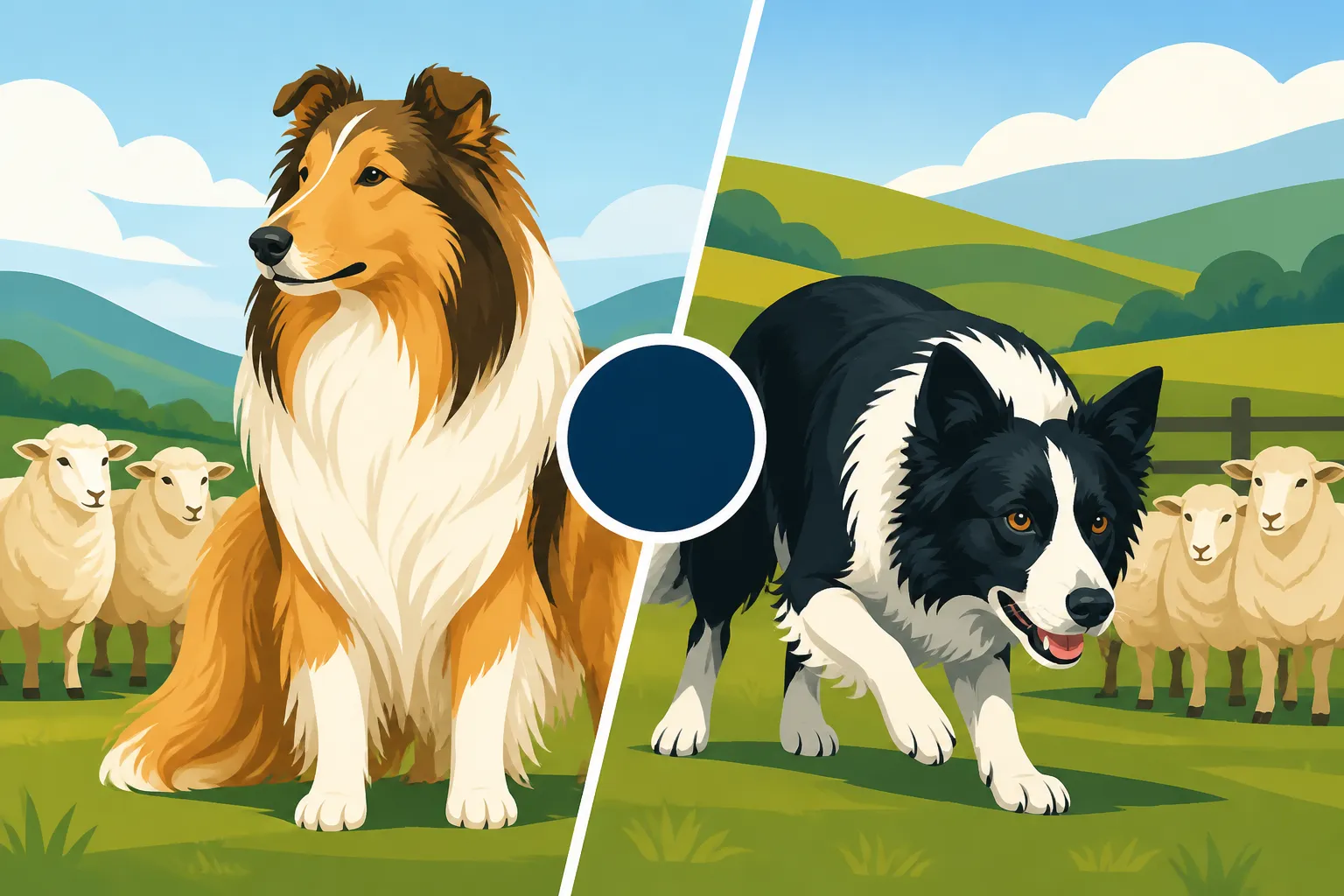
The most significant distinction between a Collie and a Border Collie lies in how they interact with stock space. A Border Collie is an “eye” dog. They use a fierce, silent glare—known as strong eye—combined with a dropped shoulder and low belly crouch to exert psychological pressure on livestock. This crouch mimics an stalking predator, forcing sheep to move away from the intense pressure.
In contrast, the Rough and Smooth Collie are “upright” or “loose-eyed” herders. They do not drop their shoulders, nor do they lock stock in an intense, crouching glare. Instead, a Collie stays standing tall on high legs, moving fluidly around the perimeter of a group. Rather than using predatory intimidation, a Collie relies on movement, broad spatial presence, and visual authority. When evaluating Whether a Collie Still Has Working Instinct, you will notice they prefer to stay further back from the herd, using sweeping arcs rather than sharp, penetrating rushes.
Droving vs. Gathering: The Historical Job
The reason for these distinct postures comes down to geography and farm duties. Border Collies were refined in the border country between Scotland and England to gather unruly sheep off rugged, vast hillsides. They needed to slink under low terrain, lock onto individual sheep, and bring them back to the shepherd with pinpoint precision.
The standard Collie, on the other hand, was primarily a droving and general farm dog across the Scottish Highlands. Their job was to keep large groups of livestock moving along roads, clear pathways through crowded markets, and protect the flock from straying into farmers’ crops. Droving requires a dog to stay on their feet for hours, bark to keep cattle or sheep moving forward, and circle widely to keep the group cohesive. When working through basic home manners or online training programs like BAXTER & Bella, recognizing this droving heritage helps explain why your dog is so keen on sweeping around the edges of family gatherings.
Tactical Differences in Motion, Sound, and Stance
When you observe both breeds in action—whether on a farm, in an agility ring, or in a suburban backyard—their tactical methods couldn’t be more different. Here is how those differences break down physically and acoustically.
Upright Movement and Visual Presence
A Border Collie’s movement is marked by explosive starts, abrupt stops, and low angles. They slide across the grass like a shadow, constantly adjusting their distance by inches to balance the stock. This gives them an almost hypnotic, calculating appearance.
A Collie moves with an effortless, floating gait. Because they do not crouch, they maintain a high perspective over the entire flock or family group. They rely on “flank work”—making broad circles around the perimeter—to gather spatial control. If stock turns to challenge a Collie, the dog rarely freezes or stares down the animal. Instead, they bounce back, reset their distance, and use their body volume and coat presence to command respect. If you wonder Why a Collie Circles Rather Than Chases, it comes down to this innate drive to enclose space from an upright stance rather than breaking down individual targets.
Vocalizations and Communication
If you put a Border Collie on a flock of sheep, silence is key. A Border Collie that barks excessively on stock is often penalized in field trials because barking can panic sheep and cause them to scatter off cliffs or into fences.
Collies, however, are naturally vocal workers. In the foggy Scottish Highlands, a shepherd could not always see the dog, and cattle could not always see the dog through dense brush. The Collie’s bark served as a beacon and a tool of encouragement. A Collie uses a rhythm of authoritative barks to keep livestock moving along droving trails. In a domestic setting, understanding Why a Collie Barks becomes much easier when you realize that to a Collie, vocalizing is not necessarily aggression or distress—it is simply a primary work tool.
| Herding Trait | Border Collie | Collie (Rough & Smooth) |
|---|---|---|
| Primary Stance | Low crouch, dropped shoulders, stalking posture | Upright, standing tall, mobile posture |
| Eye Pressure | High (“strong eye”), silent intense glare | Low to moderate (“loose eye”), relies on body placement |
| Use of Voice | Silent operator; barking is rare on stock | Vocal operator; uses bark to encourage movement |
| Working Distance | Tight, precise adjustments, operates close or far | Prefers wider distance, broad perimeter sweep |
| Primary Instinct | Gathering stock and fetching to handler | Droving, perimeter patrolling, group containment |
| Stock Interaction | Direct intimidation via head-on focus | Spatial management, broad pressure, bouncing back |
How These Herding Differences Show Up in Everyday Life
Most Collies today spend their lives as beloved family companions rather than working farm dogs. However, genetics do not disappear just because a dog lives on a couch. The unique herding style of a Collie manifests daily in suburban neighborhoods and living rooms.
The Living Room Herd: Children and Pets
A Border Collie in a home with children will often fixate. They may lie under the kitchen table, staring intently at a toddler’s feet, ready to spring forward and clap their jaws at the heels of anyone who breaks into a sprint.
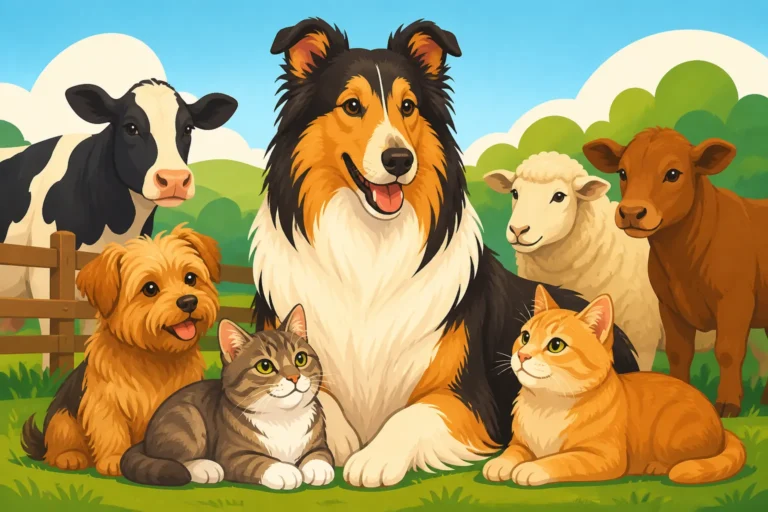
A Collie handles household excitement quite differently. When children start running around in the yard, a Collie usually jumps up, starts barking in excitement, and begins running wide, sweeping laps around the outside of the group. Rather than dropping low to grab heels, a Collie uses their shoulder space and broad turns to turn the kids back toward the center of the yard. When evaluating Whether a Collie Herds Children, you will notice they act more like a friendly visual barrier.
However, because they are vocal and physically expressive, an excited Collie might still put their mouth on clothing or bump into a small child. When researching Whether a Collie Herds Running Children or asking Whether a Collie Nips a Child Who Runs, owners should know that while a Collie rarely exhibits the hard, grabbing bite of a high-drive working Border Collie, their broad head and sudden spatial blocking can startle young kids.
To manage this, simple management tools from Amazon—such as extra-long check cords, baby gates, or durable puzzle toys—can help keep their minds engaged while keeping human play sessions calm and controlled.
Redirecting and Managing the Herding Instinct
Because a Collie’s drive is rooted in spatial containment and sound, managing their urges requires a different strategy than managing a Border Collie. A Border Collie needs direct focus work to break a deep stare. A Collie needs clear boundaries on when their “patrolling” behavior is acceptable.
If your Collie starts pacing the fence line, barking at neighbors, or circling the dining room table during dinner, you are seeing off-duty droving behavior. The dog is trying to organize their environment. When considering Whether a Collie’s Herding Instinct Can Be Redirected, the best approach is to give them a task that satisfies their desire for spatial movement without the noise.
Teaching a strong “place” command, engaging in structured trick training, or enrolling in digital instruction through BAXTER & Bella can help channel that mental energy. If you are asking Whether a Collie Can Be Taught to Stop Herding, the realistic answer is that you cannot erase centuries of genetic wiring, but you can easily teach a Collie when to step down from duty.
Choosing the Right Training Approach for a Collie’s Mindset
Understanding the tactical differences between these two breeds prevents training mistakes that can damage your relationship with your dog.
Sensitivity and Handling Differences
Border Collies are notoriously intense. They often tolerate—and sometimes require—very crisp, high-pressure direction from a trainer because their internal drive is so overwhelming. They push through friction to get to their target.
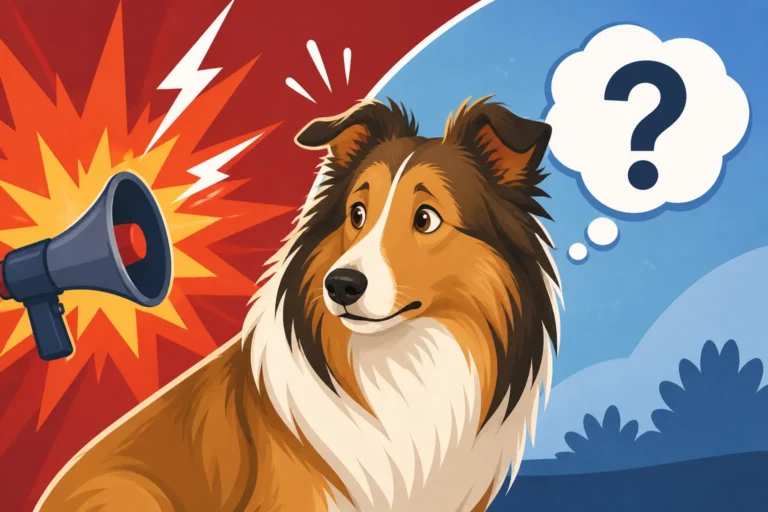
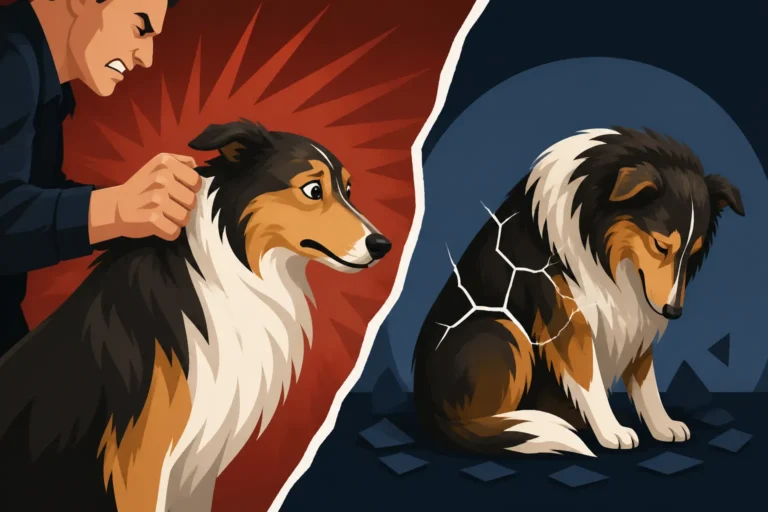
Collies are notoriously sensitive. They read human emotion with shocking precision and possess a low tolerance for harshness. A tone of voice that a Border Collie ignores might cause a Rough Collie to shut down entirely, drop their ears, and walk away. When examining How a Collie Responds to a Raised Voice, it becomes clear that yelling or heavy physical corrections backfire instantly.
As seasoned trainers often point out, Harsh Handling Breaks a Collie and It Does Not Come Back. If a Collie feels bullied during training, they simply refuse to participate. They require clear, positive, and reward-based instruction that respects their gentle demeanor.
Practical Steps for Everyday Impulse Control
To keep your Collie happy, confident, and quiet, incorporate these daily steps into your routine:
- Reward Stillness Early: Because Collies love to move wide and bark when excited, mark and reward moments where your dog chooses to lie down calmly while action is happening around them.
- Use Distance to Your Advantage: If your Collie gets overly vocal around other dogs or bikes, do not force them into tight spaces. Step back 20 feet. Because they are wide-distance herders, giving them physical space naturally lowers their stress levels.
- Channel the Chase Safely: Use a flirt pole or giant herding ball in the backyard. This allows your Collie to run broad arcs, use their body positioning, and exhaust their natural instincts in a controlled environment.
- Clarify Vocal Boundaries: Instead of shouting “No!” when your Collie barks (which the dog often interprets as you barking along with them), give a clear alternative action, such as fetching a specific toy or going to a dog bed.
Ultimately, a Collie is not just a “fluffy Border Collie.” They are an entirely distinct breed with an upright, vocal, and spatially aware approach to managing movement. By understanding their unique droving heritage and honoring their sensitive nature, you can build a quiet, cooperative partnership that brings out the very best in this iconic breed.
Disclaimer
This article is for general informational purposes only and does not constitute professional advice. Laws, prices and regulations vary by location and change over time. Consult a qualified professional for guidance on your specific situation.