Whether a Collie Herds Cyclists
It’s a scene many Collie owners are all too familiar with: you’re out for a peaceful walk, enjoying the crisp air with your beautiful, intelligent companion, when suddenly a bicycle whizzes by. Before you can even register it, your Collie springs into action, lunging, barking, perhaps even attempting to cut off the cyclist’s path. This sudden, intense reaction can be startling, embarrassing, and even dangerous, leaving you wondering if your sweet, gentle dog has suddenly gone rogue. This guide will delve into why Collies often exhibit this intense interest in cyclists, explore what these behaviors actually mean, and equip you with practical, compassionate strategies to manage and redirect these strong herding instincts.
The Deep Roots of the Herding Instinct in Collies
To truly understand why your Collie seems to have a personal vendetta against every passing cyclist, we need to take a step back and appreciate the incredible history of this breed. Collies aren't just pretty faces; they were bred for centuries to work alongside shepherds, moving and controlling flocks of sheep. This isn't a casual hobby for them; it's deeply ingrained in their very being, a fundamental part of their genetic makeup.
A Legacy of Movement and Control
Imagine the Scottish hills where the Collie first gained prominence. Sheep were often scattered, prone to wandering, and needed constant guidance to graze safely and be brought to market. The Collie's job was to gather, drive, and protect these animals. This required a keen eye, immense stamina, and an innate understanding of how to influence movement. They weren't just running around; they were strategists, using their presence, their body language, and sometimes a low bark or a gentle nip to keep the flock together. This demanding role shaped their instincts, making them acutely aware of anything that moves quickly or independently.
When you see your Collie fixating on a cyclist, it's not necessarily aggression; it’s more likely their ancient programming kicking in. That fast-moving bike, with its two wheels and sometimes erratic path, can trigger the same response that a stray lamb might have centuries ago. It’s an object that needs to be "controlled" or "brought back to the flock" in their minds, even if the "flock" is now your suburban street and the "stray" is a person enjoying an afternoon ride. You can read more about the origins of the breed in The Collie Was a Scottish Droving Dog Before It Was a Show Dog.
The Collie's Unique Herding Style
Unlike some other herding breeds that might use a strong, intimidating "eye" or a forceful body slam, Collies typically employ a more subtle, yet effective, herding style. They are known for their "loose eye," meaning they might not stare down livestock as intensely as a Border Collie, but they are constantly observing, calculating, and anticipating movement. They also use their body to circle and funnel, rather than directly confront.
When this instinct manifests with a cyclist, you might observe your Collie doing a soft circle around the bike, attempting to get ahead of it, or using their body to create a barrier. Sometimes, they might even try a soft nip at a tire or a pant leg – an echo of the gentle heel nips used to encourage stubborn sheep. It’s important to remember that this isn’t maliciousness; it’s an attempt to fulfill a deep-seated drive. They're not trying to harm the person; they're trying to control the movement, just as their ancestors did with livestock.
Why Modern Collies Still Feel the Urge
Even if your Collie has never seen a sheep in their life, the genetic blueprint for herding remains strong. Breeding practices for generations have focused on preserving these traits, not just for working lines but also for conformation and companion Collies. While a pet Collie might not need to herd, the instinct is still there, bubbling under the surface. It’s why some Collies will gently "herd" children playing in the yard, or why they might try to gather scattered toys.
Fast-moving objects like bicycles, skateboards, joggers, or even children running trigger this latent instinct. For a Collie, a moving object isn't just something to observe; it's something to interact with, to manage. Without a proper outlet for these instincts, or without guidance on what is and isn't appropriate to herd, they will find their own ways to express this natural drive, often leading to behaviors that are undesirable or even problematic in a modern human environment. Understanding this is the first step towards effectively managing the behavior.
What "Herding" a Cyclist Actually Looks Like
When a Collie's herding instinct meets a cyclist, the resulting behavior can manifest in a few distinct ways, each designed to stop or redirect the moving object. It’s more than just barking; it's a complex sequence of actions rooted in their working history.
The Chase and Nipping Behavior
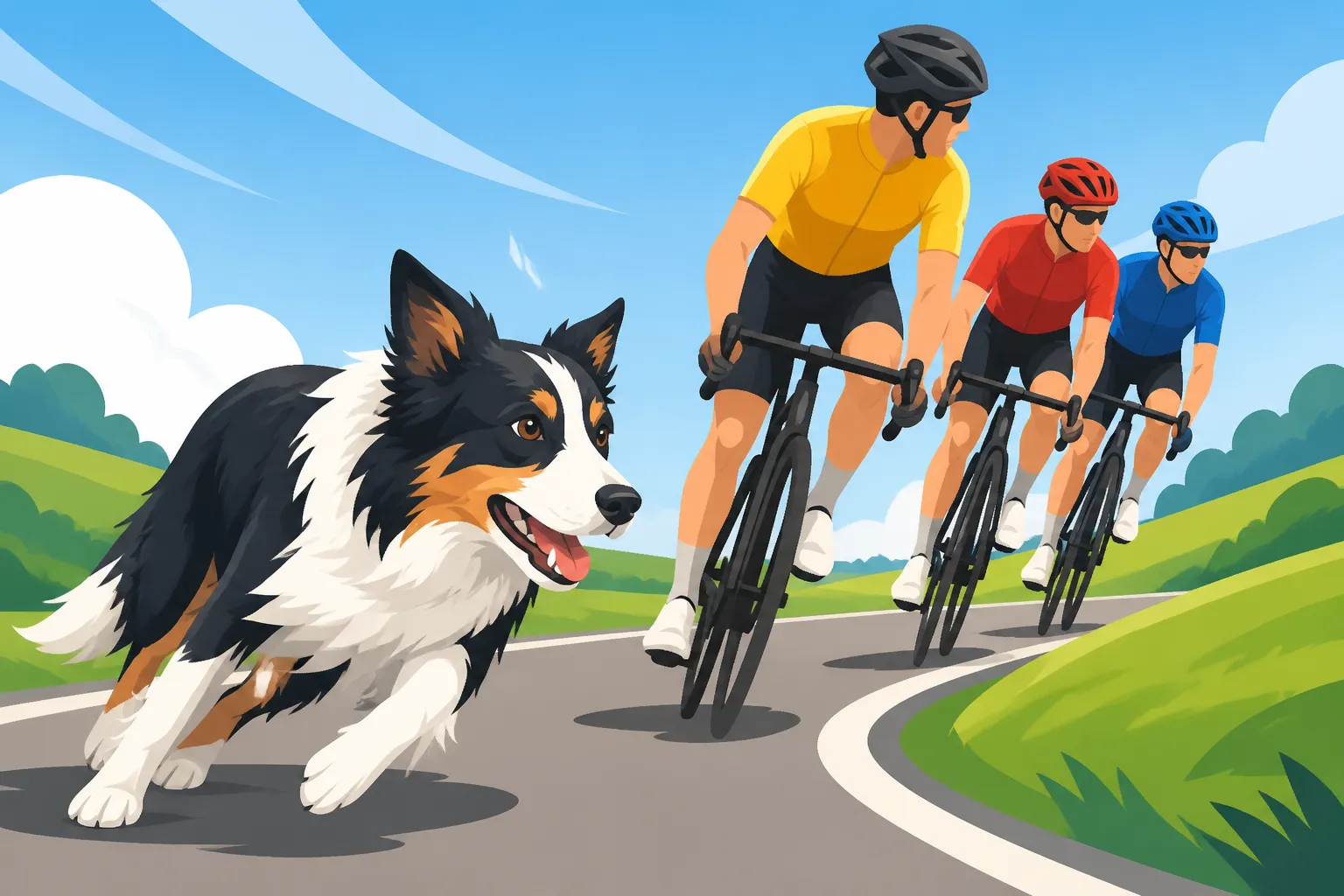
One of the most concerning manifestations is the chase. Your Collie might suddenly lunge forward, straining against the leash, determined to get after the bicycle. If they manage to get close, they might attempt to nip at the wheels, tires, or even the rider's ankles or pant legs. This isn't usually an attempt to inflict injury, but rather a direct application of their ancestral herding technique: the heel nip. A quick, sharp nip was used to get a lagging sheep to move forward. In the context of a cyclist, it's their way of saying, "Stop! Go that way! Pay attention to me!"
This behavior can escalate quickly, especially if the cyclist reacts by speeding up or trying to evade the dog, which can inadvertently reinforce the Collie's chase drive. It becomes a game of "catch me if you can," where the Collie feels a strong compulsion to engage. The speed and unpredictability of cyclists often make them prime targets for this instinct. Whether a Collie Nips a Child Who Runs explores similar behaviors in a different context.
Barking and Body Blocking
Beyond the chase and nip, Collies will often use vocalizations and physical presence to manage movement. You might hear an intense, insistent bark, often a sharp "whoof-whoof" that sounds less like an alarm and more like a directive. This is their way of communicating, of trying to gain control over the moving object.
Along with barking, a Collie might employ body blocking. This involves running parallel to the cyclist, then cutting in front to try and change their direction or bring them to a halt. It’s a very effective herding technique for sheep, but imagine this happening on a busy street with a bicycle. It's incredibly dangerous for both the dog and the rider. The Collie’s focus becomes so intense that they often tune out their owner’s commands, making these situations particularly frustrating and difficult to manage in the moment. The drive to control the "flock" (in this case, the cyclist) can override everything else.
The Difference Between Play and Predation
It’s crucial to distinguish between a Collie's herding instinct and a predatory drive. While herding behaviors like chasing and nipping might superficially resemble predatory actions, the motivation is different. A true predator hunts to kill; a herding dog moves and controls without the intent to harm. The Collie's goal is to redirect or stop the cyclist, not to injure them.
However, repeated engagement with fast-moving objects without proper redirection can sometimes blur these lines, or at least make the behavior more intense and harder to interrupt. It also creates a highly aroused state in your dog, which isn't good for their overall well-being or your relationship with them. While a Collie might not be a high-prey drive breed in the same way a sighthound is, the thrill of the chase and the feeling of "control" can be highly self-rewarding. Understanding this distinction helps in choosing the right training approach – one that focuses on redirecting the herding impulse rather than trying to suppress a predatory one.
Practical Strategies to Manage Cyclist-Herding Behavior
Managing a Collie’s instinct to herd cyclists requires consistency, patience, and a multi-faceted approach. It's not about punishing the instinct, but rather about teaching your Collie appropriate ways to channel it and to respond to your guidance instead.
Foundation Training and Impulse Control
Before you even tackle the cyclist issue directly, ensure your Collie has a strong foundation of obedience and impulse control. This means reliable "leave it," "stay," "come," and a solid loose-leash walk. These are the building blocks that allow you to interrupt and redirect unwanted behaviors. Start practicing these commands in low-distraction environments and gradually increase the difficulty.
For example, practice "leave it" with tempting items on the floor, then with people walking by, then with slow-moving objects. The goal is for your Collie to associate not chasing with positive rewards from you. Online training platforms, like those offered by BAXTER & Bella, can provide structured programs for building these essential skills from the ground up, giving you homework and video demonstrations to follow. Remember, Collies are incredibly sensitive; Harsh Handling Breaks a Collie and It Does Not Come Back, so positive reinforcement is key to building their confidence and trust in you.
Leash Skills and Environmental Management
When you're out and about, especially in areas where cyclists are common, leash skills become paramount. A loose-leash walk isn't just about politeness; it's about giving you control and giving your dog confidence that you're handling the environment. A well-fitted harness that discourages pulling (not one that attaches at the back, which can encourage pulling) can be incredibly helpful.
Environmental management means avoiding situations where your Collie is likely to be overstimulated and practice the unwanted behavior. If you know a particular path is popular with cyclists, choose a different route during peak hours while you're still working on training. When you do encounter cyclists, anticipate their approach. If you see one coming, gently move your Collie to the side, create distance, and engage them in a focused activity like a "sit" or "watch me" command, rewarding them heavily for staying calm. Consider investing in a longer lead (10-15 feet) from a retailer like Amazon for controlled outdoor practice in open, safe areas, allowing them a bit more freedom to sniff and explore without enabling the chase. How Much Exercise a Collie Needs Daily can help ensure your dog is physically satisfied before training outings.
Desensitization and Counter-Conditioning
This is where you actively change your Collie's emotional response to cyclists.
- Start from a distance: Find a location where cyclists pass, but at a distance where your Collie notices them but doesn't react. This might mean being across a field or far down the street.
- Observe and Reward: The moment your Collie spots a cyclist and doesn't react, immediately mark that moment with a verbal cue ("yes!") and give them a high-value treat. Repeat this every single time. You're teaching them that cyclists predict good things (treats) from you, not an opportunity to herd.
- Gradually Decrease Distance: Over many, many sessions, slowly decrease the distance to the cyclists. Only move closer if your Collie remains calm and responsive to your cues at the current distance. If they react, you've moved too fast; go back to an easier distance.
- Practice with Different Speeds/Types: Once they're comfortable with stationary or slow-moving bikes, work up to faster ones, or even people pushing bikes. This systematic exposure, paired with positive reinforcement, helps to reprogram their response.
A table summarizing these stages might look like this:
| Stage | Environment/Distance | Collie's Behavior Goal | Your Action/Reward |
|---|---|---|---|
| Stage 1: Awareness | Far distance (Collie notices, no reaction) | Looks at cyclist, then back at you (or ignores) | Mark & high-value treat every time cyclist appears |
| Stage 2: Closer View | Moderate distance (Collie notices, slight interest) | Remains calm, looks at cyclist, redirects attention to you | Mark & high-value treat for calm/redirected focus |
| Stage 3: Proximity | Closer distance (cyclist passes nearby) | Stays calm on leash, no lunging/barking | Continuous treats as cyclist passes, then jackpot |
| Stage 4: Active Practice | Passing cyclists, varying speeds | Engages with you, ignores or calmly observes cyclist | Intermittent high-value treats, praise for good choices |
The key is to never push your Collie past their threshold where they're over-reacting. Each successful, calm encounter builds their confidence and rewires their brain. What Motivates a Collie can give you ideas for the highest-value treats to use!
Tools and Resources to Help
Beyond training techniques, there are practical tools that can aid in managing this behavior. A comfortable, well-fitting harness with a front-clip attachment can help redirect your Collie's momentum if they lunge, making it harder for them to pull you over. Long lines (15-30 feet) from retailers like Amazon, used in safe, open, traffic-free areas, can allow your Collie to experience more freedom and practice recall and "leave it" at a greater distance, under your supervision, without the immediate danger of traffic or cyclists.
Consider enrichment activities at home that provide mental stimulation and an outlet for their herding brain. Puzzle toys, scent work, or even teaching complex tricks can tire a Collie's mind just as much as physical exercise. A tired dog, both mentally and physically, is often a better-behaved dog. For structured guidance, many online dog training programs, such as BAXTER & Bella, offer comprehensive modules that cover impulse control, leash manners, and desensitization, which can be invaluable resources when tackling specific issues like cyclist herding.
When to Call in the Professionals
While consistent effort and positive reinforcement can work wonders, some Collies might have such a deeply ingrained or intense reaction to cyclists that professional intervention becomes necessary. Recognizing when to seek expert help is crucial for both your peace of mind and your Collie's safety.
Recognizing Escalating Behavior
If, despite your best efforts, the behavior is not improving, is becoming more intense, or your Collie is showing signs of genuine aggression (like growling, snapping with intent to bite, or making hard contact), it’s time to call in a professional. Other red flags include if your Collie becomes completely unresponsive to your commands when a cyclist is present, if the behavior is causing significant stress for you, or if there's any risk of injury to your dog or others.
Sometimes, what appears to be a simple herding instinct can be complicated by underlying anxiety, fear, or a lack of confidence. These deeper issues often require a professional eye to diagnose and address effectively. It's not a sign of failure on your part, but rather a responsible decision to ensure your Collie gets the specialized help they need. How to Build Confidence in a Nervous Collie or Whether an Undersocialized Collie Can Be Fixed might offer related insights if you suspect underlying issues.
Finding the Right Trainer for Your Collie
When seeking professional help, it’s vital to find a trainer or behaviorist who understands the unique temperament of Collies and utilizes force-free, positive reinforcement methods. Collies are intelligent and sensitive; harsh corrections or fear-based training can damage their trust in you and exacerbate behavioral issues. Look for someone certified by reputable organizations and who has experience with herding breeds.
A good professional will observe your Collie's behavior, ask detailed questions about their history and daily routine, and develop a personalized training plan. They might suggest specific exercises, help you refine your leash handling skills, or even work with you on desensitization in a controlled setting. They can also help you identify if there are any underlying medical issues contributing to the behavior. Don't hesitate to interview a few trainers to find one whose philosophy aligns with yours and who makes you and your Collie feel comfortable and understood. They are there to guide you and provide the expertise needed to navigate these challenging situations.
Disclaimer
This article is for general informational purposes only and does not constitute professional advice. Laws, prices and regulations vary by location and change over time. Consult a qualified professional for guidance on your specific situation.