Whether a Collie’s DMS Risk Comes From Three Genes
You have a Collie puppy’s DNA report in front of you, and next to dermatomyositis it says something like “moderate risk” along with three separate gene results. It is natural to wonder what that means. Is the disease caused by three genes, does one bad result doom a dog, and can a low-risk pairing still produce an affected puppy? This guide explains how dermatomyositis risk works in Collies and how to use the test sensibly.
What Dermatomyositis Is and Why Collies Get It
Dermatomyositis, usually shortened to DMS or DM in Collie circles, is an inflammatory disease that affects the skin and, in some dogs, the muscles. It is seen most often in Rough and Smooth Collies and Shetland Sheepdogs, and it tends to appear in young dogs, often in the first months of life.
What owners actually see
Signs vary widely. In mild cases, a puppy may develop a few crusty, hairless patches on the face, ear tips, tail tip or over bony points on the legs, often after scrapes or sun exposure. The patches may heal and leave light scarring or slightly thin hair. In more serious cases, lesions are widespread and recurring, and the muscles are involved too, leading to muscle wasting around the head and legs, difficulty chewing or swallowing, and an unusual gait.
The Weeks a Collie Puppy First Shows Dermatomyositis explains the typical timing, and Whether a Collie With Dermatomyositis Loses Muscle goes into the muscular side of the disease.
Why it is called a complex disease
For many inherited conditions in dogs, a single gene change explains almost everything. Collie Eye Anomaly and MDR1 work broadly that way. Dermatomyositis does not. It behaves like a complex disease, meaning several genetic factors combine to set a dog’s level of risk, and other factors, such as the immune system’s response to triggers, influence whether the disease actually appears and how severe it becomes.
That is why the test result you receive is expressed as a risk level rather than a simple clear, carrier or affected label.
Does DMS Risk Really Come From Three Genes
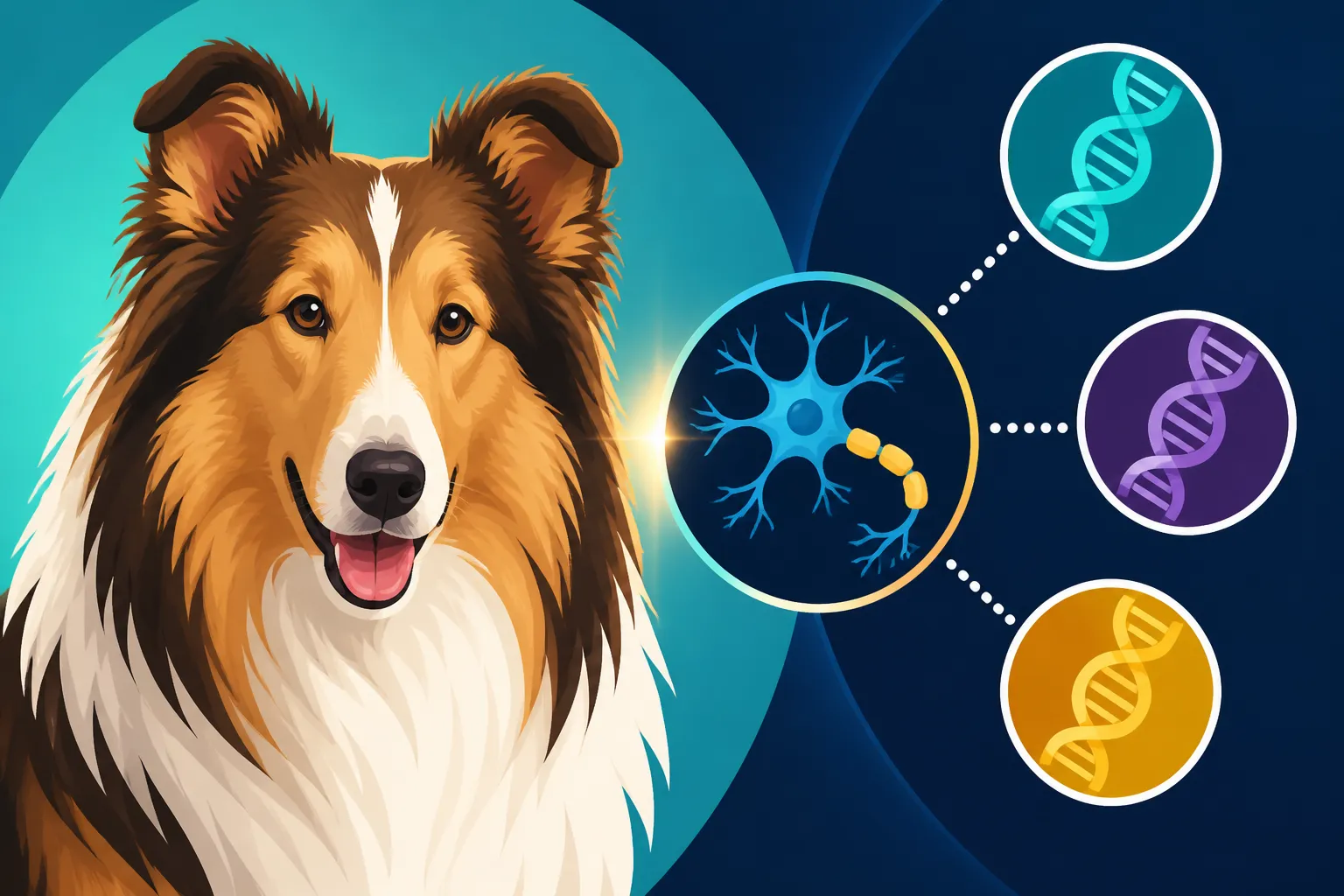
The short answer is yes, in the sense that the current DNA test looks at three genetic regions, and the combination of results at those three regions is used to estimate a dog’s risk. The longer answer is that “three genes” does not mean each gene is a simple switch.
The three regions in the test
Research in Shetland Sheepdogs and Rough Collies identified three regions of the genome that are strongly associated with dermatomyositis. In practical terms, labs commonly report them as:
- A variant in a gene called PAN2.
- A variant in a gene called MAP3K7CL.
- A particular version of an immune system gene in the DLA region, which is the canine equivalent of the immune genes that help the body recognize what is foreign.
Each dog inherits two copies of each region, one from each parent. A dog can therefore carry zero, one or two copies of the risk version at each of the three places.
How the three combine into a risk score
The lab looks at all three results together and assigns the dog to a risk category, usually described as low, moderate or high. The idea is that the risk versions add to one another. A dog with no risk versions, or only a few, falls in the low category. A dog with risk versions at several regions, especially with two copies at some of them, falls in the moderate or high categories.
How Dermatomyositis Risk Is Scored in a Collie goes through the scoring approach in more depth. The table below gives a simplified overview of how owners and breeders tend to interpret the categories.
| Risk category | Genetic picture in general terms | What it means for a pet | What it means for breeding |
|---|---|---|---|
| Low risk | Few or no risk versions across the three regions | Disease unlikely, though not strictly impossible | Useful partner for lowering risk in a litter |
| Moderate risk | Some risk versions, often at more than one region | Real chance of disease, often mild if it appears | Usually bred only to low-risk partners |
| High risk | Many risk versions, often double copies at key regions | Much higher chance of disease, sometimes severe | Generally avoided as a breeding choice |
The categories are probabilities, not predictions. A moderate-risk dog may live its whole life without a single lesion. A high-risk dog is more likely to show signs, but still may not. The test shifts the odds; it does not deliver a diagnosis.
Why environment and triggers matter
Genetics loads the gun, as the old saying goes, and other factors may pull the trigger. Researchers and vets have long suspected that triggers such as sun exposure, physical trauma to the skin, infections and other immune challenges may influence when the disease appears or flares. That is one reason two dogs with identical test results can have completely different lives. Whether Sun Makes a Collie’s Dermatomyositis Worse covers the sun question specifically.
A realistic scenario
Imagine two Collie littermates, Juno and Finn, both tested as moderate risk. Juno lives on a farm, spends long days outside in bright sun, and frequently scrapes her muzzle on fencing. At five months, she develops crusty patches on her ears and face. Finn lives with a family in the suburbs, spends more time indoors, and never shows a single lesion. Their genetics are similar. Their lives, and perhaps their immune challenges, are different.
This does not mean Juno’s owners did anything wrong. It simply shows why a test result is a starting point for good management rather than a final verdict.
Using the Test as a Buyer or Breeder
The real value of the three-region test lies in how it is used. For breeders, it helps plan pairings that lower risk in future litters. For buyers, it helps set expectations and guides early care.
For breeders: pairing to lower risk
Because each parent passes one copy of each region to each puppy, the risk profile of a litter depends on both parents. Pairing two high-risk dogs makes affected puppies much more likely. Pairing a moderate-risk dog with a low-risk dog tends to produce more low and moderate puppies. Whether a Collie’s Dermatomyositis Risk Can Be Bred Down explores this strategy.
There is a real tension here, though. Collies are a breed with a limited gene pool, and excluding every moderate-risk dog could remove otherwise excellent dogs from breeding. Thoughtful breeders balance dermatomyositis risk with other priorities, including temperament, structure, eye results and MDR1 status. Whether Breeding Only Clear Collies Would Shrink the Gene Pool discusses that broader trade-off.
Can two low-risk parents produce an affected puppy
It is uncommon, but not impossible. Low risk is not the same as no risk. Each parent may carry some risk versions that do not raise their own category, and puppies can inherit a combination that places them higher. Even a low-risk puppy can occasionally develop signs, because the test does not explain every case. Whether Two Low Risk Collies Can Produce an Affected Puppy walks through the genetics behind this.
For buyers: what to ask
- Have both parents been tested for dermatomyositis risk, and what categories did they fall into?
- Has the puppy itself been tested, or only the parents?
- Have any puppies from previous litters of this pairing, or related lines, developed the disease?
- What would the breeder do if a puppy developed signs after going home?
- What other tests have the parents had? The Three Genetic Tests a Collie Breeder Owes You is a good checklist for this part of the conversation.
A breeder who explains results clearly and does not dismiss your questions is usually one who takes the condition seriously.
Reading a puppy’s own result
If your puppy has been tested, the result helps you plan.
| Puppy’s result | Practical steps for the owner |
|---|---|
| Low risk | Normal puppy care, stay alert for unusual skin lesions |
| Moderate risk | Watch closely for lesions in the first year, protect from harsh sun and skin trauma where practical, report early signs promptly |
| High risk | Discuss a monitoring plan with your vet early, consider sun protection and gentle handling of skin, plan for possible treatment costs |
Whatever the category, early recognition helps. A puppy with suspicious crusts or hair loss on the face, ears or tail tip should be seen by a vet, and a skin biopsy may be recommended to confirm the diagnosis.
Living With and Planning for DMS Risk
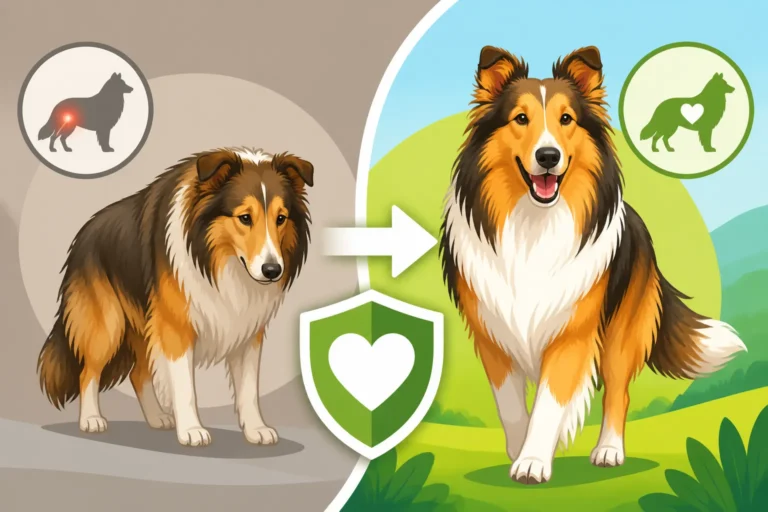
Most Collies with a moderate or even high risk score will lead full, active lives. Good planning helps keep it that way.
When signs appear
If your vet diagnoses dermatomyositis, treatment depends on severity. Mild cases may need little more than skin care, sun protection and monitoring. More significant cases may be treated with medications that reduce inflammation or modulate the immune system, sometimes long term. Whether a Collie’s Dermatomyositis Needs Lifelong Medication gives a sense of what owners can expect.
Steps that commonly help include:
- Limiting strong midday sun, especially on lightly pigmented areas.
- Avoiding rough play or equipment that scrapes the face and legs.
- Keeping lesions clean and watching for secondary infections.
- Following your vet’s medication plan closely and attending rechecks.
- Photographing lesions regularly so you can track changes over time.
What a vet visit for suspected DMS involves
If your Collie develops crusts or hair loss that look like dermatomyositis, your vet will usually start by ruling out more common skin problems. Mange mites, ringworm, bacterial skin infections and allergies can all cause patchy hair loss in young dogs, and some of them are easy to treat. Skin scrapings, a fungal culture and a careful look at the pattern of the lesions are typical first steps.
When the pattern fits dermatomyositis, especially on the face, ear tips, tail tip and bony points of the legs, a skin biopsy is often the next step. Some dogs are also referred to a veterinary dermatologist, and in dogs with muscle signs, additional tests of the muscles may be suggested. Bring the DNA report to the appointment. A known moderate or high risk result does not prove the diagnosis, but it helps the vet weigh the possibilities.
Common misunderstandings about the three-region test
- A high-risk result is not a diagnosis. Many high-risk dogs never develop severe disease.
- A low-risk result is not a guarantee. It makes disease less likely, but the test does not explain every case.
- The three regions are not three separate diseases. They are three pieces of one risk picture.
- Testing only the parents does not tell you exactly what a puppy inherited. Testing the puppy itself gives a clearer answer.
- A risk category does not change over a dog’s life. The DNA stays the same, even though the dog’s signs may come and go.
Thinking about insurance
Because dermatomyositis is inherited and often appears early, insurance timing matters. Many insurers will not cover conditions that showed signs before a policy began, and some treat hereditary conditions differently from others. Healthy Paws is one of the insurers Collie owners often compare when looking for coverage of inherited disease. Before enrolling, ask how Healthy Paws, or any provider you are considering, handles hereditary conditions, what the waiting periods are, and whether a DNA risk result on its own would affect coverage. Exact terms change and vary by plan, so rely on the provider’s own policy documents rather than general advice.
Enrolling early, while a puppy is young and before any lesions appear, generally gives you the best chance of having future treatment considered. If you already have a Healthy Paws policy or similar cover, keep your puppy’s DNA report, breeder records and vet notes together. Whether a Collie Policy Covers Genetic Disease and Whether Insuring a Collie Puppy Early Is Cheaper explain the details owners often overlook.
The bigger health picture
Dermatomyositis is only one part of the Collie health story. Your breeder should also share results for MDR1 and Collie Eye Anomaly, and your vet should know about all of them. What the Collie DNA Health Panel Covers gives an overview of the full set of tests commonly run on the breed.
The bottom line
A Collie’s dermatomyositis risk does come from three genetic regions, but not in a simple on or off way. The three results combine into a risk category that shifts the odds, while other factors influence whether disease actually appears. Used thoughtfully, the test helps breeders lower risk over generations and helps owners watch for early signs, choose insurance wisely and give their Collie the best possible start.
Disclaimer
This article is for general informational purposes only and does not constitute professional advice. Laws, prices and regulations vary by location and change over time. Consult a qualified professional for guidance on your specific situation.