Why a Collie Puppy Is Eye Checked at Five to Seven Weeks
You have found a Collie breeder you like, and they mention that the whole litter will be eye checked at around six weeks, long before the puppies go home. It can seem oddly early for a puppy that can barely walk in a straight line. There is a specific reason for that timing, and it matters a great deal for your future dog. This guide explains why the five to seven week window is so important and how to read the results you are given.
The Eye Disease Behind the Early Exam
The early eye check in Collies exists mainly because of one condition: Collie Eye Anomaly, usually shortened to CEA. It is an inherited disorder that affects how the tissues at the back of the eye develop before birth. It is present from the start, it does not appear later in life, and in Rough and Smooth Collies it is remarkably common. If you want the background on how widespread it is, Collie Eye Anomaly Affects Most Collies, So Ask How Badly is a good place to start.
What CEA actually changes in the eye
CEA is not a single defect but a range of possible changes, from barely noticeable to sight-threatening. The main ones are:
- Choroidal hypoplasia: an underdeveloped patch of the choroid, the layer of blood vessels that nourishes the retina. This is the most common and usually the mildest form, and most affected dogs see well throughout their lives.
- Coloboma: a gap or pit in the structure of the eye, often at or near the optic disc where the nerve leaves the eye. Small colobomas may cause little trouble, while larger ones can affect vision.
- Retinal detachment: the retina separates from the back of the eye, which can cause partial or complete blindness in that eye.
- Intraocular hemorrhage: bleeding inside the eye, usually linked to more severe forms of the disease.
Because the mildest forms do not affect sight, many pet owners will never notice anything wrong. That is exactly why the exam matters. It is the only practical way to know what a puppy has, and it gives breeders the information they need to make better choices for future litters. What Collie Eye Anomaly Does to the Back of the Eye goes into each change in more depth.
Why a mild case can hide later
Here is the key reason for the timing. In a young puppy, the back of the eye has not yet developed its full pigment. Mild choroidal hypoplasia stands out clearly against that pale background. As the puppy grows, usually by around three months of age, pigment develops across the back of the eye and can cover the subtle patch.
When that happens, a dog that clearly had mild CEA as a young puppy can look completely normal on an exam a few months later. Breeders and ophthalmologists call this “going normal.” The dog’s genetics have not changed, and it can still pass the condition on, but an adult exam would no longer show it. What Go Normal Means in a Collie’s Eye Exam explains the term in detail.
That is why the window is so tight. Examine too early, and the puppy’s eyes may not be developed enough to get a clear view. Wait too long, and mild changes may already be hidden. Five to seven weeks is the sweet spot where the eye is mature enough to examine but pigment has not yet masked the findings. Why a Collie’s Eye Exam Must Happen Before the Coat Grows covers the same idea from the breeder’s planning side.
What Happens at the Puppy Eye Exam
Many buyers never see the exam themselves, so it can feel a little mysterious. In practice, it is a quick, non-surgical appointment that most puppies tolerate well.
Who performs it
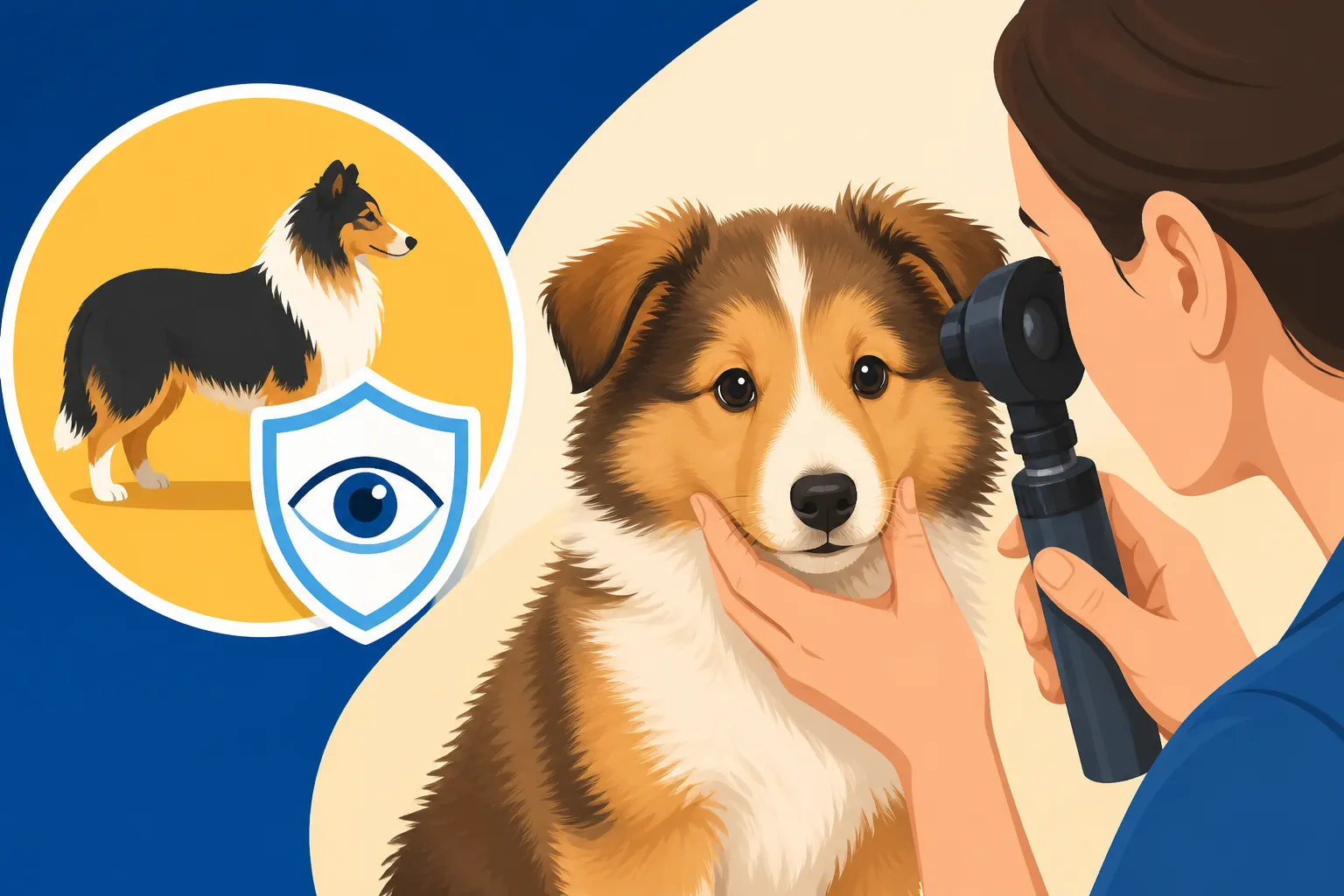
The exam should be done by a veterinary ophthalmologist, ideally board certified, rather than a general practice vet. Ophthalmologists have the training and equipment to see the fine details at the back of a tiny puppy’s eye, and their findings can be recorded through recognized eye registries. Breed clubs and specialist clinics sometimes organize eye clinics where several litters are examined on the same day, which can make the process easier for breeders.
Step by step on the day
- A few drops are placed in each eye to dilate the pupils. This takes some time to work, so puppies usually wait with their littermates.
- The ophthalmologist uses a bright light and special lenses to examine the front of the eye, checking eyelids, cornea, lens and other structures.
- Using an indirect ophthalmoscope, the specialist looks through the dilated pupil at the back of the eye, focusing on the choroid, retina and optic disc.
- Findings for each eye are recorded separately, because CEA can affect one eye more than the other.
- The breeder receives a written record of the results for each puppy.
The exam is not painful. Some puppies wriggle, and most dislike having their head held, but it is over quickly.
The certificate and the registries
After the exam, breeders often submit results to an eye registry. In the United States, many use the OFA’s Companion Animal Eye Registry, which took over the role long associated with CERF. Whether a CERF or OFA Eye Exam Suits a Collie explains how the two names relate. A good breeder will show you the paperwork, and for any puppy you are considering, you should be able to see the findings for both eyes. Whether a Collie Breeder Provides an Eye Certificate outlines what a proper certificate looks like.
Reading the possible results
| Result on the puppy exam | What it usually means | Typical effect on the dog’s life | Breeding consideration |
|---|---|---|---|
| Normal, no CEA seen | No visible CEA changes at the time of exam | Normal vision expected | Genetic status still unknown without DNA testing |
| Choroidal hypoplasia only | Mild form of CEA | Usually no noticeable vision problems | Affected dog will pass on the CEA gene |
| Small coloboma | Moderate form, depending on size and location | Often minor, sometimes reduced vision | Most breeders avoid breeding these dogs |
| Large coloboma | More severe form | Possible vision loss in that eye | Generally excluded from breeding |
| Retinal detachment or bleeding | Severe form | Partial or total blindness in affected eye | Excluded from breeding |
The table shows why the exam is useful beyond simply “pass or fail.” Two puppies can both be affected by CEA and still have very different outlooks. A puppy with mild choroidal hypoplasia often makes an excellent companion with normal vision, while one with a large coloboma may face real limitations.
A realistic scenario
Picture a Rough Collie litter of seven in Ohio, examined at six weeks. Four puppies have mild choroidal hypoplasia in both eyes. Two have no visible changes. One has choroidal hypoplasia plus a small coloboma in one eye. The breeder places the two clear-looking puppies and the four mildly affected puppies with pet homes and discusses the results openly with each buyer. The puppy with the coloboma goes to a family who understands it may have slightly reduced vision in one eye and agrees to annual checks.
None of these puppies is a “bad” puppy. What changes is that every buyer knows exactly what they are getting, and the breeder knows how to plan future pairings.
Eye Exams, DNA Tests and Smart Buying
The puppy eye exam is not the only tool available. A DNA test can now identify the gene most associated with CEA, but the two approaches do different jobs, and responsible breeders often use both.
What the DNA test adds
The CEA DNA test looks for the specific gene change linked to choroidal hypoplasia. It tells you whether a dog is clear, a carrier, or affected at the genetic level. Because CEA is inherited in a recessive way, an affected puppy must have received a copy from each parent. Whether a Collie’s Eye Test Can Be Done by DNA Instead covers the details of how the genetic test works.
Why the exam still matters
A DNA test cannot replace the eye exam entirely. It tells you about genetic status, but not about severity. It also does not explain every coloboma, so a dog can test genetically clear for CEA and still have other structural changes that only an exam will reveal. Whether the DNA Test Catches Every Affected Collie explains this gap.
| Tool | What it shows | What it cannot show | When it is done |
|---|---|---|---|
| Puppy eye exam at five to seven weeks | Actual structure of the eye and severity of any changes | Carrier status in a dog with normal looking eyes | Once, in the early window, plus later checks as advised |
| CEA DNA test | Genetic status: clear, carrier or affected | How severely an affected dog is affected, or every coloboma | Any age, often on a cheek swab or blood sample |
| Adult eye exam | Later eye problems, such as cataracts or retinal changes | Mild CEA that has gone normal | Periodically through life, often for breeding dogs |
Questions to ask a breeder
- Was the whole litter examined by a veterinary ophthalmologist between five and seven weeks?
- Can I see the written results for both eyes of the puppy I am considering?
- Have the parents been DNA tested for CEA, and what were their results?
- What other health tests have the parents had? The Three Genetic Tests a Collie Breeder Owes You is a helpful checklist here.
- If my puppy has mild CEA, what does that mean for its daily life and future eye checks?
Any breeder who cannot show eye results or becomes defensive about the questions is giving you important information.
When you did not get an early exam
If you already have a Collie that was not examined as a puppy, all is not lost. A DNA test can still tell you its genetic status, and an adult ophthalmology exam will still pick up moderate and severe changes, such as colobomas or retinal problems. What you cannot reliably do is go back and find mild choroidal hypoplasia that has already been hidden by pigment. For a rescue Collie or an older dog, that combination of DNA test and adult exam gives you the best picture you can get.
Planning for Your Collie’s Eye Health
Once your puppy comes home, the eye exam should become part of a wider health plan rather than a one-off event.
Ongoing checks and warning signs
Your regular vet will look at your Collie’s eyes during annual exams. Your breeder or ophthalmologist may recommend additional specialist checks, particularly for puppies with colobomas or for dogs that might be bred later. Between visits, watch for:
- Bumping into furniture, especially in dim light.
- Hesitation on stairs or when jumping into a car.
- Cloudiness, redness or a change in eye color.
- Squinting, rubbing or discharge.
- One pupil looking different in size from the other.
Any of these warrants a prompt vet visit, even in a Collie whose puppy exam was normal.
What life looks like for a mildly affected Collie
Owners who hear that their puppy has CEA often picture a dog going blind, and that fear is understandable. In reality, a Collie with choroidal hypoplasia alone usually sees well enough that its family never notices any difference. It herds, chases balls, learns agility, spots squirrels across the yard and finds its dinner bowl in a dark kitchen like any other dog.
The practical differences tend to be small. You keep the eye certificate with your dog’s records, you mention the finding to any new vet, and you take any change in vision seriously rather than putting it down to age. If the dog is ever considered for breeding, the finding becomes very important, but for a family pet it is mostly a piece of information rather than a daily concern.
Puppies with colobomas need a little more thought. Small ones often cause no visible problem, but your vet may want to look at them more closely during routine checks, and it is sensible to watch how the dog copes in low light or on unfamiliar ground.
Common misunderstandings about the puppy exam
- A normal adult exam does not prove a dog never had CEA, because mild cases can go normal by around three months.
- A puppy with mild CEA is not a “reject” or a lower quality pet, and many make wonderful companions.
- An eye exam is not the same as a DNA test, and a good breeder will usually explain both results.
- The exam does not need to be repeated before every litter for CEA itself, since CEA is present from birth, though breeding dogs often have adult exams for other eye conditions.
- A general vet glance at a puppy’s eyes is not a substitute for a specialist exam in the five to seven week window.
Thinking about insurance early
Eye problems, and the specialist visits that go with them, can be expensive. Pet insurance can help with unexpected costs, but inherited conditions are an area where policies differ significantly. Some insurers cover hereditary and congenital conditions as long as they were not noted before the policy began, while others limit or exclude them.
This is where the puppy eye exam can affect insurance. If your puppy’s exam shows CEA before you enroll, an insurer may treat any related eye issues as preexisting. Healthy Paws is one of the insurers many Collie owners compare, and like other providers it has its own rules about preexisting and hereditary conditions. Before enrolling with Healthy Paws or any other company, read the policy wording carefully, ask how a documented CEA finding would be treated, and look at waiting periods. Whether a Collie’s Eye Anomaly Counts as Pre Existing and Insuring a Collie Against Inherited Disease explain the questions worth asking. If you do sign up with Healthy Paws or a similar plan, keep a copy of your puppy’s eye certificate with your records so you can show exactly what was known and when.
Remember the other Collie health tests
The eye exam is one piece of a bigger picture. Collies are also commonly tested for MDR1, a drug sensitivity gene, and for dermatomyositis risk, along with other inherited conditions. Ask your breeder for the full set of results and keep them together with your puppy’s medical file. What the Collie DNA Health Panel Covers lists the tests most often run.
The bottom line
A Collie puppy is eye checked at five to seven weeks because that is the only reliable time to see mild Collie Eye Anomaly before pigment hides it. The exam gives you an honest picture of your puppy’s eyes, helps breeders make better decisions, and, combined with DNA testing and good record keeping, sets you up to protect your Collie’s sight for life.
Disclaimer
This article is for general informational purposes only and does not constitute professional advice. Laws, prices and regulations vary by location and change over time. Consult a qualified professional for guidance on your specific situation.