Whether a Collie Understands Household Rules
It’s incredibly frustrating when you feel like you’re saying the same thing to your beloved Collie over and over, only for them to seemingly ignore you and break a household rule. You might even wonder if they understand what you’re asking at all, or if they’re just being stubborn. This guide is here to reassure you: Collies are highly intelligent dogs, and they absolutely can learn and adhere to household rules, but it often comes down to our consistency and clarity in communication.
How Collies Learn and Process Rules
Collies, with their rich history as herding dogs, possess a remarkable intelligence that goes far beyond simple 'sit' and 'stay' commands. They are keen observers, highly sensitive, and quick to pick up on patterns and expectations within their environment. When it comes to household rules, it's less about them being unable to understand and more about how these rules are presented and reinforced.
Beyond Simple Commands: Cognitive Abilities
Think about it: a Collie's ancestral job required them to understand subtle cues from a shepherd and make independent decisions while managing livestock. This isn't just rote memorization; it's problem-solving, anticipation, and an understanding of cause and effect. In a household setting, this translates to them being highly attuned to routines, body language, and the emotional states of their human family members. They don't just learn a command; they learn the context in which it applies.
For example, a Collie can quickly learn that "off" means getting off the couch, but they also learn that "off" only applies when a human is in the room. If the rule isn't consistently enforced, or if they sometimes get cuddles on the couch and sometimes get told off, it becomes a murky area for them. Their intelligence means they're constantly testing boundaries and looking for loopholes, not out of malice, but because that's how they learn the true scope of a rule. They’re smart enough to realize that a rule might not be universal if enforcement isn't.
The Importance of Social Learning and Observation
Collies are inherently social creatures and learn a tremendous amount by observing us. They watch how we interact with objects, with each other, and with them. If you have another dog in the house that follows a certain rule, your Collie will likely pick up on that faster than if they were the only dog. This social learning is a huge part of how they integrate into our lives.
Imagine your Collie watching you put your shoes by the door every day. They learn that shoes belong there. Similarly, they watch you put your plate in the sink, or your coat on the hook. These are all subtle "rules" that they observe and, in their own doggy way, understand as part of the household order. When it comes to more explicit rules, like "don't jump on the counter," they're watching your reactions, your tone of voice, and any physical interventions. Every interaction is a data point for them. This observation is also why they are so sensitive to Whether a Collie Is Sensitive to Household Tension – they're constantly picking up on our emotional cues.
Consistency Is Key: The Human Side of Household Rules
The biggest roadblock to a Collie understanding household rules often isn't the dog itself, but the inconsistency in how humans apply and enforce those rules. We're busy, we're tired, and sometimes it's just easier to let something slide "just this once." But for a Collie, "just this once" can unravel weeks of diligent training.
Mixed Signals: The Biggest Hurdle
Consider the "no begging at the table" rule. If one family member occasionally slips a morsel under the table, while another strictly enforces the rule, your Collie quickly learns that begging sometimes works. They don't understand that Aunt Carol is visiting and she's a soft touch; they just understand that if they try hard enough, the jackpot might be within reach. This creates immense confusion and makes them less likely to obey the rule consistently.
Another common example is jumping. Maybe it's okay for your Collie to jump on you when you come home because you love the enthusiastic greeting, but it's not okay for them to jump on visitors. Your Collie doesn't differentiate between "family member who loves jumps" and "stranger who does not." To them, jumping is either allowed or not allowed. When rules are applied inconsistently, it's not that your Collie doesn't understand the rule; it's that they don't understand when the rule applies. This is why How Long a Collie Remembers a Bad Session and Whether Shouting at a Collie Sets Training Back are so important — negative experiences and mixed signals stick with them.
Establishing Clear Boundaries from Day One
The best approach is to establish clear boundaries from the moment your Collie puppy steps into your home. Everyone in the household needs to be on the same page regarding what is and isn't allowed. This means discussing rules like:
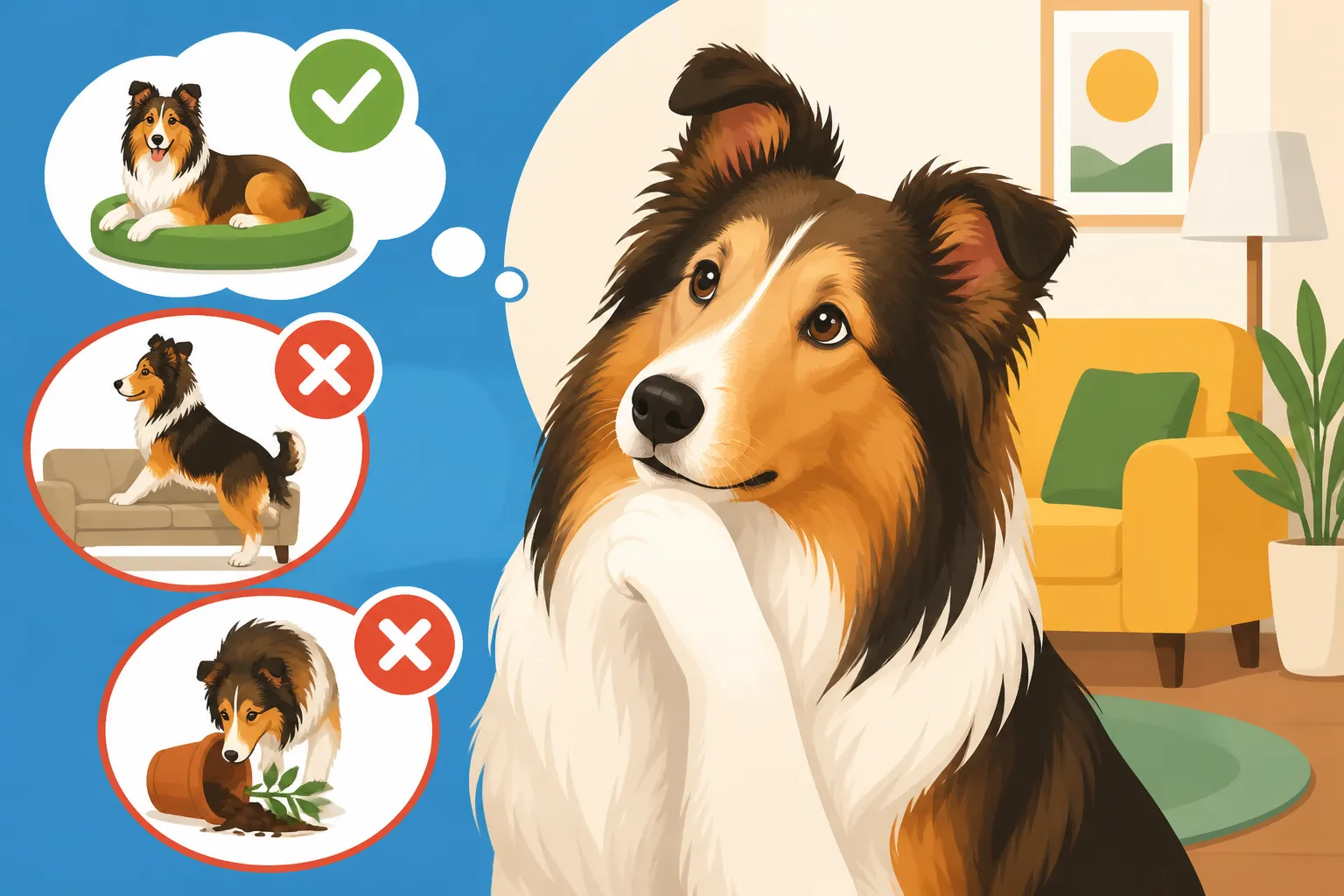
- Are they allowed on furniture? If so, which pieces?
- Where do they eat and sleep?
- Is jumping up on people ever allowed?
- What behavior is expected when guests arrive?
It's helpful to write these down and have everyone agree. Tools like crates (see: Crate Training a Collie Puppy) or specific dog beds can help define their personal space and reinforce where they are allowed to be. For instance, if the rule is "no dogs on the couch," then no dog goes on the couch, ever. If your Collie tries to get on, gently redirect them to their designated bed or mat and reward them for staying there. Consistency isn't about being harsh; it's about being predictable.
Common Household Rules and How to Teach Them to a Collie
Let's dive into some practical examples of common household rules and how you can effectively teach them to your intelligent Collie. Remember, positive reinforcement works wonders with this sensitive breed, linking to What Motivates a Collie.
The "No Jumping" Rule
This is a classic. Collies are often so overjoyed to see their people that they want to leap up and say hello.
To teach "no jumping":
- Ignore the Jumps: When your Collie jumps up, turn your back, cross your arms, and completely ignore them. No eye contact, no speaking, no touching. This removes the reward (your attention).
- Reward Four Paws on the Floor: The instant all four paws are on the ground, turn back, praise them calmly, and give them a treat or a gentle pet.
- Practice with Triggers: Have family members come home, or practice with guests. If the Collie jumps, everyone does the "turn and ignore" routine. For guests, you might even keep your Collie on a leash initially for more control, allowing you to step on the leash gently to prevent jumping, rewarding them for staying down.
- Use a Gate for High-Excitement Moments: For particularly boisterous greetings, consider using a baby gate to create a moment of separation until your Collie has settled. This is where physical management tools come in handy. Products available on platforms like Amazon can offer a wide range of gates and other management tools to help with this.
Staying Off Furniture
This rule requires commitment, especially if your Collie has found a particularly comfy spot on the sofa.
To teach "off furniture":
- Establish Alternatives: Ensure your Collie has their own comfortable bed or mat nearby where they are allowed to relax. Make it appealing!
- Consistent "Off" Command: If they get on the furniture, use a calm, firm "Off!" command and gently guide them off. Immediately praise and reward them when all four paws are on the floor.
- Restrict Access: When you're not there to supervise, block access to the furniture with chairs or physical barriers. This prevents them from practicing the unwanted behavior.
- Positive Redirection: If you see them eyeing the couch, preemptively invite them to their bed and reward them. Make their designated spot the most rewarding place to be.
Doorway Manners and Leash Etiquette
Collies, being intelligent and alert, are often very aware of what's happening outside. This can lead to door darting or pulling on the leash.
To teach good doorway manners:
- "Wait" or "Stay" at the Door: Practice having your Collie sit or lie down a few feet from the door. Start by opening the door just a crack. If they move, close it immediately. When they stay, reward them lavishly. Gradually increase the door opening and the time they wait before giving a release cue like "Okay!"
- No Bolting: Always put their leash on before opening the door. Practice having them sit calmly before you open it and step out first. If they pull ahead, stop immediately. Only move forward when the leash is loose. This teaches them that pulling gets them nowhere, but a loose leash means progress.
- Consistent Leash Walks: Ensure everyone who walks your Collie uses the same method. No pulling, no chasing squirrels unless given permission. This consistent approach solidifies the rule that walks are calm and controlled.
Quiet Time: Managing Barking
Collies are known for being vocal, as highlighted in The Bark Is the Trait Collie Owners Underestimate. Teaching a "quiet" cue or simply minimizing excessive barking is a crucial household rule.
To manage barking:
- Identify Triggers: Is it the doorbell (see: Whether a Collie Barks at the Doorbell)? People walking past the window? Other dogs? Understanding the why helps address the root cause.
- Teach "Quiet": When your Collie barks (e.g., at the doorbell), let them bark a few times. Then, say "Quiet!" and present a high-value treat right to their nose. The instant they stop barking to sniff the treat, praise and give the treat. Repeat. Gradually increase the time they need to be quiet before getting the treat.
- Manage the Environment: If your Collie barks at things outside the window, limit their view with frosted film or curtains. If they bark when left alone, address potential separation anxiety (more on this below).
- Reward Calm: Actively reward your Collie when they are not barking in situations where they normally would. This reinforces the desired quiet behavior. Many online training programs, such as those offered by BAXTER & Bella, provide structured approaches to address barking and other common behavioral challenges with positive reinforcement methods.
Addressing Rule-Breaking: Understanding the 'Why'
When your Collie seems to "break" a rule, it's easy to get frustrated and assume they're being naughty or defiant. However, for a sensitive and intelligent breed like the Collie, rule-breaking is often a symptom of something deeper: confusion, anxiety, lack of exercise, or unmet needs. Rarely is it true defiance.
Is it Disobedience or Confusion?
Often, what looks like disobedience is simply confusion stemming from inconsistent rules, a lack of clarity in training, or a human failing to understand the dog's perspective. For instance:
- Chewing forbidden items: If your Collie chews on shoes instead of their toys, it's not necessarily disobedience; it might be boredom or a lack of appropriate chew toys. They might be trying to self-soothe or simply seeking mental stimulation. This often links to Whether a Collie Chews When Bored.
- Excessive barking when left alone: This isn't defiance, but often a sign of distress, such as Whether a Collie Gets Separation Anxiety. They aren't trying to annoy the neighbors; they're communicating their fear or loneliness.
- Ignoring a recall command: If your Collie ignores you at the dog park, it could be that the environment is too distracting, or the reward for coming back isn't strong enough to compete with the thrill of chasing a squirrel. It might also indicate that their training for recall isn't fully proofed in high-distraction environments.
Before you label your Collie as "disobedient," take a moment to consider what might be driving their behavior. Are their needs being met? Is the rule clear to them? Is everyone in the household on the same page? Collies thrive on routine and predictability, as discussed in Whether a Collie Needs a Predictable Routine. Any deviation can cause confusion.
Reinforcing Desired Behavior
Instead of focusing solely on punishing unwanted behavior, shift your energy to reinforcing the behaviors you do want to see. This is the cornerstone of positive reinforcement training and is particularly effective for Collies.
Here's how:
- Catch them being good: Actively look for opportunities to praise and reward your Collie when they are following a rule, even if it's something small. If they're lying calmly on their bed instead of jumping on guests, toss them a treat and offer calm praise.
- Redirect, don't just stop: If your Collie is doing something undesirable, don't just say "no." Redirect them to an acceptable alternative. For example, if they're chewing on a table leg, give them an appropriate chew toy and praise them when they chew that instead.
- Environmental Management: Sometimes, the easiest way to prevent rule-breaking is to manage the environment. If your Collie counter-surfs, keep counters clear of tempting items. If they chew specific furniture, use bitter apple spray or physically block access when you can't supervise. This isn't a permanent solution, but it prevents them from practicing unwanted behaviors while you're training.
- High-Value Rewards: For more challenging rules or during the initial learning phase, use high-value treats (like small pieces of cheese or cooked chicken) to make adhering to the rule incredibly rewarding.
- Training Resources: Don't be afraid to seek out resources. Online programs, like those from BAXTER & Bella, or even physical books and training tools from Amazon, can provide structured guidance. Sometimes an outside perspective or a new technique is all it takes to break through a communication barrier.
Ultimately, your Collie wants to please you and be a well-integrated member of your family. By understanding their intelligence, being consistent in your expectations, and patiently guiding them with positive reinforcement, you’ll find that your Collie is more than capable of understanding and happily abiding by your household rules. It’s a journey of mutual learning and respect, and one that deepens the bond you share.
Disclaimer
This article is for general informational purposes only and does not constitute professional advice. Laws, prices and regulations vary by location and change over time. Consult a qualified professional for guidance on your specific situation.